Category: Blog

  • WAEC Portal Login 2026/2027

    WAEC Portal Login 2026/2027

    Do you know your WAEC Portal Login 2026/2027? If you want to register for WAEC 2026, Go to a cyber cafe that has been approved by the government to get your fingerprints and passport photo taken. Once you have done that, come back to the website and click “CONTINUE REGISTRATION”.

    There are two categories of people who sit for WAEC examinations every year:

    • Internal candidates
    • External candidates..

    Candidates who registered for WAEC under their respective schools are known as WAEC internal candidates. They are primarily made up of SS3 (Senior Secondary 3) or final-year secondary school students. SSCE candidates are the typical term used to describe these internal candidates. SSCE stands for Senior School Certificate Examination.

    Candidates who register for WAEC on their own are considered WAEC external candidates. They can be registered without the help of an umbrella school. Their registration procedure is not the same as that of internal candidates. They take the WAEC exam, which is called the General Certificate of Education (GCE).

    WAEC Portal Login 2026/2027

    How to Login WAEC Portal 2026/2027

    Go to the WAEC portal URL that corresponds to your purpose (for example, results, certificates, or examiners), enter your password and registered username or email, and then click “Login” or “Sign In” to gain access to your account. You must first create an account and have it validated by email if you don’t already have one.

    • Find the correct WAEC portal: for your needs (e.g., examiners.waecnigeria.org for examiners, or the digital certificate platform).
    • Select the option to create a new account: or register.
    • Fill in the required details, such as your name, email, and other personal information.
    • Verify your email address: by clicking the link sent to your registered email.
    • Log in: with your newly created credentials to start using the portal.

    How to Check  WAEC 2026/2027

    Candidates can simply check their WAEC 2026/2027 results online by visiting the official WAEC result checker Portal directly at www.waecdirect.org. Simple steps to check your WAEC 2026/2027 result:

    Step 1: Go to the Browser and or Google Search Engine

    Step 2: Search Official WAEC result checker Portal (www.waecdirect.org)

    Step 3: Input your 10 digit Examination Number (e.g, 5686546667)

    Step 5: Input your Examination year ( e.g, 2023,2024,2025 and 2026)

    Step 5: Select your Examination type (e.g,  School Candidate Exam or Private Candidate Exam)

    Step 6: Input your WAEC e-PIN Number (e.g, 36589756453)

    How To Obtain WAEC e-PIN Number?

    Candidates who didn’t have WAEC e-PIN Number can buy it by following the simple steps to obtain WAEC e-PIN Number.

    Step 7: Input your Unique PIN on the WAEC e-PIN (e.g,

    Step 8: Click on the “Check Result” to Check your WAEC result

    Click Here to Read More

    How to Register for WAEC 2026/2027 

    • Go to the official WAEC registration portal: www.waeconline.org.ng
    • Click “Start Registration”
    • Enter your registration PIN
    • Fill in your personal and subject information
    • Upload passport photo and fingerprint (biometric data)
    • Submit and print acknowledgment slip

    Click Here to Get More Details

    Frequently Asked Questions

    How much is the WAEC registration fee for 2026?

    The new WAEC registration fee is 18,000.

    What is the deadline for WAEC 2026 online registration?

    For the 20256WAEC registration for internal candidates, the WAEC authorities have stated that there will be no deadline extension, like in previous years. The WAEC online registration is starting on the 22nd of January 2026
    The deadline for WAEC 2026 online registration is the 26th of March 2026.
    The WAEC registration for 2026 starts online, when the candidate’s information will be uploaded on the WAEC portal for direct transmission to the WAEC database. 
    The two different groups of WAEC candidates have their own registration portals.
    It is necessary to know that the two WAEC examinations are not held at the same time, but at different times of the year.

  • How To Answer WAEC Questions Correctly In 2026/2027

    How To Answer WAEC Questions Correctly In 2026/2027

    It is proven that most students fail WAEC because of the way they approach the questions. This is why we’ll examine practical tips and strategies to help you learn How To Answer WAEC Questions Correctly In 2026/2027.

    First, You have to understand the format of the WAEC exam and how its questions are structured. The full meaning of WAEC is West African Examination Council. It is an examination body that started in is responsible for conducting the West African Senior Certificate examination WASSCE across the five Anglophone Nations, namely: Nigeria, Ghana, Gambia, Sierra Leone, Liberia.

    For WAEC, there are 60 mandatory multiple-choice questions, and candidates can choose to answer 3 out of 6 optional essay questions. for science subjects such as Biology and Chemistry, a separate day is usually allocated for practical exams.

    Now I will open your eyes to the hidden secrets that you need to know to ace your WAEC Examinations in flying Colors. The following are the tips for answering WAEC questions.

    Do Not Write in The Margin line

    It will be written boldly on the left-hand side of your answer sheet, Do not write in the margin line, but truth to be told, you will still find some daft students who would still want to write across the margin line ignorantly.

    Unfortunately, you would see some candidates writing on the margins of their answer sheets. According to waec, the instruction says “Do Not Write On Either Margin”, that rule should be respected. The margin is very useful to the markers because it’s the place where marks/scores of such candidate are being allotted.

    Please be aware that some markers reduces the marks of any candidate who writes on the margin. so be sure you read every instruction before attempting them.  Some WAEC officials overlook these mistakes, but others don’t.

    Read Questions Carefully

    Don’t be too confident in your reading skills because it is not always reliable; you might think you are top, but your mistakes might hurt you. Make sure you read your questions carefully and understand what your examiner wants you to write about before giving answers out of context.

    For instance, during my Secondary school days, there was a question that asked, “Discuss three systems of government that have not been practiced in Nigeria before.” However, I missed the word “NOT” while reading the question. So, I ended up discussing systems of government that had been practiced in Nigeria, not realizing my mistake until after I finished the exam. It was a question I knew how to answer well, so when I discovered my error, I felt devastated.

    You probably wouldn’t want to go through the same disappointment, so always take the time to read every question at least twice before giving your answers.

    Always Answer Easy Questions First: 

    This is one of the techniques that I will never forget. I will always apply it each time I, write any Exam In WAEC exams, you’ll probably come across some tough questions that take up a lot of time, and sometimes you might not know the answers at all.

    My advice is Always Answer Easy Questions First, skip that question quickly, and move on to one you’re more confident about. Remember, there’s always a time limit in exams. For WAEC, it’s usually 2 hours and 30 minutes. You can go back to the tough question to see if you can remember anything.

    If there is time, let it not be that you have all the time trying to crack a more difficult question, and end up not answering the much easier questions that can give you even more marks than the hard question, because sometimes the mark place on them might quite be the same as the easier one.

     Answer objective questions first

    Even though essay questions often carry more marks, it’s important to tackle objective questions first. This is because sometimes, the answers to those essay questions can be found in the objective section.

    The reality is that some of the WAEC objective questions are repeated in essay format. That’s why it’s smart to handle the objectives first.

    Use Capital Letters When Required

    You might think it’s unnecessary, but it’s not. Some WAEC officials take it very seriously. Wherever you’re instructed to write in capital letters, do so. WAEC doesn’t only assess your ability to answer questions correctly—they also check if you can follow instructions.

    Don’t fall for that little trick. Always write your name and subject in capital letters. It may not seem important to the examiner, but it keeps you on the safe side.

    Shade Your Answers—Don’t Tick

    Never tick the answers to objective questions. WAEC now uses machines to mark them, and these machines only detect shaded answers. If you tick or fail to shade properly, your answers may not be recognized.

    To stay safe, always shade your answers clearly. Use HB pencils, as recommended by WAEC—they work best for this purpose. Following this advice will help you in the upcoming WAEC examination.

    Avoid unnecessary cancellations

    WAEC isn’t just about what you know—it also tests your accuracy and attention to detail. Avoiding mistakes shows you understand the questions and follow instructions.

    Too many errors can raise suspicion of cheating or exam misconduct, which may affect how your work is judged.

    Always check your answers carefully. If you make a serious error and time permits, ask for a new answer sheet.

    Make sure you provide your exam details

    Always write your name, seat number, and exam number before starting. Forgetting this could mean automatic failure for that paper.

    Once time is up, you may not be allowed to go back and fill them in.

    At the beginning, take a moment to complete your answer sheet carefully—use capital letters and don’t forget the date. This helps avoid future issues.

    Do not Give in to Exam Anxiety

    Feeling anxious during WAEC is normal—it’s your body’s natural response to stress.

    To stay calm, focus on effective reading and try this breathing exercise: inhale for 4 counts, exhale for 8. Just a few rounds can relax your nervous system. Practice it before your exam—you’ll be surprised how well it works!

     Avoid Exam Malpractice

    Cheating, or exam malpractice, damages your integrity, your school’s reputation, and your personal growth. Though it may seem common in Nigeria, it’s a serious offense that can cost you your WAEC success.

    Focus on preparation, time management, and asking for help when needed. Honesty builds trust and creates a healthy learning environment.

    Hidden Secrects Answer WAEC Questions

    Here is the Secret that I applied that got me five good A’s in my WAEC, knowing that WAEC questions can be quite tricky at times, WAEC has a specific way they want you to answer questions to get the full marks.

    E. G

    If WAEC instructs you to “LIST and EXPLAIN,” it means there’s a mark for listing and another mark for explaining. So, paying attention to these details is very important.

    LIST and EXPLAIN: If a WAEC question says that you should list and explain, don’t make the mistake of only explaining. There is definitely a mark for listing and another mark for explaining. When you are listing, make sure that the list is numbered. Again, if you are explaining, make sure you fill, at least, 4 – 5 lines.

    WAEC Question: List and explain 5 causes of soil erosion

    Take for example:

    First is to list the five possible causes oaf soil erosion before explaining

    • Deforestation
    • Overgrazing
    • Poor Farming Practices
    • Construction Activities
    • Heavy Rainfall.

    After listing the causes of soil erosion like the one above, you can then proceed to explaining them. To get your full mark, you must explain each of them in detail.

    Deforestation

    Explanation: Cutting down trees removes the roots that hold soil together, making it easier for wind and rain to wash the soil away.

    2. Overgrazing

    Explanation: When animals graze too much in one area, they remove the vegetation cover, exposing the soil to erosion by wind and water.

    3. Poor Farming Practices

    Explanation: Practices like plowing along slopes or not rotating crops can loosen the soil structure, increasing erosion risk.

    4. Construction Activities

    Explanation: Building roads and structures disturbs the soil and removes vegetation, making it vulnerable to being washed or blown away.

    5. Heavy Rainfall

    Explanation: Intense or prolonged rain can wash away topsoil, especially on sloped or bare land.

    Mention

    Many WAEC candidates are confused by this institution. Typically, applicants will begin talking about and elaborating on unrelated topics, which may even lower their grade. When answering questions that need to be mentioned, that is not the proper approach.

    If the WAEC question says, “MENTION the causes of Soil Erosion in Nigeria“, you don’t need to list again.

    Just go ahead to mention and give little details about the causes of corruption in Nigeria.

    Describe:

    This is usually asked in WAEC CRS, IRS, or science practical questions. If you are asked a question that requires you to describe, kindly write down everything you know about the question in an orderly manner.

    For Example: “Describe the human Skeleton

    Here, you are required to know everything you know about the human skeleton. Please don’t tell about the entire human body. Just restrict yourself to that part that concerns the human skeleton. its parts and their function that’s all.

    HIGHLIGHT: If you are asked to HIGHLIGHT in the WAEC examination, it means that you should briefly examine. Don’t tell stories! Just go straight to what you were asked to highlight and hit the nail on the head.

    DEFINE: Most times many WAEC candidates DESCRIBE instead of defining when they are asked to define. Well, they are not the same. When you are asked to define, it means that you should explain precisely. It can also mean to determine with precision.

    In short, just make sure to explain what you are asked to define very precisely and make sure that all the relevant keywords are mentioned in your definition. It is worthwhile to note that a definition is not supposed to be too long. So, try to be as short as you can.

    Conclusion

    These are Deep Secrets that no one is going to tell you on How To Answer WAEC Questions Correctly but you are lucky that you found this blog, with these secrets, if implemented correctly, achieving your WAEC examination becomes so easy. It’s important to understand that writing too much in an exam can sometimes show that you are doing I too know, which is so disgusting to most examiners, and they might as well bring down your mark because of it. That’s why we suggest sticking to the questions asked and not writing past yourself. If you’re asked to explain something, just focus on that and move on to the next question.


  • How To Pass WAEC Objective Questions 2026/2027

    How To Pass WAEC Objective Questions 2026/2027

    Do you know that A high percentage of marks in the WAEC examination comes from WAEC objective questions? The WAEC examination is the apex secondary school examination in English-speaking countries of West Africa. The West African Examinations Council (WAEC) exams can be tricky, especially the multiple-choice sections.

    But fear not, because in the blog post, we are going to share with you deep Secrets on How To Pass WAEC Objective Questions 2026/2027.

    WAEC Objective Questions Overview

    In the WAEC examination, students are expected to attempt two sections of questions of different structures. The two question sections contain two types of questions, which include: Objective questions, Theory questions.

    Knowing that the WAEC examination is an examination that is set up to screen final-year secondary school students of five West African countries. The African countries whose students are tested through the WAEC examination include: Nigeria, Ghana, The Gambia, Sierra Leone, and Liberia. and every subject written in WAEC must feature an objective section, even if they don’t feature any other section. This is to tell you how important the objective is in the WAEC examination.

    The Structure Of The WAEC Objective Section

    • A Question may come in many formats, either to complete a sentence, fill in a quote, or a calculation problem (the question format differs from subject to subject).
    • Multiple answer choices (to pick from).
    • Shading the correct answer on your O.M.R sheet, using a pencil (HB pencil is recommended).

    What is O.M.R?

    (O.M.R. means: Optical mark recognition), is a technology that enables software to recognize marks made on paper documents, such as forms that contain checkmarks, bubbles, or boxes.  Basically, OMR determines checkbox states and whether they are selected.

    According to WAEC guidelines, if an objective response is deemed incorrect for a question, the incorrect option must be completely cleaned to make it less susceptible to detection by the O.M.R. marking machine. At the same time, the correct answer must be completely shaded to improve detection by the O.M.R. machine.

    Although careful shading can spare WAEC officials the extra effort of marking the multiple-choice answer sheet by hand, candidates should not be alarmed because any O.M.R. sheet that cannot be marked by a machine can be marked manually.

    How To Pass WAEC Objective Questions 2026/2027

    Only the OMR sheet may be used to answer WAEC objective questions with an HB pencil. Because the OMR machine is sensitive to depressions and may reject unclear responses, candidates should carefully consider their answers before shading to prevent multiple erasures. It is required to answer all 60 objective questions.

    Waec Objective Question Marking Scheme

    These are usually multiple-choice questions. Each correct answer earns full marks, and wrong answers get zero. There is no partial credit, so accuracy is critical.
    Example: In a Biology multiple-choice section with 40 questions, each correct answer might earn 1 mark. If a student answers 32 correctly, their raw score is 32/40.

    The different WAEC question sections have different marks allocated to them. The WAEC objective questions have a share of 25% of the total marks allocated to a subject, with theory and practical examination sessions taking the remaining 40% and 35% respectively. In cases where the subject doesn’t feature a practical session, the scores are shared with objective and theory sections having 40% and 60% of the total scores respectively.

    The WAEC objective examination session is a part of the WAEC examination, where students are given a question and four options of possible answers. The correct answer to each question is usually indicated with deep shading of that option, whether A, B, C, or D. There are 60 objective questions for every WAEC subject, and this puts students in a position to leverage the multiple-choice answers, to increase their chances of passing each WAEC examination they write.

    Frequently asked questions

    Does the practical section feature objective questions? 

    No. The WAEC practical section or Alternative to practicals doesn’t have any special options to narrow the practical results and observations. The students are expected to do a live practical, record observations, and make inferences about what was done in the laboratory. No multiple-choice questions are available in WAEC practical examinations.

    What is the mark allocated to WAEC objective section?

    The different WAEC question sections have different marks allocated to them. 
    The WAEC objective questions have a share of 25% of the total marks allocated to a subject, with theory and practical examination sessions taking the remaining 40% and 35% respectively. 
    In cases where the subject doesn’t feature a practical session, the scores are shared with objective and theory sections having 40% and 60% of the total scores respectively. 

    What is the mark allocated to WAEC objective section?

    The WAEC objective examination session is a part of the WAEC examination, where students are given a question and four options of possible answers. The correct answer to each question is usually indicated with deep shading of that option, whether A, B, C, or D. There are 60 objective questions for every WAEC subject, and this puts students in a position to leverage the multiple-choice answers, to increase their chances of passing each WAEC examination they write.


  • 9 Commercial Subjects To Write in WAEC 2026/2027

    9 Commercial Subjects To Write in WAEC 2026/2027

    WAEC Subject Combination won’t be a problem for you if you completely follow my Blog. Here are 9 Commercial Subjects To Write in WAEC 2026/2027. In every field of study in Senior Secondary School there are always Subjects that must be selected; this article, but in this article we are going to focus on the 9 mandatory Commercial subjects in WAEC.

    9 Commercial Subjects To Write in WAEC 2026/2027

    What Are WAEC Commercial Subjects?

    WAEC commercial subjects are the specific subjects designed for students who want to pursue careers in areas like business, finance, and economics. These subjects provide the knowledge and skills needed for understanding how businesses work, how the economy operates, and how to manage resources.

    If you are a commercial student, these subjects will help you build a solid foundation for courses like Accounting, Business Administration, Marketing, and Banking in higher education. They are also useful for students interested in becoming entrepreneurs or professionals in corporate settings.

    In WAEC, we all know that there are three subject areas for senior secondary students. The three categories of students are: Science students, Art students, and Commercial students. regardless, there are other elective subjects available to Commercial students, including: Further Mathematics Book Keeping Agricultural Science or Biology, Languages: Yoruba, Igbo, or Hausa.

    9 Commercial Subjects To Write in WAEC 2026 Are:

    • English language
    • Mathematics
    • Civic Education
    • Literature in English.
    • Government or history.
    • Christian/Islamic religious studies 
    • Language (Igbo, Hausa, and Yoruba).
    • Economics
    • One trade subject.

    Some subjects are neither compulsory for any subject area nor are they available to be chosen by any interested candidate. Examples of such subjects include Economics, Languages (Hausa, Igbo, or Yoruba), Agricultural Science, Biology, etc.

    English Language and Mathematics have long been core subjects in the school curriculum and remain essential for art students taking the WAEC exam.

    Frequently asked questions

    Are languages compulsory for every Commercial student?

    No. Registering for any language subject is not compulsory for any Commercial student or any student of any study area. It’s an optional subject for WAEC candidates.

    How many trade subjects can a Commercial student register in WAEC?

    Commercial students are advised to register for only one trade subject in WAEC due to the added stress of both theory and practical exams. While over 30 trade subjects are available, selecting one helps manage workload. Like other study areas, art students have specialized subjects, including core subjects like English Language, Mathematics, and Civic Education, along with optional subjects to complete their subject quota.

  • 9 Art Subjects To Write in WAEC 2026/2027

    9 Art Subjects To Write in WAEC 2026/2027

    9 Art Subjects To Write in WAEC 2026/2027?

    WAEC Subject Combination won’t be a problem for you if you completely follow my Blog. Here are 9 Art Subjects To Write in WAEC 2026/2027. In every field of study in Senior Secondary School there are always Subjects that must be selected this article, but in this article we are going to focus on the 9 mandatory Art subjects in WAEC.

    We all know that Students are always placed in sections based on their strengths: those excelling in science subjects join the science section, those strong in arts subjects enter the arts section, and those best in business-related subjects are placed in the commercial section.

    In WAEC, we all know that there are three subject areas for senior secondary students. The three categories of students are: Science students, Art students, and Commercial students. These categories of students are for students who study Science, Art, and Commerce, in the order that it was listed.

    The 9 Art Subjects To Write in WAEC 2026/2027 Are:

    • English language
    • Mathematics
    • Civic Education
    • Literature in English.
    • Government or history.
    • Christian/Islamic religious studies
    • Language (Igbo, Hausa, and Yoruba).
    • Economics
    • One trade subject.

    Notwithstanding, the above-listed subjects are mandatory for every art student in WAEC. But that notwithstanding, other subjects can substitute any of the above-listed art subjects. They include: Agricultural science, Biology, Arabic studies French, Music, and, Commerce.

    English Language and Mathematics have long been core subjects in the school curriculum, especially for art students. From primary to secondary school, students are required to study these subjects without exception. For art students taking WAEC, English and Mathematics are mandatory, while other subjects are chosen based on future academic or career goals.

    Trending Blog Post

    Frequently asked questions

    Are languages compulsory for every art student?

    No. Registering for any language subject is not compulsory for any art student or any student of any study area. It’s an optional subject for WAEC candidates.

    How many trade subjects can an art student register in WAEC?

    Art students choosing WAEC subjects are advised to register for only one trade subject due to the demanding theory and practical exams involved. While there are over 30 trade options, selecting one reduces stress. Alongside core subjects like English, Mathematics, and Civic Education, art students choose specialized and optional subjects to complete their subject list.

  • 9 Science Subjects To Write in WAEC 2026/2027

    9 Science Subjects To Write in WAEC 2026/2027

    WAEC Subject Combination won’t be a problem for you if you completely follow my Blog. Here are 9 Science Subjects To Write in WAEC 2026/2027. In every field of study in Senior Secondary School there are always Subjects that must be selected this article, but in this article we are going to focus on the 9 mandatory science subjects in WAEC.

    9 Science Subjects To Write in WAEC 2026/2027

    We all know that Students are always placed in sections based on their strengths: those excelling in science subjects join the science section, those strong in arts subjects enter the arts section, and those best in business-related subjects are placed in the commercial section.

    The 9 Science Subjects To Write in WAEC 2026/2027

    In WAEC, candidates can register for 7 to 9 subjects, allowing flexibility based on their preference, despite potential consequences. But there are compulsory subjects that are required to be registered by all science students. They include: English language, Mathematics, Civic Education, Economics, and A trade or vocational subject.

    The 9 Science Subjects To Write in WAEC 2026 are:

    • English
    • Mathematics
    • Economics
    • Physics
    • Biology
    • Chemistry
    • Geography
    • Civic Education
    • A trade subject.

    These 5 categories of subjects are expected to be in the WAEC subject selection of every science student, even though there may be some exceptions, as always.

    WAEC offers over 30 trade subjects as optional choices, allowing candidates, including science students, to include vocational subjects in their combination. However, science students are not required to take trade subjects and can explore other options like Languages (Igbo, Hausa, and Yoruba), Further Mathematics, and Technical drawing.

  • WAEC Subject Combination For Science, Arts And Commercial Students 2026/2027

    WAEC Subject Combination For Science, Arts And Commercial Students 2026/2027

    WAEC Subject Combination For Science, Arts And Commercial Students 2026/2027: The WAEC exam, has its subjects combinations structured with a minimum of seven and a maximum of nine subjects, including English Language and Mathematics.

    With all things remaining equally, generally, Science students focus on Physics, Chemistry, and Biology; Arts students include Literature and a language like Yoruba, Igbo, or Hausa; and Commercial students emphasizes on Economic.

    WAEC Subject Combination For Science, Arts And Commercial Students 2026/2027

    There are three basic areas of study in the Senior Secondary School Examination they are:

    • Science
    • Art
    • Commercial

    The three areas of study have WAEC subject combinations that are peculiar to each of them, for any career a student would want to pursue. Only three subjects have been made totally Compulsory by the West African Examination Council, irrespective of your area of study, approved by the Federal Government. The 3 Subject are:

    • English Language
    • Mathematics
    • Civic Education

    It’s important that every WAEC Candidate knows this, and also know that to be a successful student in WAEC, a candidate must have at least a credit in these three general subjects, most especially English language and mathematics.

    So, we will discuss the WAEC subject combination for these important areas of study which are Sciences, Arts, and Commercial Class. Whichever one you belong to, this article is still helpful.

    WAEC Subject Combination For Science Students 2026/2027

    The WAEC subject combination for science students includes subjects specific to the science field, most of which involve practical exams alongside theory and objective sections.

    These practicals, usually conducted in laboratories, require working with live specimens. Schools without proper lab facilities are given an alternative to the practical session. A student still has options aside from the ones listed below. Subjects: There are other subjects that science students can add to their list of compulsory subjects; they include: Further Mathematics, Languages- Yoruba, Igbo, or Hausa, and Technical Drawing.

    Going forward, the WAEC subject combination for science students includes the following subjects.

    • English language
    • Mathematics
    • Civic Education
    • Physics
    • Chemistry
    • Biology
    • Geography
    • Agricultural Science 
    • Economics
    • A Trade Subject

    WAEC Subject Combination For Art Students 2026/2027

    The subject combination for art students is totally different from that of a science student, even though there are cases where art and science students may register for subjects such as economics, biology, agricultural science, etc.

    Apart from the Nine Subjects listed below, there are other subjects available for art students, including: Arabic Studies, Agricultural Science/Biology French, Music Commerce.

    The WAEC subject combination for art students includes: 

    • English Language
    • Mathematics
    • Civic Education
    • Literature in English
    • Government or History
    • Religious Studies: Christian Religious Studies or Islamic Religious Studies
    • Languages: Yoruba, Igbo, or Hausa 
    • Economics
    • A Trade Subject

    WAEC Subject Combination For Commercial Students 2026/2027

    A commercial student is trained in subjects related to business, management, and economics, such as Economics, Commerce, Accounting, and Marketing. They form a key subset of students who sit for the WAEC examination each year.

    Apart from the Nine Subjects listed below, Other elective subjects available to Commercial students include: Further Mathematics, Book Keeping Agricultural Science, or Biology, Languages: Yoruba, Igbo, or Hausa.

     The WAEC subject combination for commercial students includes:

    • English Language
    • Mathematics
    • Civic Education
    • Economics
    • Accounting
    • Commerce
    • Government
    • Office Practice
    • A Trade Subject

    Note: There are some subjects that are neither compulsory for any subject area, but they are available to be chosen by any interested candidate. Examples of such subjects include Economics, Languages (Hausa, Igbo, or Yoruba), Agricultural Science, Biology, etc

    WAEC Trade subjects 2026/2027

    Most WAEC Trade Subjects 2026/2027 are grouped because they provide students with practical, hands-on entrepreneurial skills, fostering job readiness and global competitiveness by instilling practical skills beyond academic knowledge.

    There are 35 trade subjects in WAEC. These subjects are part of the curriculum to develop entrepreneurship and ensure students can acquire skills that lead to self-reliance and contribute to the economy, rather than solely focusing on traditional academic disciplines.

    These are subjects that were introduced by WAEC to expose students to skill acquisition and the entrepreneurial world. Some trade subjects involve practical sessions, while others don’t. Every WAEC candidate is mandated to sit for at least one trade subject.

    • Animal husbandry
    • Auto body repairs
    • Auto mechanic
    • Auto electrical work
    • Automobile parts merchandising
    • Block laying, bricklaying, and concreting work
    • Bookkeeping
    • Carpentry and joinery
    • Catering craft practice
    • Data processing
    • Dyeing and bleaching
    • Plumbing and pipe fitting
    • Printing craft practice
    • Radio, television, and electronics
    • Salesmanship
    • Stenography
    • Tourism
    • Upholstery
    • Welding and fabrication engineering craft practice
    • Marketing
    • Metalwork
    • Mining
    • Painting and decorating
    • Photography
    • Plumbing craft practice
    • Printing craft practice
    • Leather goods manufacturing and repairs
    • Insurance
    • Machine Woodworking
    • GSM phone maintenance and repair
    • Garment making
    • Furniture making
    • Fisheries
    • Shorthand
    • Keyboarding

    Criteria for Selection of Subjects for WASSCE and SSCE

    a. Compulsory Cross-Cutting Subjects

    Each student is to take the four (4) compulsory cross-cutting subjects listed. For the Trade/Entrepreneurship subject, each student is expected to select one (1) Trade/Entrepreneurship subject from the list of 34 Trade / Entrepreneurship subjects listed.

    b. Fields of Studies

    (i) Each student may then choose two (2), three (3), four (4), or five (5) subjects From each of their preferred four Fields of Studies depending on the potential, interest and capability such that the minimum number of subjects is eight (8) while the maximum number of subjects is nine.

    (ii) If students select two (2) subjects from a Field of Study, they can select two (2) or three (3) subjects from any other Field of Study or from Trade / Entrepreneurship subject to make a minimum of eight (8) or a maximum of nine (9) subjects.

    (iii) iIf students select three. (3) subjects from a Field of Study, they can select one (1) or two (2) subjects from any other Fields of Studies or Trade / Entrepreneurship subjects to make a minimum of eight (8) or a maximum of nine (9) subjects.

    (iv) If students select four (4) subjects from a Field of Study, they can select one (1) one subject from any other fields of study or Trade / Entrepreneurship subjects to make a maximum of nine (9) subjects.

    (v) If students select five (5) from a Field of Study, they have already selected a maximum of nine (9) subjects

    Note: !n all, students are to select a minimum of eight (8) or maximum of (9) subjects

    Frequently asked questions

    Is it a must to register a trade subject in WAEC?

    Yes. WAEC mandated that every WAEC candidate must sit for at least one trade subject in WAEC. This directive is the same for every candidate irrespective of their subject area. 

    Can I write 8 subjects in WAEC?

    Yes. Every student who wishes to register for 8 subjects in WAEC is free to do so. But students who intend to do that should bear in mind that they must register for the compulsory WAEC subjects, even if they are not registering for the maximum number of subjects allowed in WAEC.

    Is biology a compulsory subject in WAEC?

    Biology is an optional subject. Not every science student may sit for biology, as some science disciplines don’t prioritize the knowledge of biology. This also shows as art and commercial students may register for WAEC based on their preference, students may choose to replace it with another subject of their choice.

    Is it compulsory to register a trade subject in WAEC?

    Yes. WAEC mandated that every WAEC candidate must sit for at least one trade subject in WAEC. This directive is the same for every candidate irrespective of their subject area. 

    Conclusion

    The WAEC subject combination for science, commercial, and art students forms the complete exam package each year, reflecting students’ academic interests and specialization. Some subjects, like Physics, Commerce, and Literature, are specific to certain areas, while others like Agricultural Science, Economics, and Biology overlap across all fields. A student’s subject combination also indicates their preferred skills, especially through trade subjects, making it a key early decision that shapes future academic choices.

  • WAEC Digital Certificate Platform: How to access it in 2026/2027 Academic Session

    WAEC Digital Certificate Platform: How to access it in 2026/2027 Academic Session

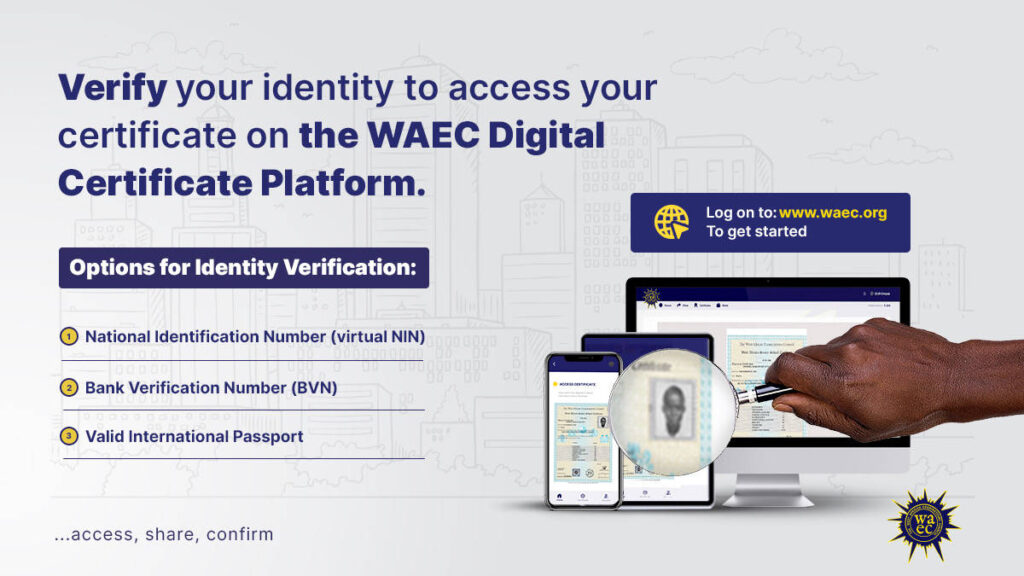
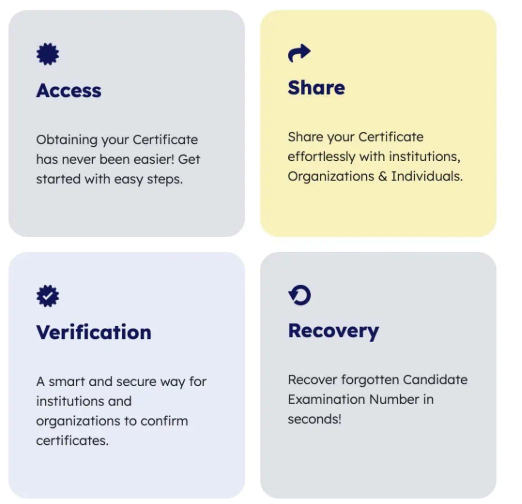
    The WAEC Digital Certificate Platform is a web and mobile-based system allowing candidates to access, share, and confirm their WAEC certificates securely and in real-time, replacing the need for physical copies or lengthy verification processes.

    WAEC Digital Certificate Platform: How to access it

    About WAEC Digital certificate

    Platform LaunchWAEC’s Digital Certificate platform launched for accessing & sharing certificates.
    Who can use it?Designed for candidates, institutions, and organisations to confirm & share certificates.
    ️ Steps1. Account creation at waec.org 2. Sign-in 3. Wallet funding 4. Certificate access & download
    SecurityMatching personal info with ID is mandatory.
    Fees12 units for number recovery, 30 units for certificate access, 14 units for sharing.
    ExceptionsWithheld certificates aren’t accessible/confirmable.
    Tech SupportComplaint ticket section available; 24-hour response rule.
    Official InfoUpdates available on WAEC’s official Twitter handle.

    The WAEC Digital Certificate Platform is a robust solution for over 30 million certificate holders, allowing them to access, confirm, and share their original certificates globally.

    Launched in October 2022 under the leadership of Patrick Areghan, the former Head of National Office (HNO) for Nigeria, the WAEC Digital Certificate Platform was designed to address challenges such as lost, damaged, or burnt certificates.

    The platform also allows for the confirmation of certificates in real time, ensuring that the authenticity of the document is never in question.

    The platform is accessible both on the web and via mobile devices, offering a seamless experience for users and is beneficial for those who need to recover certificates produced from 1999 onwards

    Candidates can not only generate and download their certificates but also share them with institutions and organizations securely.

    What is WAEC Digital Certificate Platform?

    The WAEC Digital Certificate Platform is a web and mobile-based system that allows candidates to easily obtain and securely share their certificates online with prospective educational institutions around the world.

    To facilitate this process, candidates are required to verify their identity using their National Identification Number, BVN, or international passport to gain access to their digital certificates through a straightforward verification method.

    Steps on accessing your certificate 

    • To begin, visit https://www.waec.org/
    • Click access certificate
    • Input your email and password
    • Once in, your NIN, BVN, or international passport number will be used to verify your identity and access the certificate online.

    Candidates can generate a Virtual National Identification Number (VNIN) for identity verification by dialling *346*3*NIN*696739# on their registered phone number.

    What Are the Stand Out Features of the WAEC Digital Certificate?

    • Accessing and sharing certificates
    • Requesting and confirming certificate validity
    • Retrieving forgotten WAEC candidate examination numbers

    How to Access Your WAEC Certificate Online in 2026

    . Account Creation:

    2. Account Setup:

    • Select “Certificate Access (Candidate)”.
    • Fill in your contact details, ensuring your email is accessible for verification.
    • Confirm your account using the verification code sent to your email.

    3. Personal Information:

    • When registering, enter your details exactly as they appear on your chosen ID form. This ensures your name on the platform and digital certificate align.

    4. Logging In:

    • Use your email and password to sign in.
    • To obtain the certificate, complete the form with your Exam year, Exam type, and WAEC candidate number.
    • For “Exam type,” choose from: WASSCE for school candidates or WASSCE for private students 1 & 2.

    5. Forgotten Candidate Number:

    • If you’ve forgotten your candidate number, you can retrieve it by providing additional personal details and paying 3,000 Naira (12 units) via the platform’s digital wallet.
    • The platform uses a digital wallet system to manage payments.
    • You can fund your wallet by purchasing units via card, bank transfer, or USSD. Transaction fees may apply.
    • To view your unit credits, check your billing history.

    7. Purchasing the WAEC Digital Certificate:

    • If payments aren’t reflected immediately, consider re-logging.
    • Once funded with at least 30 units, revisit the initial form and click ‘access certificate.’
    • Provide your BVN when prompted.
    • After verification, you’ll be charged 30 units, and your certificate will be available shortly.

    Downloading and Sharing:

    • You can download your certificate for free.
    • Sharing your certificate (e.g., to universities) costs 3,500 Naira (14 units). Click the share icon, enter the recipient’s email, pay the fee, and it’s sent. Confirm receipt with the recipient.

    To collect a physical WAEC certificate in Nigeria, you must visit a WAEC office with your exam details (index number, exam type, and year), a valid ID, an online result printout, a passport photograph, and the Certificate Fee (around N5,000, though this can change). The process involves online application and payment, followed by collection within a few days

  • WAEC Syllabus for All Subjects 2026/2027(SSCE & GCE)

    WAEC Syllabus for All Subjects 2026/2027(SSCE & GCE)

    The WAEC Syllabus for All Subjects 2026/2027 includes Scheme of work for subjects such as English, Math, Bio, Govt, Chem, CRS, Physics, Literature, Econs, Agric, Accounts, Trade subjects, etc. If you want to know the topics where all your WAEC questions will come from, Then the syllabus is what you need.

    What is WAEC syllabus?

    The WAEC syllabus is the official guide outlining all the topics your exam questions will come from. Each subject has its own syllabus, and it’s the same for both SSCE (school candidates) and GCE (external candidates), as they cover the same topics.

    WAEC Syllabus for All Subjects 2026/2027( SSCE & GCE)

    Is WAEC 2026 syllabus out?

    Yes. GCE and WAEC syllabus for all subjects this year is the same with last year because the topics do not changed. Except for Literature whose novels are changed every (5) years.

    Each subject syllabus covers objectives, content areas, and examination schemes. For example, in English Language, the syllabus may focus on comprehension, essay writing, summary, grammar, and oral English. In Mathematics, it emphasizes algebra, geometry, statistics, and trigonometry.

    Similarly, science subjects like Physics, Chemistry, and Biology have detailed content guides with practical components.

    WAEC Syllabus for All Subjects 2026/2027

    The list is long, from core subjects like General Mathematics, English Language, and Physics, to arts and vocational ones like Literature-in-English, Hausa, Igbo, Yoruba, Catering Craft Practice, Welding and Fabrication, and even Basketry.

    Click on the link representing the subject you want to access/download its syllabus.

    Frequently Asked Questions (FAQs) on WAEC Syllabus

    Is the WAEC syllabus the same for all countries?

    Yes, the WAEC syllabus is standardized for all participating West African countries, including Nigeria, Ghana, Sierra Leone, The Gambia, and Liberia. This ensures fairness and uniformity in the exams.

    Does WAEC follow the syllabus strictly?

    Yes. WAEC sets its examination questions strictly based on the syllabus. However, candidates should note that questions may test deeper understanding and application of knowledge within the outlined topics.

    How often does WAEC update its syllabus?

    WAEC reviews and updates its syllabus periodically. The frequency depends on changes in curriculum, educational policy, or global academic standards. Students should always seek the latest edition for accurate preparation.

    Can I pass WAEC without studying the syllabus?

    It is not advisable. The syllabus provides the foundation of the exam. While some students may pass by relying on textbooks or notes, those who ignore the syllabus risk wasting time on irrelevant areas or missing important topics.

    Is the WAEC syllabus different from the school curriculum?

    No, you don’t necessarily need to cover every single topic in the syllabus. It’s more strategic to prioritize core concepts, understand the weightage of topics, and focus on areas that are likely to appear on exams by studying past papers.

    Can I use past questions alone without the syllabus?

    Past questions are helpful, but they should be used alongside the syllabus. While past papers reveal patterns, the syllabus ensures you do not overlook topics that may appear in future exams.

    Are there practical sections in the WAEC syllabus?

    Yes, many WAEC syllabi include practical sections, particularly for science subjects like Biology and Chemistry, and technical subjects like Building Construction

    How do teachers use the WAEC syllabus?

    Teachers use the West African Examinations Council (WAEC) syllabus as a guide to plan lessons, focus on key topics, and structure their teaching to align with exam object

  • WAEC Grading System For All Subjects: Marking Scheme 2026/2027

    WAEC Grading System For All Subjects: Marking Scheme 2026/2027

    WAEC Grading System For All Subjects: Marking Scheme 2026/2027

    WAEC Grading System For All Subjects: Marking Scheme 2026/2027: What Is WAEC grading system in Nigeria? is E8 a good grade in WAEC?, how can I calculate my grades in WAEC? WAEC grade percentage?, marking scheme for physics in WAEC

    Hey Folks in this episode of my Series I shall update you with the required information about WAEC marking scheme of 2026/2027 and your grades calculation, WAEC grading system and much more, need no thanks and knowing friends as you have? STAY TUNED!

    The WAEC grading system uses letter/number combinations from A1 (Excellent) to F9 (Fail), with A1 being the highest. The marking scheme allocates points and marks based on the overall percentage scores in each subject, from A1 (75-100%) down to F9 (0-39%). For problem-solving subjects, marking is often stepwise, awarding marks for each step of the solution.

    Naturally, once you have taken an exam, the performance you have in that Exam is your main focus, and in the case of an Exam such as WAEC, grades are not released immediately after you write the Exam; they are normally released several months afterward.

    This may get you nervous, and at times exhausting hence, the reason why you have to know how what you have written will be marked and score by the long run.

    One of the most important things that you will be requiring as a student in order to be admitted into your preferred School and course of choice is your O- level Result.

    However, to make your result to be relevant (to ensure that you secure a place in a University or course of your desire), you must achieve some grades since not every grade is pass.

    This thought has made you interested, as well, in knowing what grade is pass or fail in WAEC, Well, I have got you covered.

    To justice this write-up, I will first discuss what WAEC is and why it is necessary to Ace your papers in Waec…

    What Is WAEC?

    The name WAEC, is an acronym for West Africa Examination council, this Exam is mostly conducted for secondary school students (WASSCE) or students that are yet to obtain their O’ level result. There are alternatives to this Exam (NECO and NABTEB), but for some reasons, most student prefer sitting for WAEC over the others.

    One of the requirements of admission, to any of the tertiary institutions (University, Polytechniques or Colleges of Education) in Nigeria, of which WAEC is a sample, is your O-level result.

    It is because of this that in case you aspire to being accepted in any course in Nigeria, you should first fulfill the Course requirement set by the University, which in this case would be having obtained your five (5) core courses.

    But to Pass means with a minimum of C6 right, then why does it matter that I Ace my papers or get at least a B (B2 or B3)

    I knew you always did, you see, Most Universities in Nigeria also use the result of the WAEC, rather than run Post UTME, to determine the total aggregate of the student, on basis of which they can admit the student.

    And in that case, the students who had done very well in their WAEC examination, would have better probability of being accepted.

    Not only that, improved preparation and performance in JAMB would in some instances be translated into a better performance in JAMB.

    Universities that compute aggregate score for students using their O’level result, grades individual grade for each subject as thus:

    WAEC GradeValue Point
    A110
    B29
    B38
    C47
    C56
    C65

    O level aggregate grading at universities.

    D7, E8 and F9 are not accepted by any single Institution in Nigeria and that is why they are not allocated points as those ones above. And the above is not the only method of assigning points to your WAEC result, various School have different grading system.

    Therefore, consider this case, in case a student is supposed to get four (4) A and One (1) B3 in his or her five (5) core courses, then the O level result grade would look like this;

    A10 points and B38 points
    |human|>Where A is 10 points and B3 is 8 points.

    A in 4 core courses would be 4 * 10 = 40

    B in 1 core course would be 1 * 8 = 8

    40 + 8 = 48

    Thus, the aggregate of the WAEC of that particular student would be = 48.

    Suppose now that the same student achieves JAMB 270, and you are supposed to remember that, your JAMB score is usually divided by 8, to make 50 per cent of your admission aggregate.

    The aggregate sum of admission will be:

    270 / 8 = 33.75

    48 (WAEC grade) + 33.75 (JAMB aggregate) will give = 81.75.

    Other Universities such as the University of Lagos structure about 20 percent as O’ level. In this case, the students will be required to take Post UTME (30%), and WAEC (50%).

    In Schools where O level (WAEC/ NECO/ NABTEB) is used as 20% to determine the aggregate of students, those with A in WAEC will earn 4 points, B, C and D 3, 2 and 1 respectively.

    Based on this computation above, you will concur with me that the better your WAEC performance, the higher the chances of gaining admission into the school you were applying.

    Note: This applies only in those schools where the O level result of the student is used to compute his or her Aggregate score, in Universities such as UNIBEN, they really do not care about your WAEC grad.

    WAEC Grading System 2026/2027

    WAEC allocates grade to student (A, B, C or even F9) to student based on their cumulative score on that subject, below is WAEC grading system for 2026/2027 Students and interpretation.

    GRADEDEFINITIONINTERPRETATION
    A1Excellent75% – 100%
    B2Very good70% – 74%
    B3Good65%- 69%
    C4Credit60% – 64%
    C5Credit55% – 59%
    C6Credit50% – 54%
    D7Pass45% – 49%
    E8Pass40% – 45%
    F9Fail0% – 44%

    Table Showing WAEC Grading System

    A is considered Excellent, and you must score above 75% to be awarded with this grade.

    B2 is considered Very good, students with B2 scored above 70% but below 75% and so on and so forth.

    WAEC Marking Scheme For All subjects 2026/2027

    The WAEC marking scheme is a guideline on how the total marks available for a particular subject are allocated based on the number of sections available The marks are shared unequally across the different sections of every subject.

    WAEC grades are calculated using one pattern in all the subjects (Mathematics, English Language, Biology, Commerce, Government, e.t.c). It is necessary first of all to know the total marks of the subjects (Since the total mark of subjects is not the same) to really carry out this calculation.

    The overall calculus of your total grades in percentage in your WAEC is…

    Total Marks Accumulated by the Student (Theory + Objective), divided by the Total Marks Allocated To that Subject, all multiplied by hundred.

    EXAMPLE OF HOW A WAEC SUBJECT IS MARKED:

    If you were able to score 30 marks out of 50 in WAEC mathematics, and get 75 marks in WAEC mathematics theory out of 100. Your percentage score will be calculated as thus…

    30marks for objective + 75marks for theory, all divided by 150 (Since 150 is the total score for that subject, i.e 50 for objective and 100 for theory) times (*) 100

    This will then be 105/150 * 100 = 70%

    Remember, from our table, 70% – 74% is B2, this means you would have B2 in WAEC, easy to calculate right?

    For Subjects With Practical’s here is the Formuala

    Calculation for subjects with practical like Biology, Physics, chemistry and others, the pattern for calculation is slightly different.

    Total Marks Accumulated by the Student (Theory + Objective + Practicals), divided by the Total Marks Allocated To that Subject, all multiplied by hundred.

    You can try this with your other subjects to see what your grade in those subjects would look like.

    Frequently Asked Questions

    What is the pass mark for WASSCE?

    The Pass mark for WAEC is C6, anything less than this (D7, E8 and F9) is considered as fail.The student will also be expected to rewrite the entire exam again if the D7, E8 or F9 is in a compulsory subject like mathematics or English Language.

    How many points is A1 in WAEC?

    A1 in WAEC carries the highest point when using O’ level to calculate your aggregate score.
    The points for each grade in WAEC has been discussed HERE already.

    Is C6 a good grade in WAEC?

    C6 is the minimum pass mark a student can get in WAEC.
    If the school you apply to uses O’ level to calculate for aggregate score, then C6 is a bad grade, if not, you need not worry.

    Is B3 a good grade In WAEC?

    B3 is a good grade in WAEC.
    But if your school uses O’ level to calculate for aggregate score, then you should try to perform better to boost your chances.

    Is D7 fail in WAEC result?

    D7 is not a good grade in WAEC, student with D7 on a required course in WAEC will have to sit for WAEC again.

    Has marking WASSCE started 2026?

    NO, Marking for WASSCE have not started yet, reason being that the exam has not been concluded yet, marking for WAEC should begin at most two weeks after the last paper is written.

    What are distinctions in WAEC?

    A1 is considered distinction in WAEC student and only student who scored above 75% will be rewarded with this grade.

    Do universities accept E8?

    It Depends on the course in which you had E8. Generally, Universities do not accept E8 in compulsory subjects like English, Mathematics or any Core subject specific in your field in WAEC.

    Can WAEC grading system change?

    NO, WAEC grading system has not changed for years and there are no indication it will be changing anytime soon.