Category: Blog

  • NECO Biology Practical Answers [26th June] 2026/2027

    NECO Biology Practical Answers [26th June] 2026/2027

    NECO Biology Practical Answers [26th June] 2026/2027: The NECO Biology Practical paper is a hands-on exam where you identify specimens, draw biological diagrams, and perform basic experiments. You will observe plants, animals, and slides, write down their features, and answer questions about their habits, classes, and uses.

    NECO Biology Practical SPecimen 2026/2027

    NECO BIOLOGY PRACTICAL (PAPER I)
    COMPLETE ANSWERS โ€“ QUESTIONS 1, 2 & 3

    ===========================================================
    QUESTION 1 (Specimens A, B, C, D, E)

    ===========================================================
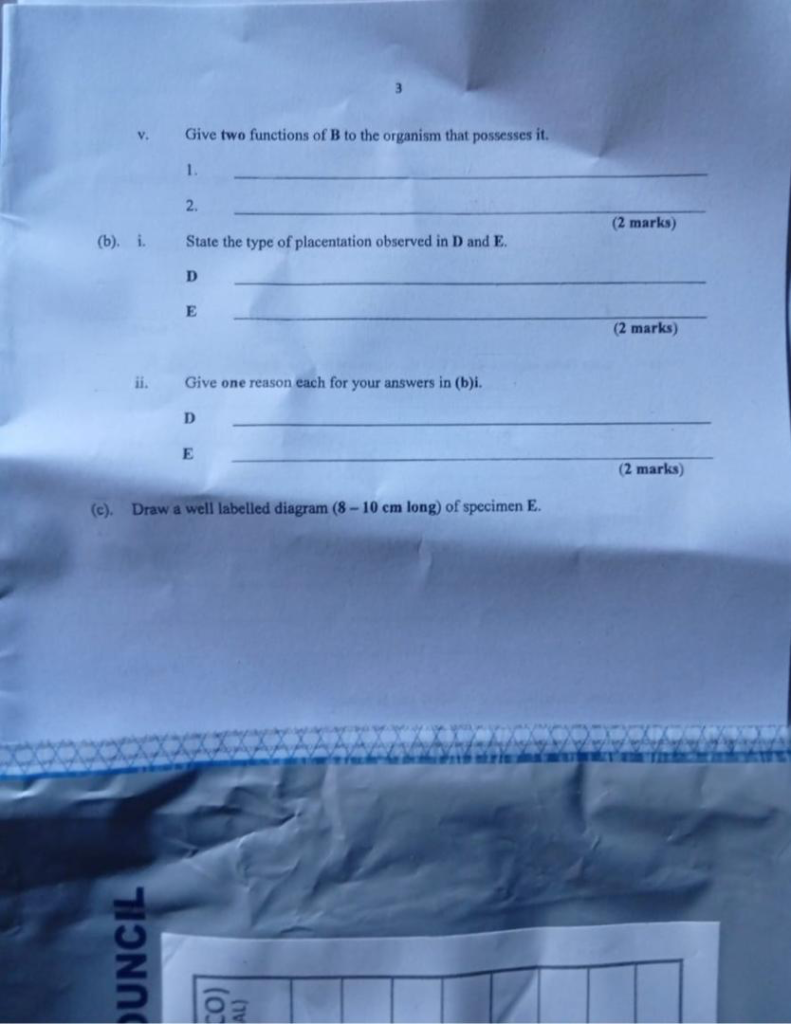
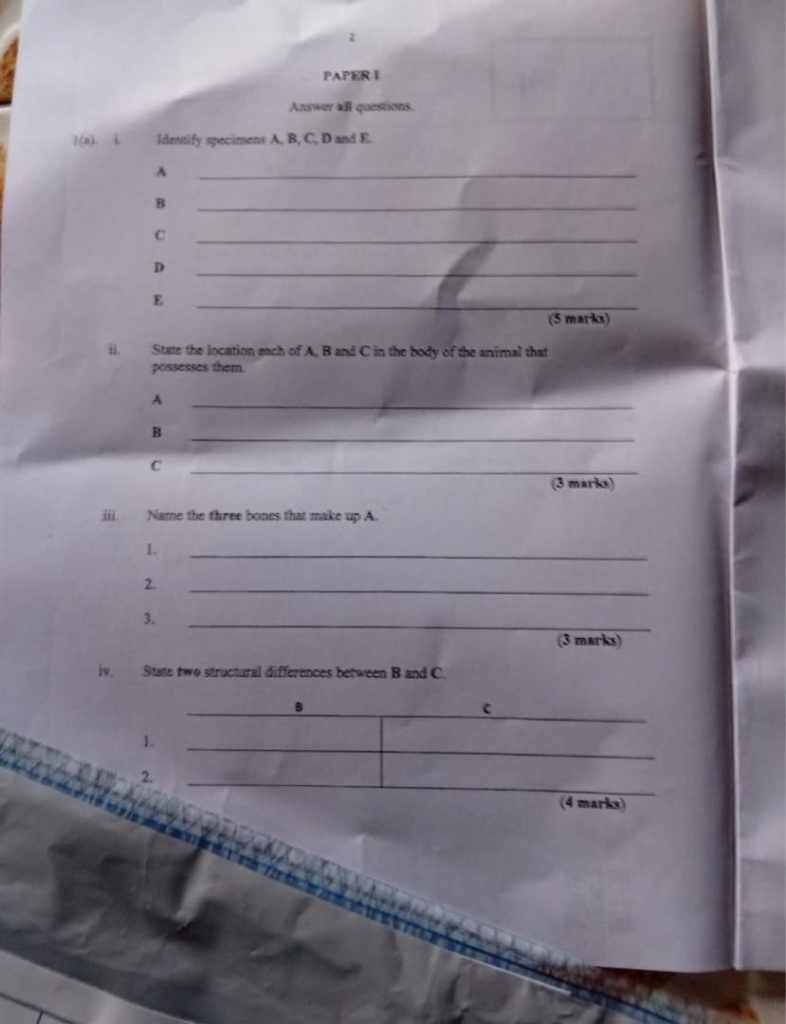
    (a)(i) Identify specimens A, B, C, D and E (5 marks)

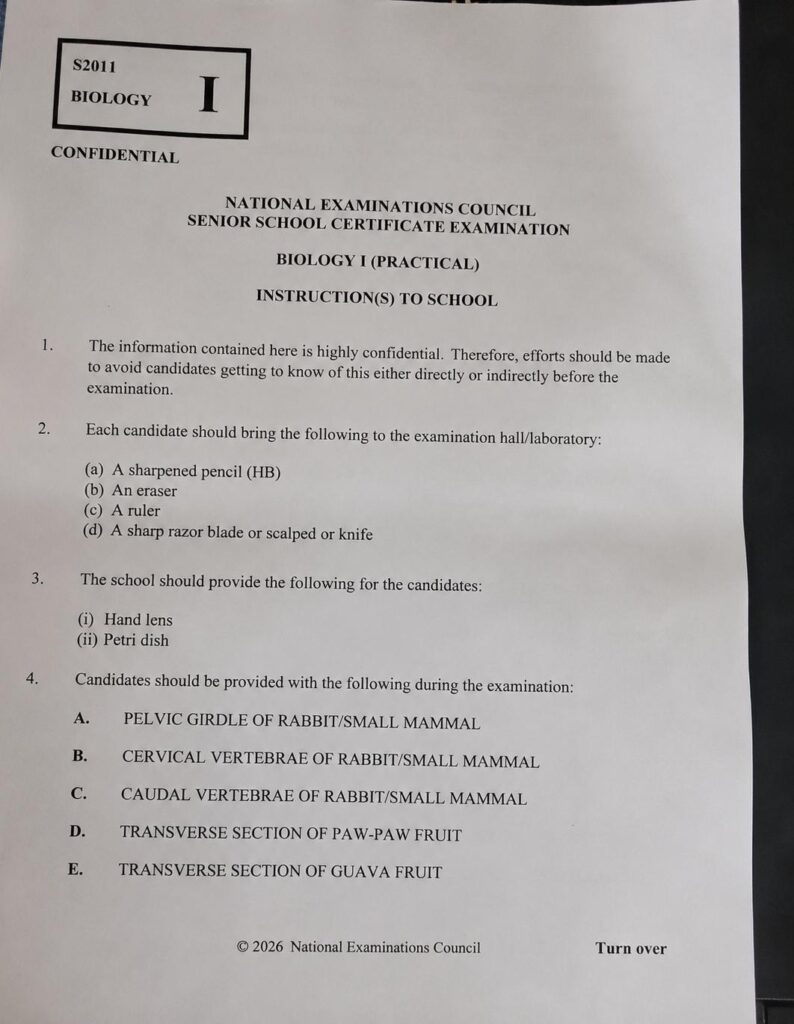
    A โ€“ Pelvic girdle of rabbit/small mammal

    B โ€“ Cervical vertebra of rabbit/small mammal

    C โ€“ Caudal vertebra of rabbit/small mammal

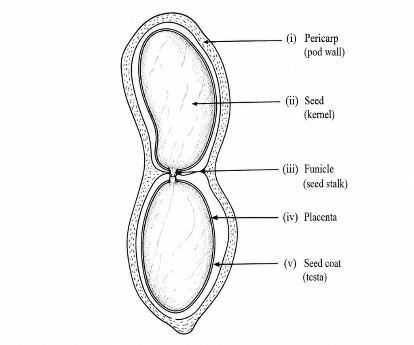
    D โ€“ Transverse section of pawpaw fruit

    E โ€“ Transverse section of guava fruit

    (a)(ii) State the location of A, B and C in the body of the animal (3 marks)

    A โ€“ Located in the pelvic region (hind limb region) of the animal.

    B โ€“ Located in the neck region (cervical region) of the vertebral column.

    C โ€“ Located in the tail region (caudal region) of the vertebral column.

    (a)(iii) Name the three bones that make up A (pelvic girdle) (3 marks)

    1. Ilium
    2. Ischium
    3. Pubis

    (a)(iv) State two structural differences between B (cervical vertebra) and C (caudal vertebra) (4 marks)

    B (Cervical vertebra) C (Caudal vertebra)

    1. Has a transverse foramen (foramen transversarium) 1. Does NOT have a transverse foramen
    2. Has a prominent neural spine 2. Neural spine is reduced or absent
    3. Has a large centrum 3. Centrum is small or reduced
    4. Articulates with ribs (in some cases) 4. Does not articulate with ribs

    (a)(v) Give two functions of B (cervical vertebra) to the organism (2 marks)

    1. It supports the head and allows movement of the head in different directions.
    2. It protects the spinal cord passing through the vertebral canal.

    (b)(i) State the type of placentation observed in D and E (2 marks)

    D (Pawpaw) โ€“ Parietal placentation

    E (Guava) โ€“ Axile placentation

    (b)(ii) Give one reason for each answer (2 marks)

    D โ€“ The ovules are attached to the inner wall of the ovary (pericarp) on ridges.

    E โ€“ The ovules are attached to a central axis (column) in the centre of the ovary.

    (c) Draw a well-labelled diagram of specimen E (guava fruit transverse section) โ€“ 8-10 cm long

    In your answer booklet, draw the transverse section of guava fruit showing:

    ยท Outer skin (epicarp)
    ยท Fleshy mesocarp
    ยท Central cavity with numerous seeds attached to the central axis
    ยท Axile placentation with seeds embedded in the pulp
    ยท Label: epicarp, mesocarp, seeds, central axis, placental tissue

    ===========================================================
    QUESTION 2 (Specimens F, G, H, I, J)

    ===========================================================
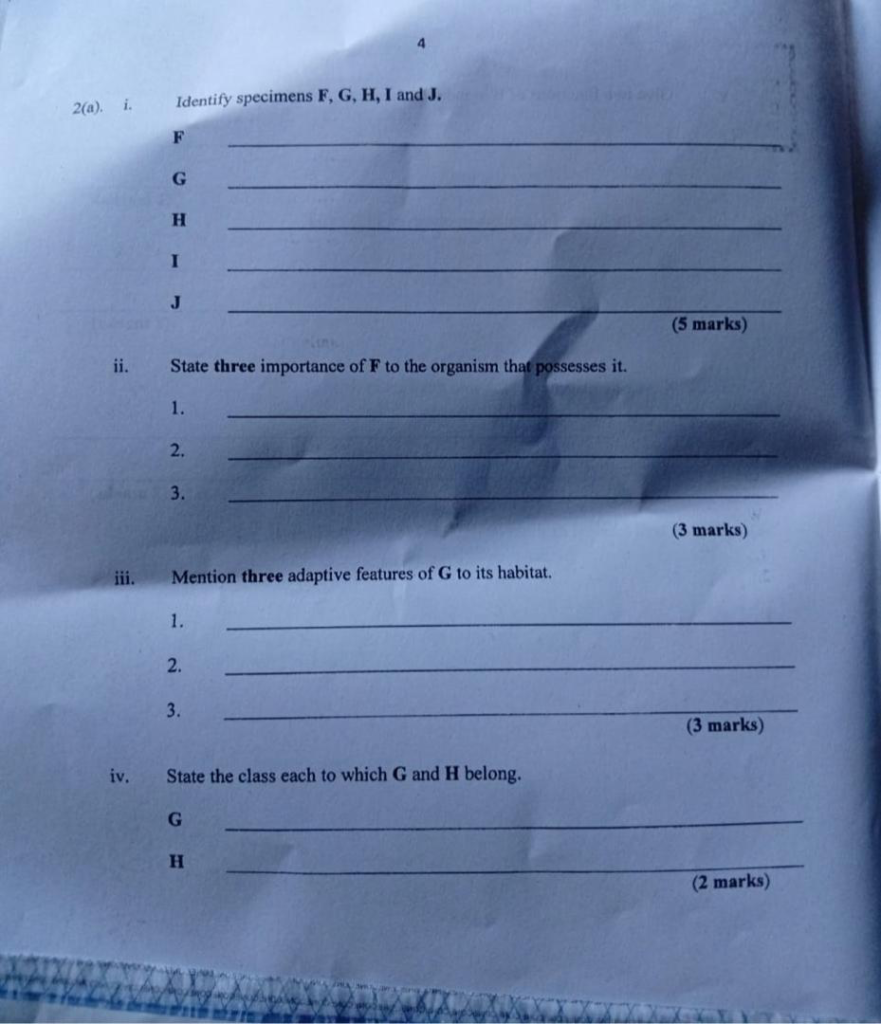
    (a)(i) Identify specimens F, G, H, I and J (5 marks)

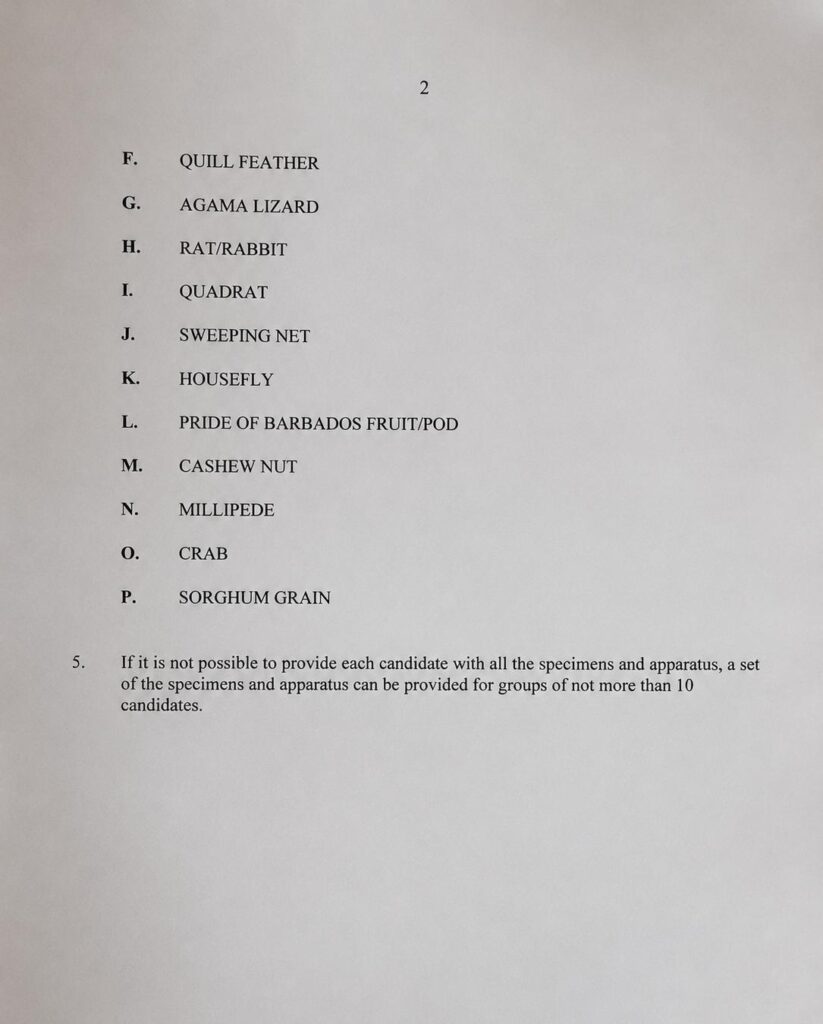
    F โ€“ Quill feather

    G โ€“ Agama lizard

    H โ€“ Rat/Rabbit (small mammal)

    I โ€“ Quadrat

    J โ€“ Sweeping net

    (a)(ii) State three importance of F (quill feather) to the organism that possesses it (3 marks)

    1. It is used for flight (in birds that fly).
    2. It provides insulation to keep the bird warm.
    3. It is used for display and camouflage.

    (a)(iii) Mention three adaptive features of G (Agama lizard) to its habitat (3 marks)

    1. It has scaly skin which prevents water loss, adapting it to dry environments.
    2. It has claws on its toes for climbing and gripping surfaces.
    3. It can change colour (camouflage) to blend with its surroundings and escape predators.

    (a)(iv) State the class each to which G and H belong (2 marks)

    G (Agama lizard) โ€“ Reptilia

    H (Rat/Rabbit) โ€“ Mammalia

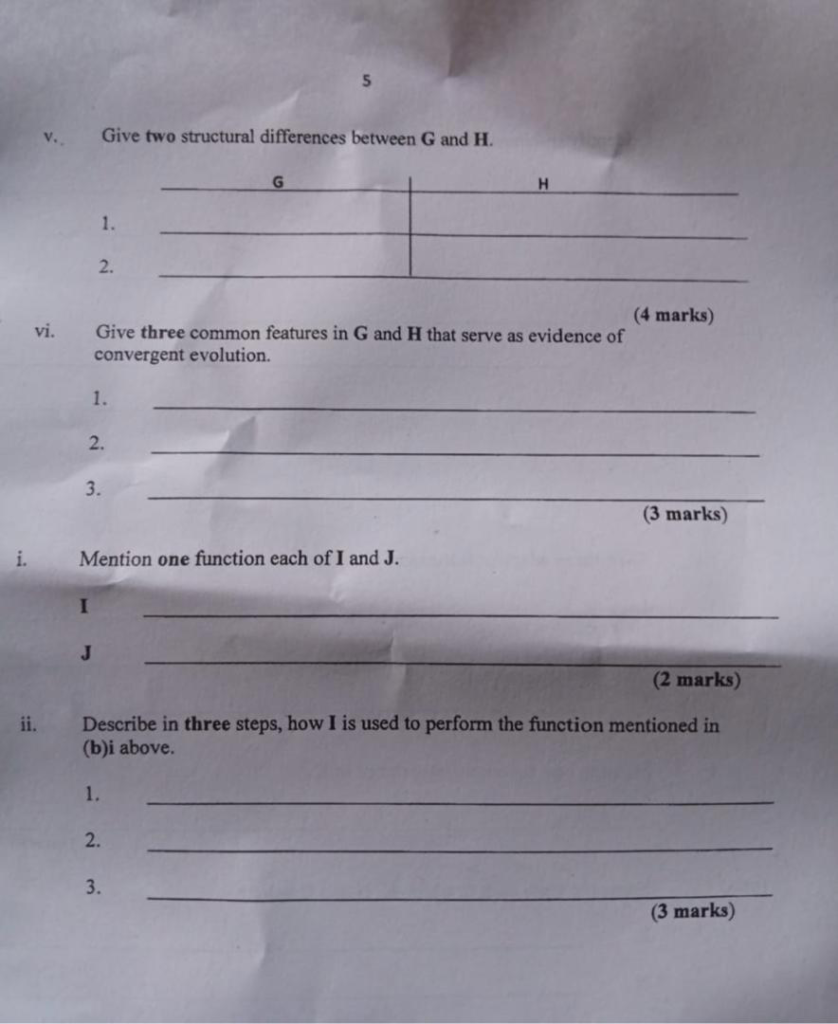
    (a)(v) Give two structural differences between G and H (4 marks)

    G (Agama lizard) H (Rat/Rabbit)

    1. Body is covered with dry, scaly skin 1. Body is covered with fur/hair
    2. Has claws on toes 2. Has nails on toes
    3. Has no external ear (pinna) 3. Has prominent external ear (pinna)

    (a)(vi) Give three common features in G and H that serve as evidence of convergent evolution (3 marks)

    1. Both have a vertebral column (backbone) โ€“ they are vertebrates.
    2. Both have paired appendages (limbs) for locomotion.
    3. Both have a well-developed head with sensory organs (eyes, nostrils, mouth).

    (b)(i) Mention one function each of I and J (2 marks)

    I (Quadrat) โ€“ Used to estimate the population of plants or slow-moving animals in a given area.

    J (Sweeping net) โ€“ Used to collect flying or ground-dwelling insects for study.

    (b)(ii) Describe in three steps how I (quadrat) is used to perform its function (3 marks)

    1. Place the quadrat randomly on the ground in the study area.
    2. Count the number of individuals of the target species within the quadrat.
    3. Repeat the process at several randomly selected points and calculate the average number per quadrat, then multiply by the total area to estimate the population.

    ===========================================================
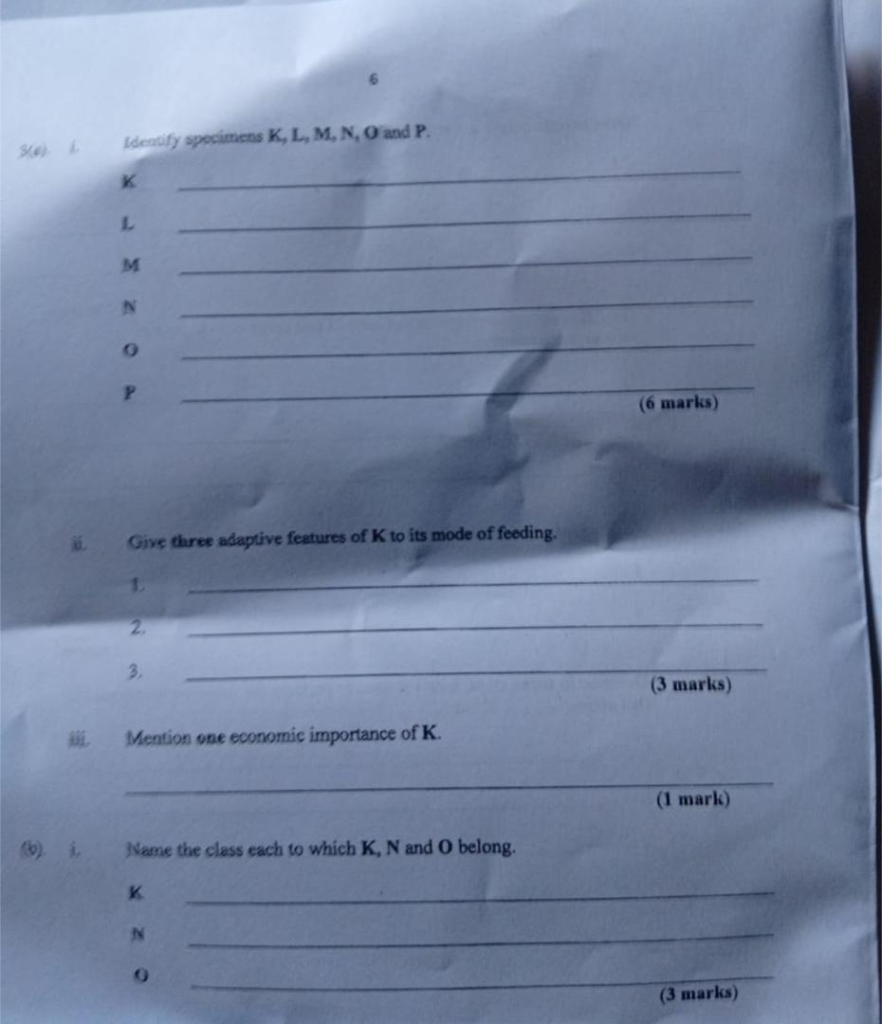
    QUESTION 3 (Specimens K, L, M, N, O, P)

    ===========================================================
    (a)(i) Identify specimens K, L, M, N, O and P (6 marks)

    K โ€“ Housefly

    L โ€“ Pride of Barbados fruit/pod

    M โ€“ Cashew nut

    N โ€“ Millipede

    O โ€“ Crab

    P โ€“ Sorghum grain

    (a)(ii) Give three adaptive features of K (housefly) to its mode of feeding (3 marks)

    1. It has sponging mouthparts (labella) for sucking liquid food.
    2. It has compound eyes that help it locate food sources.
    3. It has sensory hairs on its legs to taste and detect food.

    (a)(iii) Mention one economic importance of K (housefly) (1 mark)

    It transmits disease-causing organisms (pathogens) such as those causing typhoid, cholera, and dysentery.

    (a)(iv) Name the class each to which K, N and O belong (3 marks)

    K (Housefly) โ€“ Insecta

    N (Millipede) โ€“ Diplopoda

    O (Crab) โ€“ Crustacea

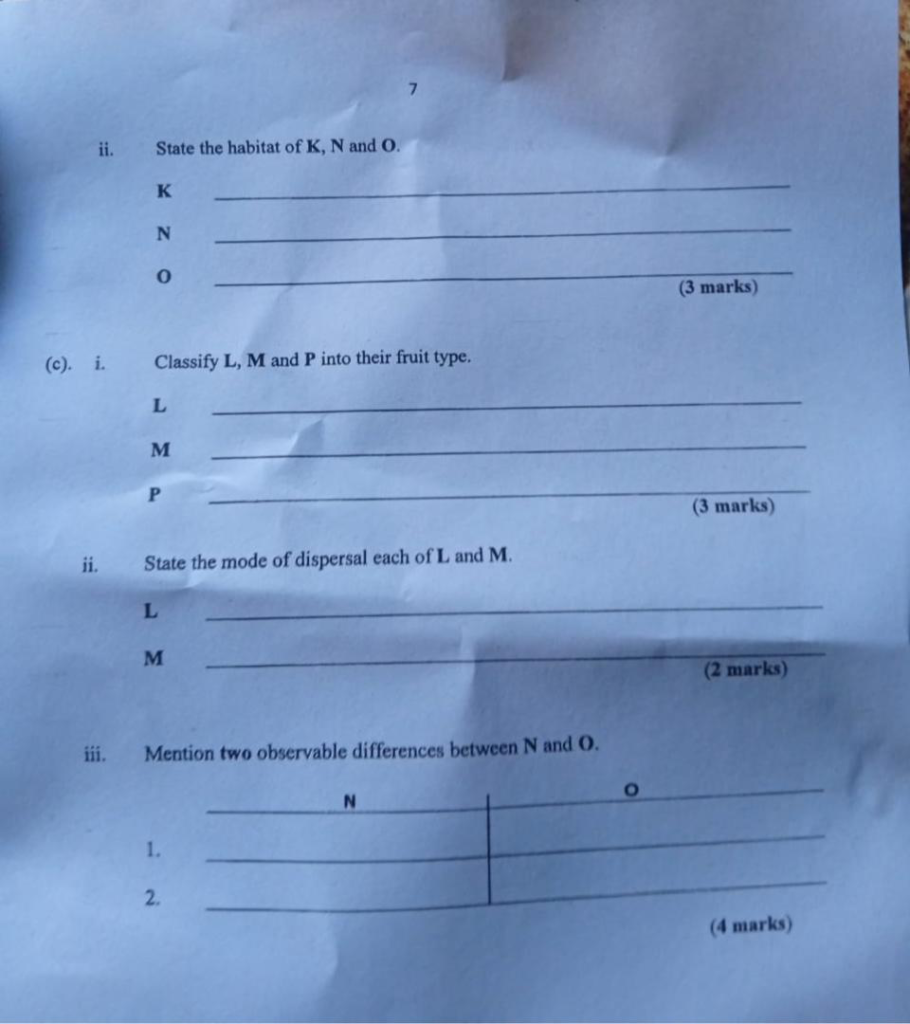
    (a)(v) State the habitat of K, N and O (3 marks)

    K (Housefly) โ€“ Terrestrial habitat (around human settlements, refuse dumps)

    N (Millipede) โ€“ Terrestrial habitat (under leaves, logs, and in moist soil)

    O (Crab) โ€“ Aquatic (marine) and terrestrial (estuarine, mangrove swamps)

    (a)(vi) Classify L, M and P into their fruit type (3 marks)

    L (Pride of Barbados fruit/pod) โ€“ Dehiscent fruit (legume/pod)

    M (Cashew nut) โ€“ Indehiscent fruit (nut)

    P (Sorghum grain) โ€“ Indehiscent fruit (caryopsis/grain)

    (a)(vii) State the mode of dispersal of L and M (2 marks)

    L (Pride of Barbados) โ€“ Dispersed by explosive mechanism (ballistic dispersal) and by wind.

    M (Cashew nut) โ€“ Dispersed by animals (zoochory) and water.

    (a)(viii) Mention two observable differences between N (millipede) and O (crab) (4 marks)

    N (Millipede) O (Crab)

    1. Body is elongated and cylindrical 1. Body is flattened and broad
    2. Has two pairs of legs per body segment 2. Has five pairs of legs (including chelipeds)
    3. Has a distinct head with short antennae 3. Has a distinct head with long antennae
    4. Does not have a hard exoskeleton 4. Has a hard, calcified exoskeleton (carapace)

    ===========================================================
    END OF ANSWERS โ€“ QUESTIONS 1, 2 & 3

    ==============================================
    NECO Biology Practical Answers [26th June] 2026/2027

    NECO Biology Practical Answers [26th June] 2026/2027, this page will be updated with fresh exam-day updates as they become available. Some parts may appear earlier than others, so keep checking back and refresh this page regularly.

    This page covers the sections for NECO Biology Practical Answers [26th June] 2026/2027. The Essay and parts will be added in stages as they become available.

    1-10: Loadingโ€ฆ
    11-20: Loadingโ€ฆ
    21-30: Loadingโ€ฆ
    31-40: Loadingโ€ฆ
    41-50: Loadingโ€ฆ
    51-60: Loadingโ€ฆ
    Solving/Typingโ€ฆ

    NECO Biology Practical Answers [26th June] 2026/2027

    Number 1

    Answers Loadingโ€ฆ

    ====================
    Number 2

    Answers Loadingโ€ฆ

    ====================
    Number 3

    Answers Loadingโ€ฆ

    ====================
    Number 4

    Answers Loadingโ€ฆ

    ====================
    Number 5

    Answers Loadingโ€ฆ
    Answers Loadingโ€ฆ
    Please refresh this page every few minutes to see new updates.

    Recent Posts

  • NECO Igbo Answers [25th June] 2026/2027

    NECO Igbo Answers [25th June] 2026/2027

    NECO Igbo Answers [25th June] 2026/2027:The 2026 NECO Igbo (Papers III & II: Objective & Essay) exam is scheduled to run for 3 hours, testing candidates on prose, poetry, oral literature, and language structure . To prepare, candidates should study the official syllabus and practice with verified past questions .

    NECO Igbo Answers [25th June] 2026/2027

    NECO Igbo OBJ

    1-10: EABCDEDABA
    11-20: CEEACCADEA
    21-30: BCABEADCBA
    31-40: ACBACEACDB
    41-50: AEAECADEDC
    51-60: ADAAABDCBA

    (WITH NUMBERING)
    1.E 2.A 3.B 4.C 5.D 6.E 7.D 8.A 9.B 10.A
    11.C 12.E 13.E 14.A 15.C 16.C 17.A 18.D 19.E 20.A
    21.B 22.C 23.A 24.B 25.E 26.A 27.D 28.C 29.B 30.A
    31.A 32.C 33.B 34.A 35.C 36.E 37.A 38.C 39.D 40.B
    41.A 42.E 43.A 44.E 45.C 46.A 47.D 48.E 49.D 50.C
    51.A 52.D 53.A 54.A 55.A 56.B 57.D 58.C 59.B 60.A

    COMPLETED!!!

    NECO Igbo Essay

    Number 1

    (1a)
    แปคmแปฅnwoke ka mkpa nโ€™ezinaแปฅlแป karแป‹a แปฅmแปฅnwaanyแป‹. โ€˜I kwenyere ka แปbแปฅ na i kwenyeghแป‹.โ€™ Isiokwu:

    Nnn แปคmแปฅnwoke na แปคmแปฅnwaanyแป‹ nwere otu uru na mkpa nโ€™ezinaแปฅlแปNโ€™ala Igbo na แปtแปฅtแปฅ omenala nโ€™แปฅwa nile, enwere echiche ochie na-asแป‹ na แปฅmแปฅnwoke ka mkpa nโ€™ezinaแปฅlแป karแป‹a แปฅmแปฅnwaanyแป‹. Mแปฅ onwe m adแป‹ghแป‹ ekwenye nโ€™echiche a ma แปlแป‹. Nโ€™oge gboo, a na-ele nwa nwoke anya dแป‹ ka onye ga-anแปchi anya nna ya, gbatแป‹kwuo aha ezinแปฅlแป, ma keta akแปฅ na แปฅba. Ma nโ€™แปฅwa nke taa, ihe agbanweela. Agbanyeghแป‹ na nwa nwoke nwere แปrแปฅ แป na-arแปฅ, nwa nwaanyแป‹ nwekwara nnukwu mkpa nke na-enweghแป‹ onye ga-emezu ya ma แป bแปฅghแป‹ ya. Ezinaแปฅlแป แป bแปฅla chแปrแป ma nwoke ma nwaanyแป‹ ka ha wee zuo oke ma nwee แปganihu.Nke mbแปฅ, anyแป‹ kwesแป‹rแป‹ แป‹ma na แปganihu akแปฅ na แปฅba nke ezinaแปฅlแป nโ€™oge taa adแป‹ghแป‹kwa adadabere naanแป‹ nโ€™elu แปฅmแปฅnwoke. Na mbแปฅ, a na-eche na แป bแปฅ naanแป‹ แปฅmแปฅnwoke na-aga แปrแปฅ ma na-eweta ego na nri nโ€™ezinaแปฅlแป. Ma taa, แปฅmแปฅnwaanyแป‹ agแปฅgoro akwแปฅkwแป nke แปma, ha na-arแปฅ แปrแปฅ dแปkแป‹ta, แปkaiwu, ndแป‹ ndแปrแป ndแปrแป แปchแป‹chแป‹, na ndแป‹ แปchแปฅnta ego. แปŒtแปฅtแปฅ oge, แป bแปฅ แปฅmแปฅnwaanyแป‹ na-akwแปฅ แปฅgwแป akwแปฅkwแป แปฅmแปฅ ha, na-azแปฅ nri, ma na-ewu แปฅlแป maka ndแป‹ mแปฅrแปฅ ha. Nwa nwaanyแป‹ gแปฅrแปฅ akwแปฅkwแป ma nwee ego na-abแปฅ nnukwu ngแปzi na ogidi siri ike nโ€™ezinaแปฅlแป ya.Nke abแปฅแป, แปฅmแปฅnwaanyแป‹ na-enye nlekแปta na nkwado mmแปฅแป nke แปฅmแปฅnwoke na-apแปฅghแป‹ inye. Nwa nwaanyแป‹ anaghแป‹ echezแป ebe o siri pแปฅta, แปbแปฅladแป‹ ma แป lแปฅแป di. Mgbe ndแป‹ nne na nna meresแป‹rแป‹ agadi, แป bแปฅ แปฅmแปฅnwaanyแป‹ na-esikarแป‹ nso na-elekแปta ha, na-asa ha uwe, na-enye ha nri, ma na-agwแป ha แปrแป‹a. แปคmแปฅnwoke na-enwesi mmasแป‹ nโ€™แป‹chแป ego na azแปฅmahแป‹a nke na ha anaghแป‹ enweta oge ha ga-eji nแปrแป nso lekแปta ndแป‹ agadi ahแปฅ otรบ ahแปฅ แปฅmแปฅnwaanyแป‹ si eme ya.Nke atแป, nโ€™ihe gbasara แปdแป‹nala na idowe aha ezinaแปฅlแป, แป bแปฅ eziokwu na nwa nwoke na-anแปchi anya, ma gแป‹nแป‹ na-eme ma แป bแปฅrแปฅ na nwa nwoke ahแปฅ ghแปแป onye na-abaghแป‹ uru ma แป bแปฅ mebie aha ezinแปฅlแป? แปŒtแปฅtแปฅ แปฅmแปฅnwaanyแป‹ ebulila aha ezinแปฅlแป ha elu site na mmeri ha meriri nโ€™agแปฅmakwแปฅkwแป na nโ€™แปrแปฅ aka nโ€™แปฅwa nile. Nwa nwaanyแป‹ nwere ezi agwa na-ewetara nne na nna ya nkwanye รนgwรน karแป‹a nwa nwoke na-eme mpแปฅ.Nโ€™ikpeazแปฅ, nwa nwoke na nwa nwaanyแป‹ bแปฅ onyinye sitere nโ€™aka Chineke. Onweghแป‹ onye ka ibe ya mkpa. Ezinแปฅlแป chแปrแป ike na nchebe nke nwa nwoke, chแปแปkwa amamihe, แป‹hแปฅnanya, na nlekแปta nke nwa nwaanyแป‹. Idobe otu dika แป ka ibe ya mma na-eweta nkoropแปฅ, แป‹kpแปasแป‹ na mmebi iwu nโ€™etiti แปฅmแปฅnne. Nโ€™ihi nke a, m na-ekwusi ike na แปฅmแปฅnwoke amaghแป‹ mkpa karแป‹a แปฅmแปฅnwaanyแป‹ nโ€™ezinaแปฅlแป; ha abแปฅแป nwere uru hร  nhata.

    2)
    (i)Mmepแปฅta แปคda : A na-emepแปฅta myiriแปฅdaume site nโ€™imi (nasal cavity), ebe mgbochiume nwere ebe dแป‹ iche iche a na-anแป egbochi ikuku ume na mbakwunye แปnแปฅ dika egbugbere แปnแปฅ, ezรฉ, ma แป bแปฅ mแปnแป‹ga.
    (ii)Ikwu onwe ya dแป‹ ka Nkejiokwu: Myiriแปฅdaume nwere ike ikwurแปฅ onwe ya naanแป‹ ya mebe otu nkejiokwu (dแป‹ ka /m/ na m-ma). Mgbochiume nkแป‹tแป‹ enweghแป‹ ike ikwurแปฅ onwe ya mebe nkejiokwu ma แป bแปฅrแปฅ na udaume esoghแป‹ ya.
    (iii)Akara แปคdaolu: A na-etinye akara แปฅdaolu nโ€™elu myiriแปฅdaume ma แป kpaa agwa dแป‹ ka แปฅdaume. Mana, anaghแป‹ etinye akara แปฅdaolu nโ€™elu mgbochiume nkแป‹tแป‹.
    (iv)แปŒnแปฅแปgแปฅgแปฅ: Myiriแปฅdaume dแป‹ naanแป‹ abแปฅแป nโ€™asแปฅsแปฅ Igbo (m, n). Mgbochiume dแป‹ iri abแปฅแป na asatแป nโ€™แปnแปฅแปgแปฅgแปฅ.


    Number 3

    (3a)
    (i)Mma (ebee ka โ€˜mโ€™ mbแปฅ bแปฅ myiriแปฅdaume)
    (ii)Nna (ebee ka โ€˜nโ€™ mbแปฅ bแปฅ myiriแปฅdaume)
    (iii)Mba (ebee ka โ€˜mโ€™ bแปฅ myiriแปฅdaume)

    (3b)
    (i)แปคdaume mfe : Ha bแปฅ a, แป‹, แป, แปฅ.
    (ii)แปคdaume nshแป‹ / arแป : Ha bแปฅ e, i, o, u


    Number 4

    (4i) Edereede
    -Nkerisi: e-de-ree-de
    -แปŒnแปฅแปgแปฅgแปฅ: แปŒ nwere nkejiokwu 4

    (4ii) แปคtแปasแปฅsแปฅ
    -Nkerisi: แปฅ-tแป-a-sแปฅ-sแปฅ
    -แปŒnแปฅแปgแปฅgแปฅ: แปŒ nwere nkejiokwu 5

    (4iii) Ogbatumtum
    -Nkerisi: o-gba-tu-m-tu-m
    -แปŒnแปฅแปgแปฅgแปฅ: แปŒ nwere nkejiokwu 6 (Rแป‹ba ama: โ€œmโ€ na-arแปฅ แปrแปฅ dแป‹ka myiriudaume nโ€™ebe a).

    (4iv) แปŒtapแป‹apแป‹a
    -Nkerisi: แป-ta-pแป‹-a-pแป‹-a
    -แปŒnแปฅแปgแปฅgแปฅ: แปŒ nwere nkejiokwu 6


    Number 5

    (5a)
    (i)Chidi (Aha mmadแปฅ)
    (ii)Enugwu (Aha ebe)
    (iii)Eke (Aha แปฅbแปchแป‹ ubi)
    (iv)Naแป‹jแป‹rแป‹a (Aha obodo)

    (5b)
    (i)Aha Mmadแปฅ (Dแป‹ka Chidi): Nke a bแปฅ แปฅdแป‹ mkpแปaha a na-enye otu onye kpแปmkwem iji mata onye แป bแปฅ na dika akara njirimara ya site nโ€™แปmแปฅmแปฅ.
    (ii)Aha Ebe (Dแป‹ka Enugwu): Nke a bแปฅ mkpแปaha a na-eji amata otu obodo, mpaghara, ma แป bแปฅ obodo ukwu pแปฅrแปฅ iche nโ€™elu ala.


    Number 6

    (6)
    Nne na-agwa nwa ya nwaanyแป‹ otu แป ga-esi biri ndแปฅ ya nke แปma. Nne ya nyere ya iwu ka แป na-arแปฅ แปrแปฅ แปฅlแป niile na-egosi na แป bแปฅ แปrแปฅ dแป‹แป‹rแป‹ ya แป‹me nke ahแปฅ. Oge แปฅfแปdแปฅ, nne ya na-agwa ya ka แป ghara แป‹dแปta uche mmadแปฅ, ka แป ghara แป‹gwa แปฅmแปฅ nwoke okwu na ka แป na-anแปrแป แปฅmแปฅ nwoke nso mgbe niile. Nโ€™aka nke แปzแป, แป na-eche na แป ga-abแปฅ onye mara mma nโ€™anya แปฅmแปฅ nwoke nโ€™ime แปha mmadแปฅ ka o wee biri ndแปฅ dแป‹ mma. Nne ya mere ka แป mata na ka mmadแปฅ wee biri ndแปฅ dแป‹ mma, แป ghaghแป‹ แป‹bแปฅ ihe na-enwu enwu. แปŒ ghaghแป‹ ibiri ndแปฅ dแป‹ka uche Chineke siri dแป‹. site nโ€™ime otu ahแปฅ, Chineke ga-eme ka ndแปฅ ya na-enwu gbaa ma maa mma. Nwa nwaanyแป‹ ahแปฅ nabatara ntแปฅziaka ahแปฅ nโ€™obi ekele.


    Number 8

    (8a)
    (i)Ezinแปฅlแป mfe / Obere ezinแปฅlแป โ€“ Nna, nne na แปฅmแปฅ ha.
    (ii)Ezinแปฅlแป nju / Nnukwu ezinแปฅlแป โ€“ Nna, nne, แปฅmแปฅ, nne na nna ochie, nwanne nna, wdg.

    (iii)Ezinแปฅlแป nwunye karแป‹rแป‹ otu โ€“ Otu nwoke, ndแป‹ nwunye ya na แปฅmแปฅ ha.

    (8b)
    (i)Ihe e ji amata ebe ihe mberede ma แป bแปฅ ihe ize ndแปฅ dแป‹: A na-eke ya nโ€™แปฅgbแปala bu ozu ma แป bแปฅ nโ€™ebe a na-arแปฅ แปrแปฅ okporo แปฅzแป.

    (ii)Ihe e ji agba mgbaร mร  nโ€™ofufe na omenala: Ndแป‹ dibแป‹a na ndแป‹ nze na แปzo na-eji ya eme ememe dแป‹ iche iche ma แป bแปฅ iji gosi na ebe anwแปฅsแป‹la nsแป.


    Number 9

    (9)
    (i)Asแปฅsแปฅ Igbo: Ha na-asแปฅ otu asแปฅsแปฅ nwere olumba dแป‹ iche iche.
    (ii)Eji m m mma (Ewumewu แปŠwa Ji): Ememe iji kwado owuwe ihe ubi แปhแปฅrแปฅ.
    (iii)แปŠgbaso omenala na nsแป ala: Nkwanye รนgwรน siri ike nโ€™ebe ndแป‹ okenye na omenala ala nna ha dแป‹.

    (9b)
    (i)แปŒjแป‹ (Oji Igbo): แปŒ bแปฅ akara mbแปฅ nke nnabata na udo.
    (ii)Mmiri: Iji mee ka akpแป‹rแป‹ kpaa แปbแป‹a mmiri ma แป bแปฅ iji kwแปแป aka.


    Number 10

    (10)
    (i)แปŒnwแปฅ ji ajแป aka kporo ya pแปฅแป.
    (ii)Eze แปnwa na-amแปฅmแปฅ แปnแปฅ แปchแป‹ nโ€™igwe.
    (iii)Ufe na-agba egwu mgbe ikuku na-efe.
    (iv)Agแปฅแปฅ na-ata m taa.
    (v)แปคbแปchแป‹ taa na-akwa รกkwรก maka mmiri ozuzo.


    Number 11

    (11)
    (i)Mkpแปmkwem
    (ii)Chakachaka

    (11b)
    (i)Gidi gidi bแปฅ ugwu eze.
    (ii)Onye kpara akแปฅkแปฅ nku rแป‹แปrแป gbatแป‹a, แป naghแป‹ efe efe.
    (iii)Eze mbe si na ihe แป sแปrแป onye sแป‹ mแปฅ ya tแปฅแป, แป sแปrแป ya ya zแปฅta ite แป ga-esi ya.


    Number 12

    (12a)
    Ihe abแปฅแป แปŒnyแป‹do gupแปฅtara bแปฅ แปฅmแปฅagbแปghแป abแปฅแป mara mma (ndแป‹ nwere ike แป‹lแปฅ di) ma แป bแปฅ ego na akแปฅnแปฅba แป ga-enweta ma แป bแปฅrแปฅ na แป gbasoro ndแปฅmแปdแปฅ ya.

    (12b)
    Tupu agha amalite, aha abแปฅแป แป kpแปrแป ya bแปฅ โ€œDibia Aghแปฅghแปโ€ na โ€œOnye Nduhieโ€ (Dแป‹ka แป na-enyo mmasแป‹ na eziokwu dibแป‹a ahแปฅ enyo).

    (12c)
    Obinna jiri แป‹chแป ndแปฅmแปdแปฅ/ngwแปta maka nsogbu ya gaa na nke แปŒnyแป‹do (karแป‹sแป‹a gbasara otu แป ga-esi gbanarแป‹ ma แป bแปฅ lanarแป‹ ihe isi ike na แปgแปฅ dแป‹ nโ€™oge agha ahแปฅ).


    Number 13

    (13a)
    Gudele, Amแปkwe, na Umuode.

    (13bi)
    Onye kwuru okwu a bแปฅ Nna แปŒbแป‹ageri (ma แป bแปฅ di Nwakaego).

    (13bii)
    Ha na-aga ije nyocha/mmemme di na nwunye (ije gbasara agbamakwแปฅkwแป ma แป bแปฅ แป‹hแปฅ maka แปdแป‹mma nwa ha nwanyแป‹ bแปฅ แปŒbแป‹ageri).


    Number 14

    (14ai)
    แปคwa แปŒjแปแป Nke Aโ€ ma แป bแปฅ โ€œOyibo Mebichara Iheโ€.

    (14aii)
    Ahแปฅmแป‹he ( Ntแปฅnyere โ€˜|โ€™) ma แป bแปฅ Egbeokwu , ebe a na-atแปฅnyere omume ma แป bแปฅ แปnแปdแปฅ anyแป‹ na แปฅgแป‹rแป‹ kworo enwe eze.

    (14b)
    (i) Eziokwu bแปฅ ihe anaghแป‹ amala amala (แป naghแป‹ ere ure ma แป bแปฅ gbanwee).
    (ii) Eziokwu bแปฅ ngwรก แปgแปฅ na-emeri แปchแป‹chแป‹rแป‹ na mmebi iwu niile.

    NECO Igbo Answers [25th June] 2026/2027, this page will be updated with fresh exam-day updates as they become available. Some parts may appear earlier than others, so keep checking back and refresh this page regularly.

    This page covers the sections for NECO Igbo Answers [25th June] 2026/2027.The Essay and parts will be added in stages as they become available.

    1-10: Loadingโ€ฆ
    11-20: Loadingโ€ฆ
    21-30: Loadingโ€ฆ
    31-40: Loadingโ€ฆ
    41-50: Loadingโ€ฆ
    51-60: Loadingโ€ฆ
    Solving/Typingโ€ฆ

    NECO Igbo Answers [25th June] 2026/2027

    Number 1

    Answers Loadingโ€ฆ

    ====================
    Number 2

    Answers Loadingโ€ฆ

    ====================
    Number 3

    Answers Loadingโ€ฆ

    ====================
    Number 4

    Answers Loadingโ€ฆ

    ====================
    Number 5

    Answers Loadingโ€ฆ
    Answers Loadingโ€ฆ
    Please refresh this page every few minutes to see new updates.

    Recent Posts

  • NECO Yoruba Answers [25th June] 2026/2027

    NECO Yoruba Answers [25th June] 2026/2027

    NECO Yoruba Answers [25th June] 2026/2027: The NECO Yoruba Objective Exam is the multiple-choice section of the SSCE Yoruba paper. It tests candidates’ knowledge of language, literature, and culture, and is written alongside the essay section within the allocated examination time.

    รˆdรจ (Language & Grammar)

    • Translation (รŒtumแปฬ€)
    • Proverbs (ร’we)
    • Idioms and expressions
    • Figures of speech
    • Spelling and grammar rules (รŒrรฒ รจdรจ)

    NECO Yoruba Answers [25th June] 2026/2027

    01-10: EDBAECCBAC
    11-20: DCCACBAAEB
    21-30: ADECDBADAA
    31-40: DBCBEADCBC
    41-50: CEABEBABDB
    51-60: BBEBCECECA

    NECO Yoruba Answers [25th June] 2026/2027, this page will be updated with fresh exam-day updates as they become available. Some parts may appear earlier than others, so keep checking back and refresh this page regularly.

    This page covers the sections for NECO Yoruba Answers [25th June] 2026/2027.The Essay and parts will be added in stages as they become available.

    1-10: Loadingโ€ฆ
    11-20: Loadingโ€ฆ
    21-30: Loadingโ€ฆ
    31-40: Loadingโ€ฆ
    41-50: Loadingโ€ฆ
    51-60: Loadingโ€ฆ
    Solving/Typingโ€ฆ

    NECO Yoruba Answers [25th June] 2026/2027

    Number 1

    Answers Loadingโ€ฆ

    ====================

    Number 2

    Answers Loadingโ€ฆ

    ====================

    Number 3

    Answers Loadingโ€ฆ

    ====================

    Number 4

    Answers Loadingโ€ฆ

    ====================

    Number 5

    Answers Loadingโ€ฆ
    Answers Loadingโ€ฆ
    Please refresh this page every few minutes to see new updates.

  • NECO Hausa Answers [25th June] 2026/2027

    NECO Hausa Answers [25th June] 2026/2027

    NECO Hausa Answers [25th June] 2026/2027:The NECO Hausa exam tests your knowledge of Language (Rubutu da Tsarin Harshe), Literature (Adabi), and Culture (Al’adu) . It generally consists of an Objective (Paper III) and an Essay (Paper II) section, evaluating grammar, oral/written literature, and reading comprehension.

    READ ALSO:neco Chemistry Practical Answers 2026

    NECO Hausa Answers [25th June] 2026/2027

    1a)

    Unguwar Lalle,
    Karamar Hukumar Sabon Gari,
    Jihar Kaduna.
    25 ga Yuni, 2026.

    Zuwa ga,
    Mai Girma Shugaban Karamar Hukuma,
    Karamar Hukumar Sabon Gari,
    Jihar Kaduna.

    Mai Girma Shugaba,

    BUKATAR AIWATAR DA AYYUKAN CIGABA A KAUYEN UNGUWAR LALLE

    Ina rubuta wannan wasiฦ™a ce a madadin daukacin al’ummar kauyen Unguwar Lalle domin bayyana muku wasu muhimmar buฦ™atu na ayyukan ci gaba da muke bukata a samar mana a wannan yankin namu. Wannan wasika tana kunshe da koke-koken da mutanen kauyen nan suka dade suna tattaunawa akai. Mun san irin kokarin da kuke yi na inganta rayuwar al’umma, shi ya sa muke rokon ku duba halin da muke ciki.

    Da farko dai, babbar matsalar da muke fuskanta ita ce ta rashin ruwan sha mai tsafta. Ruwa shine jigon rayuwa, kuma rashinsa yana janyo mana yaduwar cututtuka daban-daban. A halin yanzu, rijiyoyin burtsatse guda biyu ne kawai ke aiki a duk fadin kauyen, kuma hakan bai wadaci jama’a ba. Mutane, musamman mata da yara, suna fuskantar wahala sosai wajen samo ruwa. Muna rokon karamar hukuma da ta samar mana da karin rijiyoyin burtsatse masu amfani da hasken rana domin magance wannan matsalar.

    Na biyu, muna fuskantar kalubale babba a bangaren kiwon lafiya. Asibitin dake kauyenmu ba shi da isassun magunguna da ma’aikata. Hakan yana sa marasa lafiya, musamman mata masu juna biyu, tafiya mai nisa zuwa babban birni kafin su sami kulawa. Mata da yawa suna fuskantar matsaloli kafin su isa asibitin birni saboda nisan gari. Muna bukatar a gyara asibitin tare da samar da isassun magunguna da kwararrun ma’aikatan lafiya.

    Bugu da kari, hanyar da ta hada kauyenmu da babban birni tana cikin mummunan hali, musamman a lokacin damina. Manoma suna shan wahala wajen kai amfanin gonarsu zuwa kasuwa saboda lalacewar hanyoyi. Idan aka gyara wannan hanya, tattalin arzikin yankinmu zai bunkasa sosai.

    Daga karshe, muna rokon a duba batun samar da wutar lantarki da kuma inganta makarantar firamare ta kauyenmu, domin yaranmu su samu ilimi mai inganci a cikin yanayi mai kyau da ya dace.

    Muna fatan zaku duba wadannan bukatu namu cikin hanzari domin kawo sauki ga rayuwar al’ummar wannan kauye. Mun gode da irin kulawa da goyon baya da kuke ba mu a ko da yaushe.

    Naku na gaskiya,
    (Sa-hannu)
    Malam Bello Umar
    (Wakilin Al’ummar Unguwar Lalle)

    Number 2

    (2i)
    /aa/
    Matsayin Harshe: Harshen yana kasancewa a kasa kwance (Wasali na Kasa). Shi ma bayansa ko gabansa ba ya daukaka sosai (Wasali na Tsakiya).

    Matsayin Leษ“ษ“a: Leษ“ษ“a suna kasancewa a bude ba tare da yin gwaiwa ko rami ba (Wasali maras gwaiwa / budadde).

    (2ii)
    /uu/
    Matsayin Harshe: Bayan harshe yana daukaka zuwa silin baki (Wasali na Baya / na Sama).

    Matsayin Leษ“ษ“a: Leษ“ษ“a suna yin rami ko zama kamar gwaiwa (Wasali mai gwaiwa).

    Number 3

    Answers Loadingโ€ฆ.

    Number 4

    (4)
    Siffa:
    Misali 1: Yarinya kyakkyawa
    Misali 2: Gida babba

    Kaddau / Mallaka:
    Misali 1: Littafi nawa
    Misali 2: Mota ta Audu

    Number 5

    Answers Loadingโ€ฆ.

    Number 6

    Answers Loadingโ€ฆ.

    Number 7

    (7)
    Auren Sadaka
    Wannan shi ne nau’in auren da mutum yake bayar da ‘yarsa kyauta ga masani (malami) ko talaka wanda yawanci ba zai iya daukar nauyin da ke cikin aure ba. Muhimmancin irin wannan auren shi ne cewa aiki ne na lada ga uba, saboda haka ba ya ranar samun wata moriyar kansa ko kadan. Shi miji ba zai kashe komai ba sai kalilan da yake bayarwa ga wadanda suka kawo masa yarinyar gidansa, a matsayin alamar godiyarsa. Wannan bai wuce fam daya ba kuma yana iya yin kasa da haka. Yawanci ba a sanar da mijin da zai aura game da taron ba, kuma mamakin da yake yi lokacin da aka kawo amarya gidansa sai dai kawai a yi tunaninsa.
    A kwanakin nan, irin wannan auren yana saurin bacewa saboda cin zarafi da yawa ya shigo cikinsa. Mutane sun fara aurar da ‘ya’yansu mata ta wannan hanyar, ba don kyakkyawar manufa ta lada kadai ba.

    Number 8

    Answers Loadingโ€ฆ.

    Number 9

    (9a)
    Zaman Gandu: Tsari ne na zaman iyali na gargajiya inda uba (ko babban gida) ke zama da ‘ya’yansa maza da iyalansu gaba daya a gida daya, suna yin noma tare a gona guda don ciyar da iyalin baki daya.

    (9b)
    (i)Hadin kai: Yana karfafa dankon zumunci, kauna, da hadin kan dangi a tsakanin iyali guda.
    (ii)Taimakon Juna: Yana saukaka ayyukan gona ta hanyar samun isassun ma’aikata (karfin kwari) ba tare da biyan kudi ba.
    (iii)Tattalin Arziki: Yana rage kashe kudi wajen neman abinci tun da ana nomawa kuma ana raba abincin cikin adalci ga kowa.

    Number 10

    (10a)
    -Hausa Bakwai: Suna nufin halastattun kasashen Hausa guda bakwai na asali wadanda suka fito daga tsatson Bayajidda da Magajiya.

    -Banza Bakwai: Suna nufin makwabtansu ko wasu garuruwa bakwai wadanda suka ari yaren Hausa ko kuma suka yi tasiri da al’adun Hausawa amma ba su da asalin jinin Hausa kai tsaye.

    (10bi)
    Hausa Bakwai:

    (i)Daura
    (ii)Kano
    (iii)Katsina

    (10bii)
    Banza Bakwai:

    (i)Zamfara
    (ii)Kebbi
    (iii)Nupe

    Number 11

    Answers Loadingโ€ฆ.

    Number 12

    (12)
    (i) Laminde: Ita ce babban jigo ko daya daga cikin taurari mata a wasan, wacce ke nuna irin kalubalen da mata ke fuskanta a cikin al’umma ko dangantakarta da Malam Zalimu.

    (ii) Saude: Ita ma wata tauraruwa ce da ke taka rawa wajen fito da manufar marubucin na nuna rayuwar gida, aure, ko rikice-rikicen da ke faruwa a cikin al’ummar da aka kwatanta.

    M

    NECO Hausa Answers [25th June] 2026/2027, this page will be updated with fresh exam-day updates as they become available. Some parts may appear earlier than others, so keep checking back and refresh this page regularly.

    This page covers the sections for NECO Hausa Answers [25th June] 2026/2027.The Essay and parts will be added in stages as they become available.

    1-10: Loadingโ€ฆ
    11-20: Loadingโ€ฆ
    21-30: Loadingโ€ฆ
    31-40: Loadingโ€ฆ
    41-50: Loadingโ€ฆ
    51-60: Loadingโ€ฆ
    Solving/Typingโ€ฆ

    NECO Hausa Answers [25th June] 2026/2027

    Number 1

    Answers Loadingโ€ฆ

    ====================

    Number 2

    Answers Loadingโ€ฆ

    ====================

    Number 3

    Answers Loadingโ€ฆ

    ====================

    Number 4

    Answers Loadingโ€ฆ

    ====================

    Number 5

    Answers Loadingโ€ฆ
    Answers Loadingโ€ฆ
    Please refresh this page every few minutes to see new updates.

  • WAEC Commerce Answers (Objective & Essay) 2026/2027

    WAEC Commerce Answers (Objective & Essay) 2026/2027

    WAEC Commerce Answers (Objective & Essay) 2026/2027: To successfully tackle the WAEC Commerce (objective and essay) exams, you need a strong grasp of core commercial concepts like occupations, trade (home & foreign), transportation, banking, and business organizations. WAEC requires both objective multiple-choice answers and clear, well-explained written points in the theory section.

    Get Free Live 2026 WAEC May/June Commerce Essay (Theory) and Objective (OBJ) questions and Answers for School Candidates at no cost. Access the WAEC May/June 2026 Commerce Answer Room for the latest updates on the Commerce examination scheduled for 19th June 2026.

    WAEC May/June 2026 Commerce Examination Schedule

    DatePaperTime
    Friday, 19th June 2026Commerce 2 (Essay/Theory)9:30 AM โ€“ 11:30 AM
    Friday, 19th June 2026Commerce 1 (Objective/OBJ)11:30 AM โ€“ 12:20 PM

    Related Resources

    • JAMB Preparation Materials
    • JAMB Score Analysis
    • School Fee Calculator

    Stay updated with examination information, timetable details, and other educational resources for WAEC candidates.

    WAEC Commerce Answers (Objective & Essay) 2026/2027

    NOTE: USE THIS TO TRACE CAREFULLY IF THE OBJECTIVE QUESTION PAPER WHERE RESHUFFLED

    1. B. trade and auxiliaries to trade
    2. C. computers to conduct business
    3. B. primary occupation
    4. D. land
    5. A. it faces unlimited liability
    6. B. participating preference shareholders
    7. D. consortium
    8. B. public company
    9. C. interest
    10. B. Distribution of goods to customers
    11. A. trade association
    12. A. sex
    13. A. insufficient capital
    14. A. D 3,000
    15. D. D 6,000
    16. D. 3,000
    17. D. terms of trade
    18. D. customs duties
    19. A. Central Bank
    20. D. bonus issue
    21. B. assured value
    22. D. shares
    23. A. bulk purchase
    24. C. commission
    25. B. Retail
    26. B. dock warrant
    27. D. bonded warehouse
    28. C. motherboard
    29. A. store of value
    30. B. finance the purchase of equipment
    31. B. contribution
    32. B. informative advertising
    33. B. television
    34. C. sales promotion
    35. A. written communication
    36. B. lapse of time
    37. C. regulates businesses
    38. B. increase investment
    39. D. demographic
    40. B. provision of pipe borne water
    41. D. Penetration
    42. C. copyright
    43. C. Standard Organization Act
    44. C. span of control
    45. C. futures price
    46. D. setting company goals
    47. A. privatization
    48. A. improvement of revenue base
    49. A. 1964
    50. D. Togo

    Number 1

    (1a)
    Commerce is the buying, selling and distribution of goods and services through physical or traditional means, while e-commerce is the buying and selling of goods and services through the internet or other electronic means.

    Commerce usually involves face-to-face contact between buyers and sellers, while e-commerce allows buyers and sellers to transact online without physical contact.

    Commerce may require a physical shop or marketplace, while e-commerce can be carried out through websites, mobile apps and online platforms.

    1b)
    (i) Business to customer: This is a type of e-commerce where a business sells goods or services directly to final consumers through the internet. For example, a customer buying clothes, phones or food from an online store.Exam preparation tips

    (ii) Government to business: This is a type of e-commerce where government agencies provide services or information to business organizations through electronic means. For example, online tax payment, business registration, licence renewal and submission of company documents to government agencies.

    1c)
    Advantages of e-commerce:
    (PICK ANY TWO)
    (i) It saves time because customers can buy goods and services online without going to a physical shop.WAEC timetable updates

    (ii) It reduces the cost of running a business because the seller may not need many physical shops.

    (iii) It allows buying and selling to take place at any time of the day.

    (iv) It helps businesses to reach customers in different locations.

    ix) Some hawkers sell goods on credit to familiar customers.

    (x) Hawkers can operate at convenient times and places.

    (4b)
    (PICK ANY FIVE)
    (i) A hypermarket is a very large retail store that sells many varieties of goods.

    (ii) It combines the features of a supermarket and a departmental store.

    (iii) It usually operates on a self-service basis.

    (iv) It sells both food and non-food items.

    (v) It usually has large parking space for customers.

    (vi) It sells goods at relatively low prices because it buys in large quantities.

    (vii) It is usually located in large buildings or shopping complexes.

    (viii) It uses modern equipment such as trolleys, shelves, scanners and electronic payment systems.

    (ix) It offers customers a wide range of products under one roof.

    (x) It is usually owned and operated by large business organizations.

    Number 5

    (5a)
    (PICK ANY FIVE)
    (i) Performance of the contract by both parties.

    (ii) Agreement between the parties to end the contract.

    (iii) Breach of contract by one of the parties.

    (iv) Frustration of contract due to an unforeseen event.

    (v) Impossibility of performance.

    (vi) Lapse of time fixed for the contract.

    (vii) Death or insanity of one of the parties, especially in personal contracts.

    (viii) Bankruptcy of one of the parties.

    (ix) Operation of law.

    (x) Destruction of the subject matter of the contract.

    (5b)
    (i) Sale of Goods Act: This is an Act that regulates the buying and selling of goods. It protects both buyers and sellers by stating their rights and duties in a contract of sale. It ensures that goods sold must correspond with description, be of good quality and be fit for the purpose for which they are bought.

    (ii) Foods and Drugs Act: This is an Act that controls the production, sale and distribution of food and drugs. It protects consumers from harmful, fake, adulterated or expired food and drugs. It also ensures that food and drugs sold to the public are safe for consumption and properly labelled.

    (iii) Standard Organization Act: This is an Act that establishes a body responsible for setting and maintaining standards for goods and services. It ensures that products meet the required quality and safety standards before they are sold to consumers. It also helps to prevent the sale of substandard goods.

    (iv) Factory, Shops and Offices Act: This is an Act that protects workers in factories, shops and offices. It provides rules on safety, health, working conditions, ventilation, cleanliness, working hours and welfare of workers. It helps to prevent accidents and poor working conditions in business premises.

    (v) Hire Purchase Act: This is an Act that regulates hire purchase transactions. It protects the buyer and seller in an agreement where goods are taken and paid for by instalments. The buyer can use the goods while paying gradually, but ownership fully passes to the buyer only after the final payment is made.

    Number 6

    (6a)
    Business management is the process of planning, organizing, directing, coordinating and controlling the activities and resources of a business in order to achieve its goals. It involves using human, financial, material and other resources effectively to produce goods or services and make profit.

    (6b)
    (i) Economic environment: Economic environment refers to the economic conditions and factors that affect the activities and performance of a business. These factors include inflation, interest rate, exchange rate, taxation, income level of consumers, unemployment, availability of credit and general economic growth. A favourable economic environment helps business to grow, while an unfavourable one can reduce sales and profit.

    (ii) Social environment: Social environment refers to the customs, beliefs, values, lifestyle, education, religion and attitudes of people in the society where a business operates. It affects the type of goods and services people demand. For example, changes in fashion, taste, family size, culture and standard of living can influence business decisions.

    (6c)
    (PICK ANY FOUR)
    (i) Human resources: These are the people who work in the business, such as managers, supervisors, clerks, machine operators and sales workers. They provide the skills, knowledge and labour needed for the operation of the business.

    (ii) Financial resources: These are the funds or money available to a business for carrying out its activities. They are used to buy goods, pay workers, acquire machines, expand the business and meet daily expenses.

    (iii) Material resources: These are the raw materials, goods, tools, machines, equipment and other physical items used in production or business operation. They help the business to produce goods and services.

    (iv) Time resources: Time is an important business resource because every business activity must be done within a given period. Proper use of time helps to increase efficiency and reduce delay or waste.

    (v) Information resources: These are facts, records and data used by a business to make decisions. Information about customers, prices, competitors, market demand and government policies helps the business to plan properly.

    (vi) Technological resources: These include machines, computers, internet facilities, software and modern methods used to improve business operations. Technology helps a business to produce faster, reduce cost and serve customers better.

    Number 7

    (7a)
    Deregulation.

    (7b)
    (PICK ANY FOUR)
    (i) Poor management: The company may have been managed by people who lacked the required skills and experience, leading to poor decisions and wastage of resources.

    (ii) Government interference: Too much interference by government officials may have affected the smooth running of the company and prevented quick business decisions.

    (iii) Overstaffing: The company may have employed more workers than necessary, thereby increasing the cost of operation.

    (iv) Corruption and mismanagement of funds: Money meant for the running and maintenance of the company may have been diverted or misused.

    (v) Poor maintenance of vehicles: Failure to maintain buses, cars or other vehicles properly could lead to frequent breakdown and poor service.

    (vi) Low fares: The company may have charged fares that were too low to cover the cost of operation.

    (vii) Lack of competition: Since the company was government-owned, it may not have faced serious competition and this could make workers careless and inefficient.

    (viii) Poor attitude of workers: Workers may have been lazy, rude to customers or careless because they felt the business belonged to the government.

    (7c)
    Advantages of deregulation:
    (PICK ANY TWO)
    (i) It encourages competition among firms, which can lead to better services.

    (ii) It reduces government spending on inefficient businesses.

    (iii) It allows private investors to participate in the industry.

    (iv) It can lead to improved efficiency and better management.

    Disadvantages of deregulation:
    (PICK ANY THREE)
    (i) It may lead to increase in prices or transport fares.

    (ii) Private operators may exploit consumers in order to make more profit.

    (iii) Some workers may lose their jobs after deregulation.

    (iv) Essential services may become difficult for poor people to afford.

    (v) Private firms may concentrate only on profitable routes and neglect rural areas.

    (vi) It may lead to unhealthy competition among firms.

    Recent Post

    in

  • WAEC Economics Answers (Objective & Essay) 2026/2027

    WAEC Economics Answers (Objective & Essay) 2026/2027

    WAEC Economics Answers (Objective & Essay) 2026/2027:WAEC Economics examination consists of two main papers: Paper 1 (Objective) and Paper 2 (Essay). The syllabus generally covers foundational microeconomic and macroeconomic theories, economic systems, trade, and economic development. 

    WAEC Economics Answers (Objective & Essay) 2026/2027

    PLS KINDLY TRACE CAREFULLY WITH THIS ANSWERS WITH YOUR QUESTIONS;
    KINDLY TRACE
    1 B. Joint supply
    2 B. Implicit cost
    3 B. They are natural and renewable
    4 C. 0
    5 A
    6 C. Rise in the general price level
    7 D. An increase in import tariffs
    8 C. National income increases faster than population
    9 A. There will be no demand for the product
    10 B. $416.66 million
    11 B. Price is higher than marginal revenue
    12 C. Harmonization of monetary and fiscal policies
    13 A. Backed by deposits in current accounts
    14 C. It is required by law to publish its accounts
    15 C. Inadequate productive resources
    16 C. ฮ”Qd/ฮ”P ร— P/Qd
    17 C. External economies of scale
    18 D. Liberalizing exchange control for investors
    19 B. Proportional
    20 D. Purchase of securities by Central Bank
    21 B. Ageing
    22 B. 20 utils
    23 A. Technical assistance
    24 B. Plantation farming
    25 B. Purchase goods and services
    26 C. Combines factor inputs in right proportions
    27 A. Experience technology transfer
    28 A. Economic system
    29 C. On equal basis for members
    30 D. Formulate plans to increase industrial productivity
    31 B. Total Cost minus Total Fixed Cost
    32 B. Increasing sale of local goods in foreign markets
    33 D. Existence of numerous middlemen
    34 A. Output being greater than demand
    35 C. Excess demand for the crop
    36 A. University graduate looking for a job
    37 C. There is an increase in demand for the good
    38 A. Labour specialization
    39 B. Economy must grow to produce there
    40 A. Manufacturing sector
    41 D. A new supply curve positioned to the right
    42 C. Public goods
    43 A. They are falsified for political gain
    44 A. The limit to variable inputs an entrepreneur can employ
    45 D. Capital
    46 A. Financial market
    47 B. Increase price Octโ€“Dec, reduce at other months
    48 B. Rent, wage, interest and profit paid to factor inputs
    49 A. It is used in the production of other goods
    50 B. Inelastic supply

    WAEC Economics Essay

    Number 1

    (1a)
    (i) Point of saturation (MU = 0): Qx = 6 units
    (ii) MU declining but positive (MU between 8 and 0): Qx = 1 to 5 units
    (iii) TU decreasing (when MU is negative): Qx = 7 units and beyond
    (iv) TU at maximum (when MU = 0): Qx = 6 units

    (1b)
    (i)Law of Diminishing Marginal Utility
    (ii)Law of Consumer Equilibrium

    (1ci)
    Consuming 1 unit of X: MU = 8 > Price ($4) โ†’ Consumer should increase consumption since theyโ€™re getting more utility than theyโ€™re paying. They are NOT in equilibrium yet.

    (1cii)
    Consuming 4 units of X: MU = 4 = Price ($4) โ†’ Consumer is at equilibrium. They should maintain this level of consumption as MU equals the price paid.

    3a)
    (PICK ANY ONE)
    A scale of preference is important to an individual because it helps him or her to arrange wants in order of priority according to their importance. Since human wants are unlimited while resources are limited, a scale of preference enables an individual to make rational choices and allocate available resources efficiently. It also helps to avoid wasteful spending and ensures that the most urgent wants are satisfied first.

    OR

    A scale of preference is important to an individual because it helps to arrange wants in order of priority. Since resources are scarce and human wants are numerous, an individual cannot satisfy all wants at the same time. Therefore, a scale of preference helps in making choices among alternatives, enables the satisfaction of urgent wants before less urgent ones, promotes the efficient allocation of scarce resources, and helps to achieve maximum satisfaction from available resources.

    OR

    A scale of preference is important to an individual because it helps an individual to rank wants in order of importance. Since resources are limited and wants are unlimited, it enables the satisfaction of the most pressing wants first. It also assists in making rational decisions and choices among competing wants. It ensures efficient use of scarce resources and helps to avoid waste and unnecessary expenditure. As a result, the individual is able to make the best use of available resources

    3b)
    (PICK ANY ONE)
    The knowledge of the basic concepts of economics can help a producer in many ways. It helps the producer to make rational decisions on what to produce, how to produce, and for whom to produce. It also enables the producer to allocate scarce resources efficiently in order to maximize profit. Knowledge of economics helps the producer to determine the level of demand for goods and services, set appropriate prices, reduce production costs, and avoid waste. It assists the producer in planning production, utilizing resources effectively, and responding to changes in market

    OR

    The knowledge of the basic concepts of economics is important to a producer because it helps in making rational decisions concerning production. It enables the producer to allocate scarce resources efficiently and determine the level of demand for goods and services. Such knowledge also assists in fixing appropriate prices, minimizing production costs, and maximizing profit. In addition, it promotes efficient utilization of available resources, helps in planning and organizing production activities, and enables the producer to respond effectively to changes in market conditions.

    3c)
    (PICK ANY FOUR)
    (i) Availability of adequate capital: When producers have access to sufficient funds, they can purchase more machinery, employ more workers, and acquire additional raw materials, thereby increasing the quantity of goods supplied.

    (ii) Technological advancement: The adoption of modern technology and improved production techniques increases efficiency and output, enabling producers to supply more goods within a given period.

    (iii) Availability of raw materials: A steady and adequate supply of raw materials ensures uninterrupted production and allows producers to increase the quantity of goods supplied to the market.

    (iv) Government assistance: Government measures such as subsidies, grants, tax concessions and low-interest loans reduce production costs and encourage producers to expand their output.

    (v) Availability of skilled labour: Skilled workers perform their tasks more efficiently and productively, leading to higher output and an increase in the supply of goods.

    vi) Favourable weather conditions: Good weather promotes agricultural production by improving crop yields and livestock performance, thereby increasing the supply of agricultural commodities.

    Number 4

    (4ai)
    Consumer goods are goods purchased and used directly by consumers to satisfy their wants. Examples are bread, clothing, television and soap. While producer goods are goods used in the production of other goods and services. They help in further production rather than direct consumption. Examples are machines, tractors, factory equipment and industrial tools.

    4aii)
    Primary production involves the extraction or exploitation of natural resources from the land, sea or forest. Examples are farming, fishing, mining and forestry. While tertiary production involves the provision of services that facilitate production and distribution of goods. Examples are banking, transportation, insurance, communication and warehousing.

    (4bi)
    Fixed capital refers to durable assets that are used repeatedly in the production process over a long period of time. These assets are not completely used up in a single production cycle. Examples are factory buildings, machines, vehicles and equipment.

    4bii)
    Working capital refers to the funds and materials used for the day-to-day running of a business. It consists of assets that are used up during the production process and must be replaced regularly. Examples are cash, raw materials, fuel and stock of goods.

    (4biii)
    Social capital refers to the basic infrastructure and public facilities provided by the government or society to support production and improve the welfare of the people. These facilities help businesses operate efficiently and promote economic development. Examples are roads, electricity, hospitals, schools and communication networks.

    Number 5

    (5a)
    A firm is a single business unit that produces goods and services for sale. An industry is a group of firms producing similar goods and services. For example, Dangote Cement is a firm, while all cement-producing firms together form the cement industry.

    (5b)
    (i) Much red tape and legal expenses in starting the firm – Public limited liability company.

    (ii) Owner(s) personal assets can be used to settle business debts – Sole proprietorship and partnership.

    (iii) No specialized management – Sole proprietorship.

    (iv) Has a life independent of its owner(s) – Public limited liability company.

    (v) Permits some but not great deal of specialization – Partnership.

    vi) Greatest ability to acquire funds for expansion of the firm – Public limited liability company.

    (vii) Unresolved disagreements among members can end the business – Partnership.

    (viii) Distinct separation of ownership and control of the business – Public limited liability company.

    (5c)
    A profit-maximizing firm in monopolistic competition is in equilibrium where marginal cost equals marginal revenue, that is MC = MR. At this point, the firm produces output OQ and sells at price OP from the average revenue curve.

    The firm makes a loss when the average cost is above the average revenue at the equilibrium output. This means that the cost per unit is higher than the price per unit. Therefore, the firmโ€™s loss is shown by the vertical difference between AC and AR at output OQ.

    In the diagram, the MC curve cuts the MR curve at the equilibrium point. From this point, output is traced down to the quantity axis, while price is traced up to the AR curve. Since AC is above AR at that output level, the firm is making a loss.

    Number 6

    (6a)
    (PICK ANY ONE)
    Industrialization can be defined as the process by which a country develops manufacturing industries and increases the production of goods through the use of modern technology, machinery, and large-scale production methods. It contributes to employment creation and economic growth.

    OR

    Industrialization refers to the establishment and expansion of industries in a country through the use of machines, skilled labour, capital, and modern production techniques. It leads to increased output, higher income, improved standards of living, and overall economic development.

    (6b)
    Location of industry refers to the particular place or site where an industry is established and carries out its production activities. The choice of location is influenced by factors such as raw materials, labour, power supply, and market. For example, A cement factory located at Ewekoro in Ogun State because of the availability of limestone. WHILE Localization of industry refers to the concentration of many firms producing the same or related products in a particular area. This enables firms to enjoy advantages such as a large labour force, specialized services, and shared facilities.For example, The concentration of textile industries in Anambra or automobile industries in Detroit, USA

    (6c)
    (i)Sawmill: A sawmill should be located near the forest or source of timber. This is because timber is the major raw material required for production, and locating the sawmill close to the forest reduces transportation costs and ensures a regular supply of logs for processing. For Example, A sawmill may be located in forest-rich areas such as Ondo State or Cross River State.

    (ii)A ceramic tile producing factory : ceramic tile producing factory should be located near the source of clay and other raw materials. This is because clay is the major raw material used in the production of ceramic tiles, and locating the factory close to the raw material source reduces transportation costs and ensures continuous production. For Example, A ceramic tile factory may be located in areas where clay deposits are abundant, such as parts of Kogi State or Ogun State

    (iii)An egg-producing poultry farm: An egg-producing poultry farm should be located near a large market or urban centre. This is because eggs are highly perishable and need to be sold quickly to consumers. Locating the farm close to the market reduces transportation costs and minimizes spoilage. For Example, An egg-producing poultry farm may be located near cities such as Lagos, Abuja, or Benin City where demand for eggs is high.

    Number 7

    (7a)
    Economic growth is an increase in the production of goods and services, while economic development involves improvements in the welfare and standard of living of the people. In Country X, GDP increased from $80 billion to over $100 billion, indicating economic growth. However, because poverty and unemployment remained high and per capita income was low, the benefits of growth did not significantly improve the welfare of the people.

    (7b)
    Economic growth can improve the standard of living by increasing income, employment opportunities, and the availability of goods and services. However, in Country X, despite the increase in GDP, poverty and unemployment remained high and per capita income was low. As a result, the standard of living of many citizens did not improve significantly.

    (7c)
    (PICK ANY FOUR)
    (i) Inadequate funding of the economic plan: The government may not have provided enough money to finance the projects and programmes contained in the plan, leading to poor implementation. This would make it difficult to complete development projects as scheduled.

    (ii) Corruption and embezzlement of public funds: Funds meant for the execution of the plan may have been diverted or misused by public officials, thereby affecting its success. As a result, many projects may remain unfinished or abandoned.

    (iii) Poor planning and implementation of government policies: The plan may have lacked clear objectives and proper coordination, making it difficult to achieve the desired results. This can lead to wastage of resources and failure to meet development targets.

    (iv) Political instability and frequent policy changes: Changes in government or government policies can disrupt the continuity of development programmes and hinder their implementation. New administrations may abandon projects started by previous governments.

    (v) Shortage of skilled manpower and technical expertise: The absence of qualified personnel to manage and execute projects can reduce the effectiveness of the economic plan. This may result in delays and poor-quality project execution.

    (vi) Inadequate infrastructure: Poor roads, irregular electricity supply, and weak communication networks can make the implementation of development projects difficult and costly. This can discourage investment and slow down economic activities.

    Number 8

    Recent Post

  • WAEC Biology Practical Answers 2026/2027

    WAEC Biology Practical Answers 2026/2027

    WAEC Biology Practical Answers 2026/2027: Biology practical examinations require accurate identification of specimens, including plants, animals, and laboratory apparatus. Candidates should draw neat diagrams using a sharp HB pencil, avoid shading, indicate magnification where necessary, and ensure label lines are straight and do not cross.

    Common practical questions often involve distinguishing insects based on body structure, antennae, and mouthparts; identifying monocot and dicot seeds as well as their germination types; and conducting simple tests on soil samples and food substances such as starch, proteins, and reducing sugars.

    A good understanding of specimen features, functions, and proper biological drawing techniques is essential for success in the practical examination.

    WAEC Biology Practical Answers 2026/2027

    1a)
    Fill the table;

    Under; TEST
    (i) Iodine test
    (ii) Biuret test
    (iii) Grease spot test/filter paper test

    Under; OBSERVATION
    (i) No blue-black colouration; iodine remains brown/yellow-brown
    (ii) Purple/violet colouration appears
    (iii) Translucent/greasy spot is seen on the filter paper

    Under; INFERENCE
    (i) Starch is absent
    (ii) Protein is present
    (iii) Fat/oil is present

    (1b)
    (PICK ANY FIVE)
    (i) It is rich in protein needed for growth and repair of body tissues.

    (ii) It contains fat/oil which provides energy for metabolic activities.

    (iii) It contains mineral salts needed for bone and teeth development.

    iv) It contains vitamins needed for healthy growth.

    (v) It provides energy needed for the childโ€™s physical activities.

    (vi) It helps in building body tissues in a growing child.

    (1ci)
    Legume/pod.

    (1cii)
    It develops from a single carpel and splits along two sides when ripe to release its seeds.

    1cii)
    It develops from a single carpel and splits along two sides when ripe to release its seeds.

    (1d)

    Diagram

    2ai)
    (i) Peristalsis
    (ii) Chemical digestion

    (2aii)
    (i) Peristalsis occurs in the oesophagus.
    (ii) Chemical digestion occurs in the stomach.

    (2b)
    (i) It has muscular walls for churning/mixing food.

    (ii) It has a narrow tubular oesophagus for movement of food.

    iii) It has folded inner walls/rugae for expansion.

    (iv) It has a sac-like stomach for temporary storage of food.

    (2c)
    (i) Pepsin
    (ii) Rennin/Gastric lipase

    (2d)
    Draw specimen F and label:
    (i) Oesophagus
    (ii) Stomach
    (iii) Cardiac sphincter
    (iv) Pyloric sphincter
    (v) Duodenum opening

    (2ei)
    Parasitism.

    (2eii)
    Specimen G benefits by obtaining water and mineral salts from the host plant, while the host plant is harmed.

    (2eiii)
    Presence of haustoria/sucking roots which penetrate the host plant and absorb water and mineral salts.

    Number 3

    (3a)
    Complete the table;

    Under; Material for preservation:
    (i) Refrigerator
    (ii) Salt
    (iii) Fire
    (iv) Empty tin
    (v) Sunlight

    Under; One specimen that could be preserved with material:
    (i) J
    (ii) J
    (iii) J
    (iv) L
    (v) K

    Under; Name of method of preservation:
    (i) Refrigeration/freezing
    (ii) Salting
    (iii) Smoking/drying
    (iv) Canning
    (v) Sun-drying

    Under; One reason for preservation method:
    (i) Low temperature slows down the activities of microorganisms.

    (ii) Salt removes water from microorganisms and prevents their growth.

    (iii) Heat kills microorganisms and reduces the moisture content of the food.

    (iv) The tin prevents entry of air and microorganisms.

    (v) Sunlight removes moisture from the food and prevents the growth of microorganisms.

    (3b)
    (i) Bacteria

    (ii) Fungi

    (3c)
    (i) Weevil

    (ii) Grain moth

    (3d)
    Loadingโ€ฆ

    (3e)
    Loadingโ€ฆ

    Number 4

    Recent Post 
    WAEC Chemistry Practical Answers 2026/2027 [ALT. B]

  • WAEC Practical Physics Answers 15th June 2026/2027

    WAEC Practical Physics Answers 15th June 2026/2027

    WAEC Practical Physics Answers 15th June 2026/2027: WAEC Physics Practical questions and solutionsย vary depending on the specific Alternative (usually Alternative A or B) and the set sent to your center. The exam tests core themes acrossย mechanicsย (e.g., pendulum, equilibrium of forces),ย Electricity, andย heat.

    WAEC Practical Physics Answers 15th June 2026/2027

    If you are looking for WAEC Practical Physics Answers 15th June 2026/2027, this page will be updated with fresh exam-day updates as they become available. Some parts may appear earlier than others, so keep checking back and refresh this page regularly.

    This page covers the sections for WAEC Practical Physics Answers 15th June 2026/2027.The Essay and parts will be added in stages as they become available.

    1-10: Loadingโ€ฆ
    11-20: Loadingโ€ฆ
    21-30: Loadingโ€ฆ
    31-40: Loadingโ€ฆ
    41-50: Loadingโ€ฆ
    51-60: Loadingโ€ฆ
    Solving/Typingโ€ฆ

    WWAEC Practical Physics Answers 15th June 2026/2027

    Number 1

    Answers Loadingโ€ฆ

    ====================

    Number 2

    Answers Loadingโ€ฆ

    ====================

    Number 3

    Answers Loadingโ€ฆ

    ====================

    Number 4

    Answers Loadingโ€ฆ

    ====================

    Number 5

    Answers Loadingโ€ฆ
    Answers Loadingโ€ฆ
    Please refresh this page every few minutes to see new updates.

    Recent Post

  • WAEC Physics Practical Questions and Answers 2026/2027

    WAEC Physics Practical Questions and Answers 2026/2027

    WAEC Physics Practical Questions and Answers 2026/2027: WAEC physics practical questions generally fall into three core areas: mechanics, electricity, and optics/waves. You will be expected to use provided apparatus to perform an experiment, record your readings in a table, plot a graph, calculate physical constants, and state experimental precautions.

    WAEC Physics Practical Questions and Answers 2026/2027

    Number 1

    If you are looking for WAEC Physics Practical Questions and Answers 2026 for 15th June 2026, this page will be updated with fresh exam-day updates as they become available. Some parts may appear earlier than others, so keep checking back and refresh this page regularly.

    This page covers the sections for WAEC Physics Practical Questions and Answers 2026.The Essay and parts will be added in stages as they become available.

    1-10: Loadingโ€ฆ
    11-20: Loadingโ€ฆ
    21-30: Loadingโ€ฆ
    31-40: Loadingโ€ฆ
    41-50: Loadingโ€ฆ
    51-60: Loadingโ€ฆ
    Solving/Typingโ€ฆ

    WAEC Physics Practical Questions and Answers 2026

    Number 1

    Answers Loadingโ€ฆ

    ====================

    Number 2

    Answers Loadingโ€ฆ

    ====================

    Number 3

    Answers Loadingโ€ฆ

    ====================

    Number 4

    Answers Loadingโ€ฆ

    ====================

    Number 5

    Answers Loadingโ€ฆ
    Answers Loadingโ€ฆ
    Please refresh this page every few minutes to see new updates.

    Recent Post

  • WAEC Marketing Answers (Objective & Essay) 2026/2027

    WAEC Marketing Answers (Objective & Essay) 2026/2027

    WAEC Marketing Answers (Objective & Essay) 2026/2027: The exam requires a solid grasp of core business theories, the marketing mix (the 4 Ps), consumer behavior, and distribution channels. Both the Objective (Paper 1) and Essay/Theory (Paper 2) sections evaluate your ability to apply these concepts.

    WAEC Marketing Answers (Objective & Essay) 2026/2027

    01-10: ACDACBBCBC
    11-20: ADCBCACABB
    21-30: BBCBCABCCB
    31-40: ABCCDDADBA

    COMPLETED!!!

    Number 1

    (1a)
    (PICK ANY FIVE)
    (i) Buying goods in large quantities from Azon Ltd to enable the company sell more products at once and reduce marketing costs.

    (ii) Breaking bulk and selling in smaller quantities to retailers who may not have enough capital to buy directly from Azon Ltd in large quantities.

    (iii) Storing goods until they are needed by retailers, thereby ensuring continuous availability of the products in the market.

    (iv) Transporting and distributing goods to retailers in different locations, making Azon Ltdโ€™s products easily accessible.

    (v) Financing Azon Ltd through bulk purchases, which helps the company to recover part of its production costs quickly.

    (vi) Bearing business risks such as theft, damage, spoilage and fall in price while the goods remain in her possession.

    (vii) Providing market information and feedback to Azon Ltd concerning customersโ€™ preferences, demand and competitorsโ€™ activities.

    (viii) Promoting and advertising Azon Ltdโ€™s products to retailers in order to encourage increased sales.

    (ix) Maintaining steady supply of goods to retailers so that shortages are avoided and customersโ€™ needs are met.

    (x) Assisting in grading, packaging and labelling of goods to make them more attractive and suitable for sale.

    (1b)
    (PICK ANY FIVE)
    (i) Nature of the product.

    (ii) Perishability of the product

    (iii) Size and financial strength of Azon Ltd.

    (iv) Nature and size of the market.

    (v) Number and location of customers.

    (vi) Cost of distribution.

    (vii) Availability of middlemen such as wholesalers and retailers.

    (viii) Government regulations and policies.

    (ix) Competition and competitorsโ€™ distribution methods

    (x) Desired speed of delivery to consumers.

    Number 2

    (2a)
    Pricing is the process of fixing the amount of money that customers will pay for a product or service.

    (2b)
    (i) Penetration pricing: This is a pricing strategy where a new product is introduced into the market at a low price in order to attract many customers and gain a large market share.

    (ii) Level of competition in the market.

    (iii) Demand for the product.

    (iv) Quality of the product.

    (v) Government regulations and policies.

    (vi) Income level of the target customers.

    (vii) Pricing objectives of the firm.

    (viii) Nature of the product.

    (ix) Stage of the product in its life cycle.

    x) Prices charged by competitors.

    Number 3

    (3a)
    (PICK ANY THREE)
    (i) Storage of goods: A warehouse helps a retail firm to keep goods safely until they are needed for sale.

    (ii) Steady supply of goods: It enables the retailer to have enough goods available for customers at all times.

    (iii) Protection of goods: It protects goods from theft, rain, sun, damage and other dangers.

    (iv) Bulk buying: It enables the retailer to buy goods in large quantities and store them for future sale.

    (v) Price stability: It helps the retailer to keep goods when supply is high and sell them when demand increases.

    (vi) Seasonal supply: It enables the retailer to store seasonal goods and sell them when customers need them.

    (3b)
    (i) Scrambled merchandising is the practice whereby a retailer sells goods that are not related to its normal line of business.

    (ii)
    (PICK ANY FOUR)
    (i) To increase sales by offering different types of goods to customers.

    (ii) To increase profit by selling additional products that customers may need.

    (iii) To attract more customers to the retail shop.

    (iv) To satisfy customers who prefer buying different items from one place.

    (v) To compete favourably with other retailers in the market.

    (vi) To make use of available space in the shop.

    (vii) To reduce the risk of depending on only one line of products.

    Number 4

    (4a)
    The advertising medium Dacon Ltd intends to use is print advertising, such as newspapers, magazines, brochures or leaflets.

    (PICK ANY FIVE)
    (i) It provides detailed information about the product for customers to read and understand.

    (ii) It can be kept by customers and read again whenever they want.

    (iii) It is useful for educating customers because the message can be clearly written.

    (iv) It can reach literate customers who read newspapers, magazines or leaflets.

    (v) It allows the use of pictures, colours and words to make the advertisement attractive.

    (vi) It can be used to target people in a particular area or group.

    (vii) It is cheaper than some electronic advertising media like television.

    (viii) It gives customers enough time to study the advertisement before making decisions.

    (4b)
    The advertising medium recommended by the consultant is television advertising.

    (PICK ANY FIVE)
    (i) It combines sound, pictures and movement, making the advertisement more attractive.

    (ii) It can easily catch the attention of viewers.

    (iii) It helps the company to demonstrate how the product is used.

    (iv) It reaches many people at the same time.

    (v) It makes the advertisement more interesting and easy to remember.

    (vi) It can influence customers quickly because they can see and hear the message.

    (vii) It is suitable for advertising products that need demonstration.

    (viii) It helps to create a good image for the company and its products.

    Number 5

    (5a)
    (i) Identifying the problem: The consultant will first find out the real problem affecting the toy shopโ€™s sales.

    (ii) Setting research objectives: He will decide what the research is expected to achieve.

    (iii) Collecting data: He will gather information from customers, sales records, competitors and the market.

    (iv) Analysing the data: He will study the information collected to find out the cause of the problem.

    (v) Interpreting the findings: He will explain the meaning of the information gathered from the research.

    (vi) Presenting the report: He will prepare a report and recommend possible solutions to improve sales.

    (5b)
    (PICK ANY FIVE)
    (i) To find out customersโ€™ needs and wants.

    (ii) To know customersโ€™ opinion about the product.

    (iii) To discover new market opportunities.

    (iv) To know the level of competition in the market.

    (v) To determine the best price to charge for the product.

    (vi) To find out the best advertising method to use.

    (vii) To know why customers prefer competitorsโ€™ products.

    (viii) To test a new product before introducing it into the market.

    (ix) To know the best distribution channel to use.

    (x) To improve the quality and design of the product.

    Number 6

    (6a)
    (PICK ANY TWO)
    (i) Teaching is a service, while a refrigerator is a physical good.

    (ii) Teaching is intangible because it cannot be seen or touched, while a refrigerator is tangible because it can be seen and touched.

    (iii) Teaching cannot be stored for future use, while a refrigerator can be stored in a shop or warehouse.

    (iv) Teaching is produced and consumed at the same time, while a refrigerator can be produced first and bought later.

    (v) The quality of teaching may vary from one teacher to another, while a refrigerator can be made to have the same standard and quality.

    (vi) Teaching cannot be owned physically by the buyer, while a refrigerator can be owned by the buyer after purchase.

    (6b)
    (PICK ANY FOUR)
    (i) Cost of transport: The cement factory will consider the transport mode that is affordable and will not increase the selling price too much.

    (ii) Distance to the market: Long distances may require rail or heavy trucks, while short distances may be handled by road transport.

    (iii) Nature of the product: Cement is heavy and bulky, so it requires a strong and suitable means of transportation.

    (iv) Quantity of cement to be moved: Large quantities may require trailers, trucks or rail transport.

    (v) Speed of delivery: If the cement is needed urgently, the factory may choose a faster means of transportation.

    (vi) Availability of transport facilities: The factory will consider the type of transport that is available in the area.

    (vii) Safety of the goods: The factory will choose a transport mode that can protect the cement from damage, rain and loss.

    (viii) Accessibility of the destination: The factory will consider whether the place where the cement is going can be reached by road, rail or water.

    Recent Post