Category: Blog

  • Download WAEC Syllabus 2026/2027 For All Subjects – PDF

    Download WAEC Syllabus 2026/2027 For All Subjects – PDF

    Download WAEC Syllabus 2026/2027 For All Subjects (PDF Download): Welcome to the 2026 WAEC Syllabus Download Page.  Access mobile-friendly web versions and PDFs of all 2026 WASSCE syllabuses. WAEC provides these schemes of work to guide students on the topics they need to master for effective exam preparation.

    Waec Syllabus for MAY JUNE 2026/2027 Candidates

    #Subject
    1Agricultural Science
    2Animal Husbandry (ALT A)
    3Animal Husbandry ALT B
    4Art
    5Auto Body Repairs
    6Auto Electrical Work
    7Auto Mechanical Work
    8Auto Parts Merchandising
    9Basic Electricity / Applied Electricity
    10Basketry
    11Biology
    12Book Keeping
    13Building Construction
    14Business Management
    15Christian Religious Studies
    16Catering
    17Ceramics
    18Chemistry
    19Civic Education
    20Clerical Office Duties
    21Commerce
    22Computer Science
    23Data Processing
    24Economics
    25Edo
    26Efịk
    27English Language
    28Financial Accounting
    29Fisheries (Alternative B)
    30Foods and Nutrition
    31Forestry
    32French
    33Further Mathematics
    34Geography
    35Government
    36GSM Phones
    37Hausa
    38Health Education
    39History
    40Home Management
    41ICT (Core)
    42Ibibio
    43Igbo
    44Insurance
    45Islamic Studies
    46Literature in English
    47Marketing
    48Mathematics
    49Mining
    50Music
    51Office Practice
    52Painting and Decorating
    53Physics
    54Radio, Television and Electronics Works
    55Refrigeration and Air-Conditioning
    56Shorthand
    57Store Management
    58Textiles
    59Tourism
    60Typewriting
    61Welding
    62West African Traditional Religion
    63Woodwork
    64Yoruba

  • WAEC Chemistry Practical Specimen 2026/2027

    WAEC Chemistry Practical Specimen 2026/2027

    The WAEC Chemistry Practical Specimen 2026/2027 requires that candidates have standard lab equipment like burettes and pipettes, plus common reagents for qualitative tests (NaOH, HCl, litmus, etc.) and quantitative titrations (e.g., KMnO₄/FeSO₄ or acid/base), plus specific labelled solutions (like A, B, C, containing defined substances like Na₂CO₃ or HCl), and basic items like burners, test tubes, and spatulas, focusing on titration, salt analysis, and reducing sugar tests (Fehling’s).

    The West African Examination Council (WAEC)will publish the 2026/2027 WASSCE practical examination specimens for school candidates. The specimens cover key science subjects, including biology, physics, agricultural science, and animal husbandry, and are intended to guide students in their practical preparations. All candidates sitting for the 2026 WASSCE are advised to study these specimens carefully, as they outline the materials and areas likely to be tested in the practical exams.

    WAEC Chemistry Practical Specimen 2026/2027

    NOTE – Each candidate should be supplied with the following, where ‘n’ is the candidate’s serial number. (a.) 150 cm³ of tetraoxosulphate(VI) solution in a corked flask or bottle, labelled ‘An’. These should all be the same containing 5.5 cm³ of concentrated H₂SO₄ per dm³ of solution. (b.) 150cm3 KOH solution, in a corked flask or bottle labelled ‘Bn’. These should be same containing 5.6g of KOH per dm3 of solution. (c.) One spatulaful: (NH₄)₂SO₄.FeSO₄.6H₂O in a specimen bottle labelled ‘Cn’.

    WAEC 2025 CHEMISTRY PRACTICAL SPECIMEN:

    WAEC Practicals Specimens 2025 | Bio, Chem, Phy  & Agric
    WAEC Practicals Specimens 2025 | Bio, Chem, Phy  & Agric
    WAEC Practicals Specimens 2025 | Bio, Chem, Phy  & Agric

    WAEC Chemistry Practical questions to expect. Many WAEC candidates find it difficult to answer the WAEC practical chemistry correctly due to not understanding the questions. We are going to be releasing the most common repeated WAEC chemistry practical specimen questions, which are likely to come out.

    Waec Chemistry Practical Alternative A

    • Dilute sodium hydroxide solution
    • Dilute ammonia solution
    • Dilute hydrochloric acid
    • Distilled water
    • Red and blue litmus paper
    • Fehlings solution (I II)
    • Concentrated tetraoxosulphate (vi) solution (H2SO4)
    • Freshly prepared iron (II) tetraoxosulphate (VI) solution (Fe2SO4), burette (50cm 3), pipette (20cm 3 or 25cm 3), filtration apparatus, methyl orange, boiling tube, test tubes, SALTS: CuO,ZnSO4, Na2CO3

     Measurement Instructions

    • One burette of 50cm3 capacity
    • One pipette, either 20cm3 or 25cm3. All candidates at one centre must use pipettes of the same volume. These should be clean and free from grease

    Waec Chemistry Practical Alternative B

    • i) Red and blue litmus paper
      (ii) Aqueous ammonia
      (iii) Dilute hydrochloric acid
      (iv) Dilute sodium hydroxide solution
      (v) Barium chloride solution
      (vi) Dilute trioxonitrate (V) acid
      (vii) Silver trioxonitrate (V) acid

    (a) One burette of 50cm^3 Capacity
    (b) One pipette, either 20cm^3 or 25 cm³. All candidates at one centre must use pipettes of the same volume. These should be clean and free from grease.
    (c) The usual apparatus for titration;
    (d) The usually apparatus and reagents for qualitative work include the following, with all reagents appropriately labeled:

    Conclusion

    The WAEC 2025 practical specimens are designed to help students prepare effectively for their practical examinations. By carefully reading instructions, practicing experiments ahead of time, observing outcomes closely, and asking questions when unsure, students can build confidence and improve their performance.

    These specimens are important because they familiarize candidates with exam tools and materials, help them master correct procedures, and deepen their understanding of the scientific concepts behind each experiment. With the release of the WAEC Practical Specimen PDF for all subjects for the 2026/2027 academic session, students now have a valuable resource to guide their preparation and achieve better results in their practical exams.

  • WAEC Areas of Concentration 2026/2027 for all Subjects (WAEC Schemes & Sample Questions)

    WAEC Areas of Concentration 2026/2027 for all Subjects (WAEC Schemes & Sample Questions)

    WAEC Areas of Concentration 2026/2027 for all Subjects focuses on the official WAEC syllabus for 2026/2027 (SSCE & GCE) on waec2026.blog, as areas of concentration include core topics like English, Maths, and Civic Education and specific subjects (Physics, Chemistry, and Biology for Science; Literature and Government for Arts; and Accounting and Commerce for Business) plus optional/elective subjects, with past questions and marking schemes as key resources for preparation.

    This is the West African Examinations Council (WAEC) Senior School Certificate Examination (WASSCE) schemes of work and sample questions for all subjects for both School Candidates (May/June) and Private Candidates (GCE). This resource covers the 2021, 2022, 2023, 2024, 2025 and 2026 examination sessions and is available in PDF format.

    The West African Examinations Council (WAEC) is the leading examining body in West Africa, legally established to conduct public examinations in English-speaking West African countries. WAEC is responsible for setting examinations, awarding internationally recognized certificates, and maintaining standards comparable to other global examining authorities.

    WAEC Areas of Concentration 2026/2027

    WAEC Schemes & Sample Questions (All Subjects)
    Agricultural Science WAEC Scheme and Sample Questions
    Air Conditioning and Refrigeration WAEC Scheme and Sample Questions
    Animal Husbandry Alternative A WAEC Scheme and Sample Questions
    Animal Husbandry Alternative B WAEC Scheme and Sample Questions
    Applied Electricity WAEC Scheme and Sample Questions
    Arabic WAEC Scheme and Sample Questions
    Auto Body Repairs and Spray Painting WAEC Scheme and Sample Questions
    Auto Electrical Works WAEC Scheme and Sample Questions
    Auto Mechanical Work WAEC Scheme and Sample Questions
    Auto Mechanics WAEC Scheme and Sample Questions
    Automobile Parts Merchandising WAEC Scheme and Sample Questions
    Basic Electronics WAEC Scheme and Sample Questions
    Basketry WAEC Scheme and Sample Questions
    Biology WAEC Scheme and Sample Questions
    Block-laying, Bricklaying and Concrete Works WAEC Scheme and Sample Questions
    Book Keeping WAEC Scheme and Sample Questions
    Building Construction WAEC Scheme and Sample Questions
    Business Management WAEC Scheme and Sample Questions
    Carpentry and Joinery WAEC Scheme and Sample Questions
    Catering Craft Practice WAEC Scheme and Sample Questions
    Ceramics WAEC Scheme and Sample Questions
    Chemistry WAEC Scheme and Sample Questions
    Christian Religious Studies WAEC Scheme and Sample Questions
    Civic Education WAEC Scheme and Sample Questions
    Clothing and Textile WAEC Scheme and Sample Questions
    Commerce WAEC Scheme and Sample Questions
    Computer Studies WAEC Scheme and Sample Questions
    Cosmetology WAEC Scheme and Sample Questions
    Crop Husbandry and Horticulture WAEC Scheme and Sample Questions
    Dagaare WAEC Scheme and Sample Questions
    Dagbani WAEC Scheme and Sample Questions
    Dangme WAEC Scheme and Sample Questions
    Data Processing WAEC Scheme and Sample Questions
    Dyeing and Bleaching WAEC Scheme and Sample Questions
    Economics WAEC Scheme and Sample Questions
    Edo WAEC Scheme and Sample Questions
    Electrical Installation and Maintenance Work WAEC Scheme and Sample Questions
    Electronics WAEC Scheme and Sample Questions
    Engineering WAEC Scheme and Sample Questions
    English Language WAEC Scheme and Sample Questions
    Ewe WAEC Scheme and Sample Questions
    Fante WAEC Scheme and Sample Questions
    Financial Accounting WAEC Scheme and Sample Questions
    Fisheries Alternative A WAEC Scheme and Sample Questions
    Fisheries Alternative B WAEC Scheme and Sample Questions
    Food and Nutrition WAEC Schemes and Sample Questions
    Forestry WAEC Scheme and Sample Questions
    French WAEC Scheme and Sample Questions
    Further Mathematics WAEC Scheme and Sample Questions
    GA (Elective) WAEC Scheme and Sample Questions
    Garment Making WAEC Scheme and Sample Questions
    General Agriculture WAEC Schemes and Sample Questions
    General Knowledge in Art WAEC Scheme and Sample Questions
    General Mathematics WAEC Scheme and Sample Questions
    Geography WAEC Scheme and Sample Questions
    Gonja WAEC Scheme and Sample Questions
    Government WAEC Scheme and Sample Questions
    Graphics Design WAEC Scheme and Sample Questions
    GSM Phones and Maintenance WAEC Scheme and Sample Questions
    Hausa WAEC Scheme and Sample Questions
    Health Science WAEC Scheme and Sample Questions
    History WAEC Scheme and Sample Questions
    Home Management WAEC Scheme and Sample Questions
    Ibibio WAEC Scheme and Sample Questions
    ICT (Core) WAEC Scheme and Sample Questions
    ICT (Elective) WAEC Scheme and Sample Questions
    Igbo WAEC Scheme and Sample Questions
    Insurance WAEC Scheme and Sample Questions
    Integrated Science WAEC Scheme and Sample Questions
    Islamic Studies WAEC Scheme and Sample Questions
    Jewellery WAEC Scheme and Sample Questions
    Kasem WAEC Scheme and Sample Questions
    Leather Goods Manufacturing WAEC Scheme and Sample Questions
    Leather Works WAEC Scheme and Sample Questions
    Literature in English WAEC Scheme and Sample Questions
    Machine Wood Working WAEC Scheme and Sample Questions
    Management in Living WAEC Scheme and Sample Questions
    Marketing WAEC Scheme and Sample Questions
    Metal Work WAEC Scheme and Sample Questions
    Mining WAEC Scheme and Sample Questions
    Music WAEC Scheme and Sample Questions
    Nzema WAEC Scheme and Sample Questions
    Office Practice WAEC Scheme and Sample Questions
    Painting and Decoration WAEC Schemes and Sample Questions
    Photography WAEC Scheme and Sample Questions
    Physical Education WAEC Scheme and Sample Questions
    Physics WAEC Scheme and Sample Questions
    Picture Making WAEC Scheme and Sample Questions
    Plumbing and Pipe Fitting WAEC Scheme and Sample Questions
    Principles of Cost Accounting WAEC Scheme and Sample Questions
    Printing Craft Practice WAEC Scheme and Sample Questions
    Radio, Television and Electrical Works WAEC Schemes and Sample Questions
    Salesmanship WAEC Scheme and Sample Questions
    Science WAEC Scheme and Sample Questions
    Sculpture WAEC Scheme and Sample Questions
    Social Studies WAEC Scheme and Sample Questions
    Storekeeping WAEC Scheme and Sample Questions
    Store Management WAEC Scheme and Sample Questions
    Technical Drawing WAEC Scheme and Sample Questions
    Textiles WAEC Scheme and Sample Questions
    Tourism WAEC Scheme and Sample Questions
    Twi (Akuapem) WAEC Scheme and Sample Questions
    Twi (Asante) WAEC Scheme and Sample Questions
    Typewriting WAEC Scheme and Sample Questions
    Upholstery WAEC Scheme and Sample Questions
    Visual Art WAEC Scheme and Sample Questions
    Welding and Fabrication Engineering WAEC Scheme and Sample Questions
    West African Traditional Language WAEC Scheme and Sample Questions
    Woodwork WAEC Scheme and Sample Questions
    Yoruba WAEC Scheme and Sample Questions

    Are you preparing for the 2026 WAEC examination and searching for reliable WAEC Areas of Concentration 2026/2027 for all subjects (WAEC schemes & sample questions) and answers? You’re not alone—thousands of students visit this site daily for free study resources, and many go on to achieve excellent exam results.

    Recent Posts

  • WAEC Biology Practical Specimen 2026/2027

    WAEC Biology Practical Specimen 2026/2027

    WAEC Biology Practical Specimen 2026/2027 are specific biological samples (plants, animals, parts, models, food items) used for identification, observation, drawing, and experiments. They differ yearly but typically include common organisms like prawns, earthworms, insects (butterflies, mosquitoes, and ants), plant parts (leaves, seeds, and flowers), feathers, bones, and sometimes prepared slides/models of internal structures or diseases (like moldy bread) for identification and drawing tasks, requiring candidates to use tools like hand lenses to detail features like morphology, adaptation, and pest damage.

    Free live WAEC May/June 2026 Biology practical specimen questions and answers for school candidates at no cost. Join the WAEC 2026/2027 free Biology practical EXPO

    This guide presents the official WAEC Biology Practical Specimen 2026/2027, explains each specimen, shares practical preparation tips, outlines what examiners expect, and answers common student questions.

    The aim is to help you prepare early, avoid surprises, and approach the biology practical exam with confidence.

    Want to write WAEC and pass with flying colors? Check this guide on how to pass WAEC 2026 in one sitting; it will help you score high and get all your grades/papers once and for all.

    WAEC Biology Practical Specimen 2026/2027

    • 2025 Biology Specimen and materials:
    • Specimen A: Bean weevil;
    • Specimen B: Bean seeds (with holes);
    • Specimen C Waterleaf plant (whole):
    • Specimen D: Quill feather of a domestic fowl;
    • Specimen E Pineapple fruit (longitudinal section);
    • Specimen F: Orange fruit (transverse section);
    • Specimen G—Raw egg of a domestic fowl (freshly procured with shell
    • intact);
    • Specimen H—test tube containing 3 ml of water (placed on a test tube
    • rack);
    • Specimen J—Longitudinal section of boiled egg (with shell)
    • (b) It is essential that each candidate be provided with the
    • following materials:
    • (i) a hand lens/magnifying lens;
    • (ii) beaker;
    • (iii) plastic syringe (without needle);
    • (iv) sodium hydroxide;
    • (V) 1% copper sulphate solution;
    • (vi) scalpel;
    • (vii) test tube;
    • (viii) test tube rack;
    • (ix) Bunsen burner.

    LIKELY QUESTIONS AND ANSWERS

    Specimen A (Bean Weevil) vs Specimen B (Bean Seeds with Holes)

    a) Make a well-labeled drawing (10–12 cm) of Specimen A (Bean Weevil).

    2026 biology specimen (Bean weevil)


    Title: Diagram of Specimen A


    b. Describe the life cycle of specimen A
    Life cycle: Egg → Larva → Pupa → Adult (Complete metamorphosis)
    Specimen A – Bean Weevil Callosobruchus maculatus
    c. Explain how bean weevils affect stored grains.

    Effect on grains:

    • Larvae burrow into seeds, reducing viability (1 mark)
    • Infested grains lose weight (1 mark)
    • Leads to contamination (1 mark)
      i. State the habitat of specimen A.
      : Dry stored grains or legumes (especially cowpea/beans).
      d. Identify two adaptive features of bean weevils
      Adaptive features:
    • Hard exoskeleton for protection (1 mark)
    • Small body size for easy grain penetration
      Description of Bean Weevil (Specimen A):
    • Small beetle-like insect with head, thorax, and abdomen.
    • Has distinct antennae and chewing mouthparts.
    • Possesses six jointed legs for mobility.
      e. Compare Specimens A and B using the table below:

    Observable Differences

    2025 biology specimen

    Observable Similarities:

    • Both are small in size.
    • Both are hard in texture.
    • Both have visible outer coverings.

    f. Explanation of Holes in Bean Seeds (Specimen B):

    • Holes result from weevil larvae feeding inside the seeds.
    • Larvae hatch from eggs laid in seeds and burrow through the seed coat.
    • The relationship is parasitic—the insect damages the seed’s viability.
      g. How to prevent damage to specimen B
    • Storage in airtight containers
    • Use pesticides/fumigant/insecticides
    • Freezing
    • Radiation of seeds.
      h. Type of germination in specimen B is Epigeal

    2. Using Specimen C (Whole Waterleaf plant), describe its overall morphology.

    Title: Diagram of Specimen C

    a. Describe the observable features of a waterleaf plant.

    • Waterleaf plants have broad, soft, and green leaves
    • Presence of succulent stem
    • Shallow fibrous root system.
    • Simple leaves arranged alternately along the stem.
    • Reticulate (net-like) venation is visible under a hand lens.

    b. Explain the importance of waterleaf in human nutrition.

    • Rich in vitamins
    • Contains essential minerals
    • High fiber content aids digestion

    c. State two observable differences between the upper and lower
    surfaces of waterleaf leaves.

    • The upper (adaxial) surface is generally darker green, smoother,
      and may be glossier.
    • The lower (abaxial) surface is paler, may have a slight fuzziness or
      more visible stomata.
    1. d. Identify adaptive features of waterleaf plants.
    • A high water content in the leaves helps the plant survive in droughtprone areas.
    • Rapid growth and regeneration allow it to recover quickly after partial
      defoliation.
      -Broad leaves increase light interception for photosynthesis.
    • Venation facilitates efficient transport of water and nutrients*.
    1. e. Explain the role of waterleaf plants in erosion control and
      improving soil structure.
    • Their dense root systems help bind the soil, reducing erosion caused
      by wind and water.
    • The plant canopy intercepts rainfall, lessening the impact of raindrops
      and preventing soil particle displacement.
    • The plant’s fibrous roots help improve soil structure and prevent
      compaction.
    • Decomposing leaves add organic matter and nutrients back into the
      soil.
    • It contributes to nutrient cycling by returning essential elements to the
      soil upon decomposition.
    1. f. Describe the reproductive structures of waterleaf plants.

    Structures of biological importance in Specimen D

    • Presence of Quill feather: serves as waterproof/protection/keeps the bird warm/insulation;
    • The vane is flat/broad to provide surface area for flapping during flight/against desiccation.
    • rachis/shaft, which is centrally placed, to provide point of attachment to barbs/strengthen the feather;
    • barbs with hooks; interlock to form the vane;
    • the overlapping arrangements of Quill feathers over the body of birds allow smooth movement/little resistance in flight.
    • coloration of the quill feather; enhances courtship display/camouflage.
    • Waterleaf plants have small flowers that typically contain both stamens (male parts) and pistils (female parts). After pollination, these flowers give rise to fruits that house the seeds.
    1. g. State two ways waterleaf plants can be propagated.
    • Propagation via seeds: Mature seeds are collected and sown under
      favorable conditions.
    • Vegetative propagation: Cuttings from the plant’s stem can be
      replanted to form new individuals.

    Specimen D – Quill Feather of a Domestic Fowl

    2025 WAEC biology specimen D

    Penalty: minus 1 mark for no tabulation.

    Specimen E (Pineapple) vs Specimen F (Orange)


    a) Make labeled drawings of Specimen E (longitudinal section) and Specimen F (transverse section).

    2025 WAEC Biology specimen E
    2025 WAEC Biology specimen F

    a. Describe the observable features of Specimen E

    Answer

    • Fibrous central core
    • Yellow, fleshy edible part
    • Few black spots indicating undeveloped seeds
    • The pineapple fruit has a rough, spiky outer skin in a brownish-green
      color with visible segmented “eyes”
    • It is crowned by long, green leaves
    1. State some economic importance.
    • Used in juice and fruit salad production.
    • Pineapple is rich in vitamin C and bromelain,
    • It aids digestion, and provides dietary fiber
    • It contains essential minerals like manganese
    • It is a source of income
    1. Pineapple fruits are typically propagated vegetatively.
    2. Type of Fruit: It is a multiple or composite fruit
      Specimen F – Transverse Section of Orange Fruit
      Title: Diagram of the Transverse Section of Orange Fruit
    3. State three observable features.
      Answer:
    • Radial segment arrangement
    • Juicy pulp with vesicles
    • Presence of seeds in some segments

    d. Compare observable features:

    Observable features between pineapple and orange |2025 WAEC biology practical

    c. Observable Similarities:

    • Both are fleshy fruits.
    • Both have juicy interiors.
    • Both show clear layers when cut.
    • Both are yellow to orange in color.
      Type of Fruit: Hesperidium (Berry)

    Specimen G (Raw Egg) vs Specimen J (Boiled Egg)

    2025 WAEC Biology Practical | specimen G and J


    a. Make a labeled drawing of Specimen J (longitudinal section).

    2026 WAEC Biology Practical specimen J

    Title: Diagram of the longitudinal section of Specimen J

    Magnification (Mg) (x1- 1½)
    Details (D)
    Yolk centrally located (YC)
    Cut surface shown in double lines(CS)
    Big albumen shown (BA)
    Labels (L)
    Shell; egg white/albumen; yolk; air
    space, shell membrane, chorion.
    Function of labelled parts
    . Shell: Protection/aeration/shape/gaseous
    exchange;
    • Shell membrane: allows gaseous
    exchange;
    . Albumen: Supplies protein;
    • Yolk: Provides food for embryonic
    growth/embryo;
    • Air space: allows exchange of gases;
    • Chorion: protects the embryo/yolk sac.

    Compare observable features:

    Observable Similarities:

    • Both have shell, yolk, and albumen.
    • Both are oval-shaped.
    • Both are similar in size.
    • Both show two internal regions upon cutting.

    Food Test Experiment Using Specimen G (Raw Egg)
    Protein Test: Biuret Test
    Materials Needed:

    • Specimen: Raw egg (Specimen G)
    • Equipment & Reagents:
    • Test tube
    • Plastic syringe
    • Beaker (for dilution if necessary)
    • Sodium hydroxide solution
    • 1% Copper sulphate solution
      Procedure:
    1. Collect a sample of egg albumen.
    2. Transfer it to a clean test tube*
    3. Add 2–3 drops of sodium hydroxide to create an alkaline medium.
    4. Add 2–3 drops of 1% copper sulphate solution
    5. Swirl the test tube gently to mix.
    6. Observe:
    • A violet/purple colour change indicates protein presence

    Conclusion

    Many students are already searching for the WAEC Biology Specimen 2026 and how to prepare for the practical exam. If you’re sitting for the 2026 biology practical, this article serves you more. While theory is important, the specimen list is your main guide—it shows the exact materials and organisms to expect, helping you practice early and avoid mistakes.

    TO SUBSCRIBE FOR BIOLOGY PRACTICAL ANSWERS DIRECTLY VIA LINK

    • JUST GO OUT AND BUY MTN CARDS OF N100 (500 + 200 + 200 +100 = 1000)
    • GO TO YOUR MESSAGE, TYPE THE CARD PINS CORRECTLY AND SEND TO 09076081368
    • DON’T CALL, JUST TEXT, IF THE CARDS PINS ARE VALID, A REPLY WILL BE SENT TO YOU CONFIRMING THAT YOU HAVE BEEN SUBSCRIBED.
    • RELAX AND WAIT FOR YOUR ANSWERS 30MINUTES BEFORE EXAM STARTS OR AFTER EXAM STARTS.

    NB: DO NOT SEND USED CARD PINS OR YOUR NUMBER WILL BE BLACKLISTED.

    NB: ONLINE ANSWERS COMES 1hr After Exam Commences (KEEP REFRESHING THIS PAGE)

    Click Here to follow Our whatsapp Channel.

    NB: Only Share this Page with Trusted Students, We will be hiding this page immediately exam ends and a new page will be created for the upcoming exam. Kindly do well to bookmark the site and check back later.

    ===============================================

    DAILY SUBSCRIPTION – PER SUBJECTS

    • *******Direct Mobile Payment Per Subject: N1000***** [Gets Answers On Time]
    • ******Direct Mobile Payment Per Practical: N1000***** [Gets Answers On Time]

    ============================================

    TO SUBSCRIBE FOR 2026 WAEC BIOLOGY PRACTICAL ANSWERS

    Recent Posts

    See the Full List of West African Examination Council (WAEC) 2026 Senior Schools Certificate Examination (WASSCE) for School Candidates Practicals Specimens for Biology, Chemistry, Physics, Agricultural Science and Animal Husbandry.

    This is to inform all students who will participating in the 2026 West African Senior Schools Certificate Examination (WASSCE) that the 2026 WAEC Practical Specimens for Biology, Agric Science, Chemistry, Physics and Animal Husbandry and other practical subjects is not yet out but will soon be released and we promise to update this page once the current specimen are released.

  • WAEC Practical Specimen 2026/2027 for All Subjects

    WAEC Practical Specimen 2026/2027 for All Subjects

    WAEC Practical Specimen 2026/2027 for All Science Subjects includes items like watering cans, pliers (biology/agriculture), litmus paper, soil/cow dung, plant tubers (yam/cassava), and fruits (orange), plus typical titration apparatus (burette, pipette, reagents like NaOH, HCl, limewater for Chemistry) and biology tools (hand lens and scalpel).

    WAEC Practical Specimen 2026/2027 for all subjects: – includes various subjects like biology, physics, chemistry, agricultural science, animal husbandry, fisheries, technical drawing, computer studies, visual art, data processing, and more for the 2026/2027 academic session. These specimens are important for students to practice and prepare for their exams.

    Students preparing for the 2026 examinations need an up-to-date guide to all practical specimens, including subject breakdowns, safety tips, and exam requirements. Practical work is crucial because it tests laboratory skills, analytical ability, and proper handling of specimens, all of which affect final grades.

    WAEC2026.blog positions itself as a trusted exam-prep platform in Nigeria, offering verified answers a day before exams, strong performance guarantees, and 24/7 support, helping students gain confidence and improve their chances of success in the WAEC 2026 examinations.

    WAEC Practical Specimen 2026/2027

    The WAEC Practical Specimen materials that you will find here will outline the range of subjects that include WAEC practical examinations, covering sciences, technical, vocational, and arts subjects. Schools use official specimens to assess students’ hands-on skills and understanding, making it essential for candidates to study them ahead of time.

    WAEC practical specimens are designed to ensure uniform standards, fair assessment, and alignment with the official curriculum while helping students prepare effectively for their exams.

    This article explains that students can access WAEC practical specimens for all subjects with practical exams through a simple list of. Each link allows instant download to a phone, enabling offline access at any time. Students can choose any subject from the available list and download the corresponding practical specimens immediately to aid their exam preparation.

    To perform well in the WAEC 2026/2027 practical exams, students should carefully read all instructions, practice using the required equipment before the exam, observe experiments closely to understand what is happening, and ask teachers or classmates for clarification whenever they are unsure.

    WAEC examinations are vital across West Africa, and Physics is especially important because of its practical components. The WAEC Physics practical exam tests students’ ability to conduct experiments, analyze results, and apply theory to real-life situations.

    Practical specimens play a key role by giving students hands-on experience, reinforcing theoretical understanding, and forming a significant part of the overall Physics assessment, making familiarity with them essential for success in the 2026 exams.

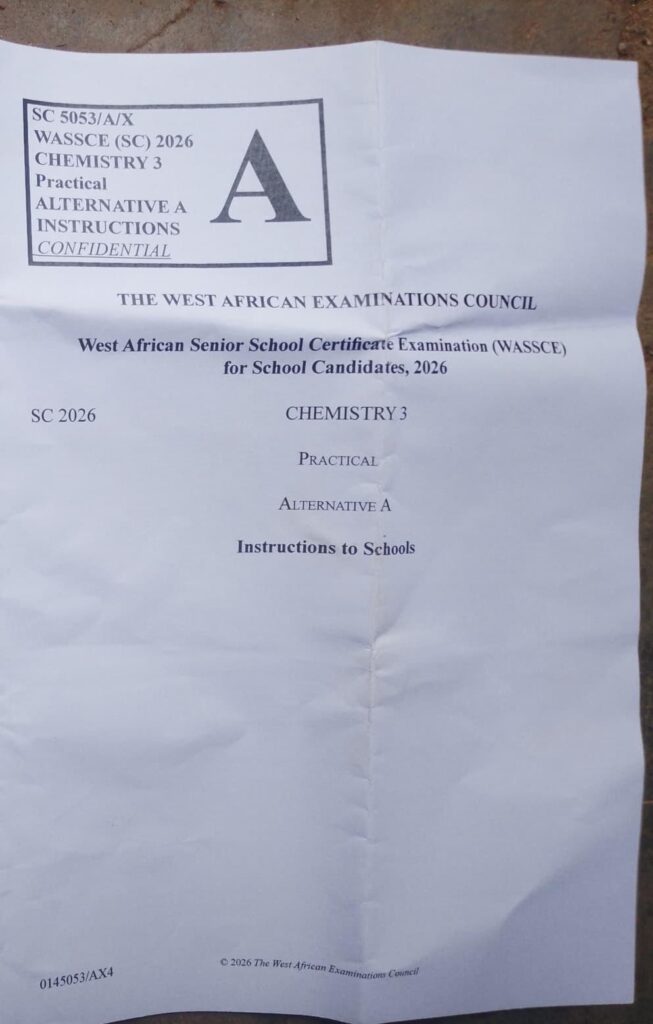
    CHEMISTRY PRACTICAL SPECIMEN 2026

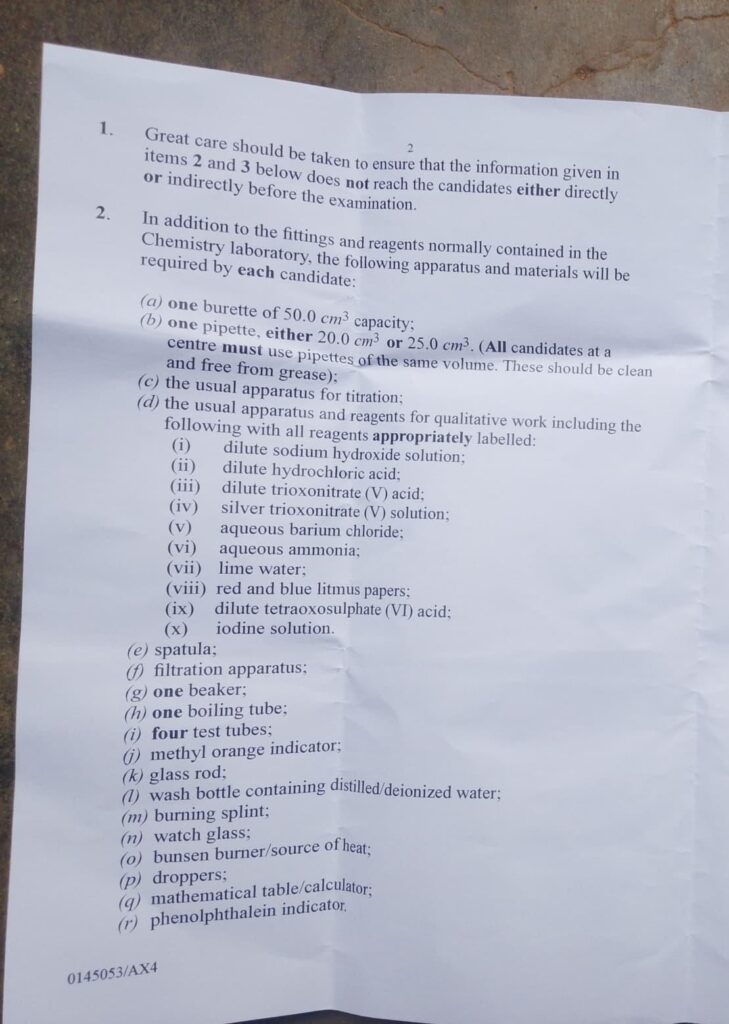
    (1) Great care should be taken to ensure that the information given in items 2 and 3 below does not reach the candidates either directly or indirectly before the examination.

    (2) In addition to the fittings and reagents normally contained in a Chemistry laboratory, the following apparatus and materials will be required by each candidate:

    (a) one burette of 50.0 cm³ capacity;

    (b) one pipette, either 20.0 cm³ or 25.0 cm³. (All candidates at one centre must use pipettes of the same volume. These should be clean and free from grease);

    (c) the usual apparatus for titration;

    (d) the usual apparatus and reagents for qualitative work including the following with all reagents appropriately labelled:

    (i) dilute sodium hydroxide solution

    (ii) dilute hydrochloric acid

    (iii) dilute trioxonitrate (V) acid

    (iv) silver trioxonitrate (V) solution

    (v) aqueous barium chloride

    (vi) aqueous ammonia

    (vii) lime water

    (viii) red and blue litmus papers

    (ix) dilute tetraoxosulphate (VI) acid

    (x) Fehlings solution A & B

    (e) spatula

    (f) filtration apparatus;

    (g) one beaker:

    (h) one boiling tube;

    (i) four test tubes:

    (j) methyl orange indicator;

    (k) glass rod;

    (l) wash bottle containing distilled/deionized water:

    (m) burning splint:

    (n) watch glass:

    (o) bunsen burner/source of heat;

    (p) droppers

    (q) mathematical table/calculator;

    (r) phenolphthalein indicator.

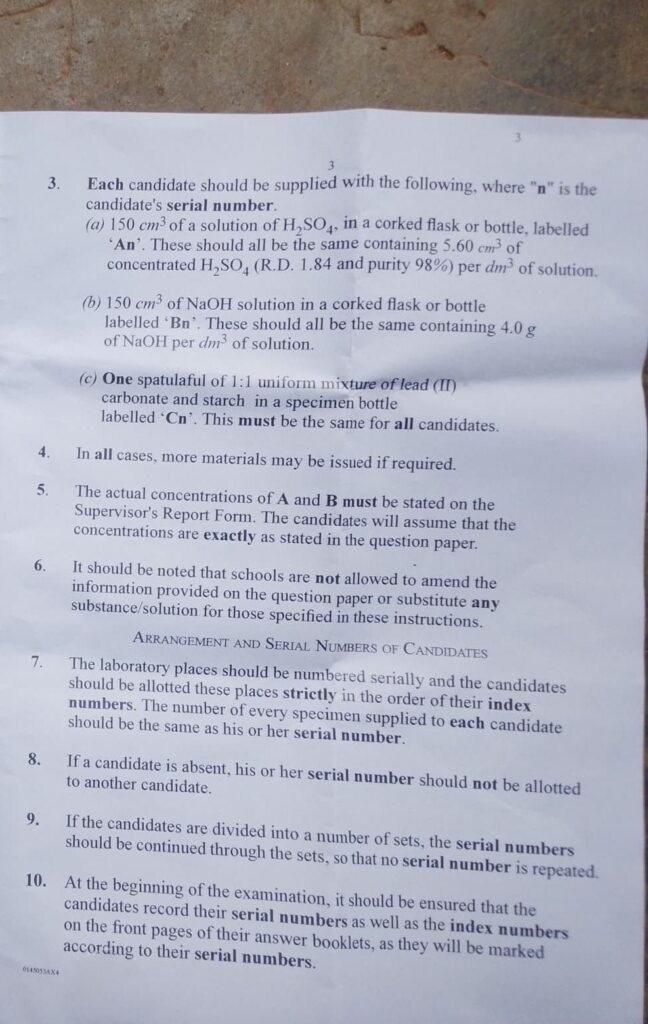
    (3) Each candidate should be supplied with the following, where n is the candidate’s serial number.

    (a) 150 cm³ of a solution of HCl, in a corked flask or bottle, labelled An’. These should all be the same containing 8.6 cm³ of concentrated HCI per dm³ of solution.

    (b) 150 cm³ of NaHCO, solution in a corked flask or bottle labelled ’Bn’. These should all be the same containing 8.0 g of NaHCO3 per dm³ of solution.

    (c) One spatulaful of 1:1 uniform mixture of copper (II) tetraoxosulphate (VI) and glucose in a specimen bottle labelled ’Cn’. This must be the same for all candidates

    PHYSICS PRACTICAL SPECIMEN 2026/2027

    Question 1:

    (1) Three retort stands with clamps

    (2) G-clamp

    (3) A spiral spring

    (4) Two 100 cm – rulers

    (5) 100g mass labelled m

    (6) Two pieces of thread with loops.

    (7) Stop watch.

    (8) An optical pin.

    (9) Sellotape.

    Question 2:

    (1) Rectangular prism.

    (2) A plane mirror.

    (3) Four Optical pins.

    (4) Thumb pins.

    (5) Drawing board.

    (6) Drawing paper.

    Question 3:

    (1) One potentiometer.

    (2) Rheostat.

    (3) Two cells (1.5V each).

    (4) A voltmeter (0.2V).

    (5) An ammeter (0.1A).

    (6) A jockey.

    (7) A key.

    (8) One standard resistor labelled Rx (Rx = 1 ohm).

    (9) Connecting wires.

    BIOLOGY PRACTICAL SPECIMEN 2026/2027

    Specimen A: Bean weevil

    Specimen B: Bean seeds (with holes)

    Specimen C: Waterleaf plant (whole)

    Specimen D: Quill feather of a domestic fowl

    Specimen E: Pineapple fruit (longitudinal section).

    Specimen F: Orange fruit (transverse section)

    Specimen G: Raw egg of a domestic fowl (freshly procured with shell intact)

    Specimen H: Test tube containing 3 ml of water (placed on a test tube rack)

    Specimen J: Longitudinal section of boiled egg (with shell)

    AGRIC PRACTICAL SPECIMEN 2026

    Specimen A: Ammonium sulphate (labelled)

    Specimen B: Muriate of potash (labelled)

    Specimen C: Cow dung

    Specimen D: Compost (labelled)

    Specimen E: Cutlass

    Specimen F: Spade

    Specimen G: Wheelbarrow

    Specimen H: Yam beetle

    Specimen I: Cowpea weevil

    Specimen J: Centrosema pubescens

    Specimen K: Spear grass

    Specimen L: Gizzard (chicken)

    Specimen M: Goat skin (fresh, with hairs intact)

    Specimen N: Horn

    ANIMAL HUSBANDRY PRACTICAL SPECIMEN 2026

    SPECIMEN A: Wood shavings

    SPECIMEN B: Beef

    SPECIMEN C: Leather

    SPECIMEN D: Crop with its content (Poultry)

    SPECIMEN E: Fresh liver (From ruminant)

    SPECIMEN F: Hoof

    SPECIMEN G: Weighing scale

    SPECIMEN H: Egg candler

    SPECIMEN J: Thermometer

    SPECIMEN K: Hypodermic syringe

    SPECIMEN L: Cheese

    SPECIMEN M: Milk (labelled)

    SPECIMEN N: Horn

    SPECIMEN P: Fresh Leucaena leucocephala

    FISHERIES PRACTICAL SPECIMEN 2026

    Specimen A: Thermometer

    Specimen B: Aerator

    Specimen C: Pelleted feed

    Specimen D: Syphoning tube

    Specimen E: Hand gloves

    Specimen F: Knife

    Specimen G: Common salt

    Specimen H: Polyethene

    Specimen J: Fish oil

    Specimen K: Fish scale

    Specimen L: Fish bone

    Specimen M: Fish egg

    Specimen N: Smoked sardinella

    Specimen P: Salted dried fish

    Specimen Q: Fermented catfish

    More Loading…

    Recent Posts

  • WAEC Timetable 2026/2027-May June for Science, Art & Commercial Students

    WAEC Timetable 2026/2027-May June for Science, Art & Commercial Students

    The WAEC Timetable 2026 isn’t out yet (it’s currently late 2025), but expect it around March/April 2026; it will detail exams for Science (Physics, Chem, Bio), Art (Govt, Lit, Econ), and Commercial (Accounting, Commerce, Econ) subjects, following a hybrid CBT/Paper format, with updates and the final timetable released on official WAEC portals (waecdirect.org, etc.) and educational sites like Ours.

    If you are preparing for the WAEC 2025/2026 WASSCE? Using the WAEC Timetable 2025/2026 PDF is key for organizing your study schedule, tracking exam dates, and following exam rules. This guide explains how to access, print, and use the timetable effectively, along with useful exam preparation tips to help you succeed.

    WAEC has not released the Timetable for the 2026/2027 exams. it is on rumour that the exams will start on Tuesday, April 30th, 2026, and end on Tuesday, June 25th, 2026, spanning six weeks, just like the previous.

    WAEC Timetable 2026/2027 How To Get it.

    The WAEC Timetable 2026/2027 PDF provides exam dates, times, and subjects, helping candidates:

    • Plan study schedules efficiently
    • Avoid subject clashes
    • Prepare for practical and oral exams
    • Stay informed about morning and afternoon sessions

    Using the timetable helps manage time and ensures no exams are missed

    WAEC Timetable 2026/2027 -How to Use it

    Once you have the WAEC Timetable 2026/2027 PDF, follow these steps:

    • Mark exam dates on a calendar.
    • Check each subject’s exam duration for time management.
    • Confirm morning or afternoon sessions to avoid missing exams.
    • Ensure your subjects are correctly listed.
    • Follow WAEC rules and guidelines.

    Staying organized with the timetable will boost your exam preparation.

    WAEC Examination Guidelines and Rules

    Candidates must strictly follow WAEC examination rules to avoid penalties. Arrive at least 30 minutes early, bring only approved materials (e.g., mathematical sets and scientific calculators), and do not bring phones, smartwatches, or unauthorized items.

    Ensure your name, index number, and signature are written on all answer booklets, and follow invigilators’ instructions at all times. Non-compliance may lead to disqualification or malpractice penalties. Always use the WAEC Timetable 2026/2027 PDF as your guide.

    WAEC Timetable 2026/2027

    DatePaper CodeSubject PaperDurationTime (GMT)
    Tuesday, 7th April, 2026 to Monday, 27th April, 2026SC7073Basketry 3 (Project Work)*6 hours a day for 5 days for each paperDate and time for each paper will be arranged by the Council.
    Tuesday, 7th April, 2026 to Monday, 27th April, 2026SC7083Ceramics 3 (Project Work)*6 hours a day for 5 days for each paperDate and time for each paper will be arranged by the Council.
    Tuesday, 7th April, 2026 to Monday, 27th April, 2026SC7113Jewellery 3 (Project Work)*6 hours a day for 5 days for each paperDate and time for each paper will be arranged by the Council.
    Tuesday, 7th April, 2026 to Monday, 27th April, 2026SC7123Leatherwork 3 (Project Work)*6 hours a day for 5 days for each paperDate and time for each paper will be arranged by the Council.
    Tuesday, 7th April, 2026 to Monday, 27th April, 2026SC7133Picture Making 3 (Project Work)*6 hours a day for 5 days for each paperDate and time for each paper will be arranged by the Council.
    Tuesday, 7th April, 2026 to Monday, 27th April, 2026SC7143Sculpture 3 (Project Work)*6 hours a day for 5 days for each paperDate and time for each paper will be arranged by the Council.
    Tuesday, 7th April, 2026 to Monday, 27th April, 2026SC7153Textiles 3 (Project Work)*6 hours a day for 5 days for each paperDate and time for each paper will be arranged by the Council.
    Tuesday, 7th April, 2026 to Monday, 27th April, 2026SC7103Graphic Design 3 (Project Work)*/****6 hours a day for 5 days for each paperDate and time for each paper will be arranged by the Council.
    Tuesday, 7th April, 2026 to Monday, 27th April, 2026SC8143Art and Design – Studio 3 (Project Work)*6hrsDate and time for each paper will be arranged by the Council.
    Tuesday, 7th April, 2026 to Monday, 27th April, 2026SC8113Applied Technology II (Building Construction and Wood Technology 3) (Practical)*6hrsDate and time for each paper will be arranged by the Council.
    Tuesday, 7th April, 2026 to Monday, 27th April, 2026SC8103Applied Technology I (Automotive & Metal Technology) 3 (Practical)*6hrsDate and time for each paper will be arranged by the Council.
    Tuesday, 7th April, 2026 to Monday, 27th April, 2026SC4303Dagaare 3 (Oral)*20minsDate and time for each paper will be arranged by the Council.
    Tuesday, 7th April, 2026 to Monday, 27th April, 2026SC4313Dagbani 3 (Oral)*20minsDate and time for each paper will be arranged by the Council.
    Tuesday, 7th April, 2026 to Monday, 27th April, 2026SC4323Dangme 3 (Oral)*20minsDate and time for each paper will be arranged by the Council.
    Tuesday, 7th April, 2026 to Monday, 27th April, 2026SC4333Ewe 3 (Oral)*20minsDate and time for each paper will be arranged by the Council.
    Tuesday, 7th April, 2026 to Monday, 27th April, 2026SC4343Fante 3 (Oral)*20minsDate and time for each paper will be arranged by the Council.
    Tuesday, 7th April, 2026 to Monday, 27th April, 2026SC4353Ga 3 (Oral)*20minsDate and time for each paper will be arranged by the Council.
    Tuesday, 7th April, 2026 to Monday, 27th April, 2026SC4363Gonja 3 (Oral)*20minsDate and time for each paper will be arranged by the Council.
    Tuesday, 7th April, 2026 to Monday, 27th April, 2026SC4373Kasem 3 (Oral)*20minsDate and time for each paper will be arranged by the Council.
    Tuesday, 7th April, 2026 to Monday, 27th April, 2026SC4383Nzema 3 (Oral)*20minsDate and time for each paper will be arranged by the Council.
    Tuesday, 7th April, 2026 to Monday, 27th April, 2026SC4393Twi (Akuapem) 3 (Oral)*20minsDate and time for each paper will be arranged by the Council.
    Tuesday, 7th April, 2026 to Monday, 27th April, 2026SC4403Twi (Asante) 3 (Oral)*20minsDate and time for each paper will be arranged by the Council.
    Tuesday, 7th April, 2026 to Monday, 27th April, 2026SC2283Performing Arts 3 (Performance)*15minsDate and time for each paper will be arranged by the Council.
    Tuesday, 7th April, 2026 to Monday, 27th April, 2026SC8083Manufacturing Engineering 3 (Project)*6hrsDate and time for each paper will be arranged by the Council.
    Tuesday, 7th April, 2026 to Monday, 27th April, 2026SC8153Aviation and Aerospace Engineering 3 (Project)*6hrsDate and time for each paper will be arranged by the Council.
    Tuesday, 7th April, 2026 to Monday, 27th April, 2026SC8073Engineering 3 (Project)*4hrsDate and time for each paper will be arranged by the Council.
    Tuesday, 21st April, 2026SC7023Foods and Nutrition 3 (Practical) Planning Session1hr08:30 hrs. – 09:30 hrs.
    Tuesday, 21st April, 2026SC8213Foods and Nutrition 3 (Practical) – Planning Session *1hr08:30 hrs. – 09:30 hrs.
    Tuesday, 21st April, 2026SC7023Foods and Nutrition 3 (Practical) – Planning Session*1hr08:30 hrs. – 09:30 hrs.
    Tuesday, 21st April, 2026SC7033Home Management 3 (Practical) Planning Session1hr10:00 hrs. – 11:00 hrs.
    Tuesday, 21st April, 2026SC8033Robotics 3 (Practical)*2hrs13:00 hrs. – 15:00 hrs.
    Friday, 24th April, 2026SC5383Agriculture 3 (Practical)*2hrs08:30 hrs. – 10:30 hrs.
    Friday, 24th April, 2026SC1071Typewriting*2hrs 40mins08:30 hrs. – 11:10 hrs. (1st Set)
    Friday, 24th April, 2026SC1071Typewriting*2hrs 40mins11:30 hrs. – 14:10 hrs. (2nd Set)
    Friday, 24th April, 2026SC2152West African Traditional Religion 2 (Essay)*2hrs 10mins08:30 hrs. – 10:40 hrs.
    Friday, 24th April, 2026SC2151West African Traditional Religion 1 (Objective)*50mins10:40 hrs. – 11:30 hrs.
    Friday, 24th April, 2026SC5413Biomedical Science 3 (Practical)*2hrs08:30 hrs. – 10:30 hrs.
    Friday, 24th April, 2026SC7092General Knowledge in Art 2 (Essay)*1hr 30mins14:00 hrs. – 15:30 hrs.
    Friday, 24th April, 2026SC7091General Knowledge in Art 1 (Objective)*50mins15:30 hrs. – 16:20 hrs.
    Friday, 24th April, 2026SC8092Design and Communication Technology 2 (Essay)*2hrs 30mins14:00 hrs. – 16:30 hrs.
    Friday, 24th April, 2026SC8091Design and Communication Technology 1 (Objective)*1hr16:30 hrs. – 17:30 hrs.
    Monday, 27th April, 2026 to Friday, 8th May, 2026SC3013Arabic 3 (Oral)15minsDate and time for each paper will be arranged by the Council.
    Monday, 27th April, 2026 to Friday, 8th May, 2026SC8063Arabic 3 (Oral)*15minsDate and time for each paper will be arranged by the Council.
    Monday, 27th April, 2026 to Friday, 8th May, 2026SC3043French 3 (Oral)40minsDate and time for each paper will be arranged by the Council.
    Monday, 27th April, 2026 to Friday, 8th May, 2026SC4233French 3 (Oral)*15minsDate and time for each paper will be arranged by the Council.
    Monday, 27th April, 2026 to Friday, 8th May, 2026SC4413Spanish 3 (Oral)*20minsDate and time for each paper will be arranged by the Council.
    Monday, 27th April, 2026SC7102Graphic Design 2 (Essay)****2hrs08:30 hrs. – 10:30 hrs.
    Monday, 27th April, 2026SC7101Graphic Design 1 (Objective)****50mins10:30 hrs. – 11:20 hrs.
    Monday, 27th April, 2026SC7102Graphic Design 2 (Essay)*2hrs08:30 hrs. – 10:30 hrs.
    Monday, 27th April, 2026SC7101Graphic Design 1 (Objective)*50mins10:30 hrs. – 11:20 hrs.
    Monday, 27th April, 2026SC5153Fisheries (Alternative A) 3 (Practical)******2hrs08:30 hrs. – 10:30 hrs. (1st Set)
    Monday, 27th April, 2026SC5153Fisheries (Alternative A) 3 (Practical)******2hrs10:30 hrs. – 12:30 hrs. (2nd Set)
    Monday, 27th April, 2026SC5153Fisheries (Alternative A) 3 (Practical)*2hrs08:30 hrs. – 10:30 hrs. (1st Set)
    Monday, 27th April, 2026SC5153Fisheries (Alternative A) 3 (Practical)*2hrs11:00 hrs. – 13:00 hrs. (2nd Set)
    Tuesday, 28th April, 2026SC8093Design and Communication Technology 3 (Practical)*3hrs08:30 hrs. – 11:30 hrs.
    Tuesday, 28th April, 2026SC7094General Knowledge in Art 3B (Lettering and Design)*3hrs08:30 hrs. – 11:30 hrs.
    Tuesday, 28th April, 2026SC8142Art and Design – Studio 2 (Essay)*2hrs13:00 hrs. – 15:00 hrs.
    Tuesday, 28th April, 2026SC8141Art and Design – Studio 1 (Objective)*50mins15:00 hrs. – 15:50 hrs.
    Wednesday, 29th April, 2026SC6232Information and Communication Technology (Elective) 2 (Essay)******2hrs08:30 hrs. – 10:30 hrs.
    Wednesday, 29th April, 2026SC6231Information and Communication Technology (Elective) 1 (Objective)******1hr10:30 hrs. – 11:30 hrs.
    Wednesday, 29th April, 2026SC8162Information and Communication Technology 2 (Essay)*1hr08:30 hrs. – 09:30 hrs.
    Wednesday, 29th April, 2026SC8161Information and Communication Technology 1 (Objective)*1hr09:30 hrs. – 10:30 hrs.
    Wednesday, 29th April, 2026SC5142Crop Husbandry and Horticulture 2 (Essay)****/******2hrs13:00 hrs. – 15:00 hrs.
    Wednesday, 29th April, 2026SC5141Crop Husbandry and Horticulture 1 (Objective)****/******1hr15:00 hrs. – 16:00 hrs.
    Wednesday, 29th April, 2026SC5142Crop Husbandry and Horticulture 2 (Essay)*2hrs13:00 hrs. – 15:00 hrs.
    Wednesday, 29th April, 2026SC5141Crop Husbandry and Horticulture 1 (Objective)*1hr15:00 hrs. – 16:00 hrs.
    Thursday, 30th April, 2026SC5152Fisheries (Alternative A) 2 (Essay)******2hrs08:30 hrs. – 10:30 hrs.
    Thursday, 30th April, 2026SC5151Fisheries (Alternative A) 1 (Objective)******1hr10:30 hrs. – 11:30 hrs.
    Thursday, 30th April, 2026SC5152Fisheries (Alternative A) 2 (Essay)*2hrs08:30 hrs. – 10:30 hrs.
    Thursday, 30th April, 2026SC5151Fisheries (Alternative A) 1 (Objective)*1hr10:30 hrs. – 11:30 hrs.
    Thursday, 30th April, 2026SC8122Applied Technology III (Electrical & Electronic Technology) 2 (Essay)*2hrs08:30 hrs. – 10:30 hrs.
    Thursday, 30th April, 2026SC8121Applied Technology III (Electrical & Electronic Technology) 1 (Objective)*1hr10:30 hrs. – 11:30 hrs.
    Thursday, 30th April, 2026SC8052Computer Science 2 (Essay)*1hr 30mins13:00 hrs. – 14:30 hrs.
    Thursday, 30th April, 2026SC8051Computer Science 1 (Objective)*1hr14:30 hrs. – 15:30 hrs.
    Thursday, 30th April, 2026SC6092Woodwork 2 (Essay and Design)***2hrs 20mins13:00 hrs. – 15:20 hrs.
    Thursday, 30th April, 2026SC6091Woodwork 1 (Objective)***40mins15:20 hrs. – 16:00 hrs.
    Thursday, 30th April, 2026SC6092Woodwork 2 (Essay and Design)*2hrs 20mins13:00 hrs. – 15:20 hrs.
    Thursday, 30th April, 2026SC6091Woodwork 1 (Objective)*40mins15:20 hrs. – 16:00 hrs.
    DatePaper CodeSubject PaperDurationTime (GMT)
    Friday, 1st May, 2026PUBLIC HOLIDAY (WORKERS’ DAY)
    Monday, 4th May, 2026SC5372Agricultural Science 2 (Essay)*1hr 30mins08:30 hrs. – 10:00 hrs.
    Monday, 4th May, 2026SC5371Agricultural Science 1 (Objective)*1hr10:00 hrs. – 11:00 hrs.
    Monday, 4th May, 2026SC6013Applied Electricity 3 (Practical)3hrs08:30 hrs. – 11:30 hrs. (1st Set)
    Monday, 4th May, 2026SC6013Applied Electricity 3 (Practical)3hrs12:00 hrs. – 15:00 hrs. (2nd Set)
    Monday, 4th May, 2026SC6013Applied Electricity 3 (Practical)*3hrs08:30 hrs. – 11:30 hrs. (1st Set)
    Monday, 4th May, 2026SC6013Applied Electricity 3 (Practical)*3hrs12:00 hrs. – 15:00 hrs. (2nd Set)
    Monday, 4th May, 2026SC6143Basic Electricity 3 (Practical) ****3hrs08:30 hrs. – 11:30 hrs. (1st Set)
    Monday, 4th May, 2026SC6143Basic Electricity 3 (Practical) ****3hrs12:00 hrs. – 15:00 hrs. (2nd Set)
    Monday, 4th May, 2026SC7012Clothing and Textiles 2 (Essay)1hr 30mins13:00 hrs. – 14:30 hrs.
    Monday, 4th May, 2026SC7011Clothing and Textiles 1 (Objective)1hr14:30 hrs. – 15:30 hrs.
    Monday, 4th May, 2026SC8202Clothing and Textiles 2 (Essay)*2hrs13:00 hrs. – 15:00 hrs.
    Monday, 4th May, 2026SC8201Clothing and Textiles 1 (Objective)*50mins15:00 hrs. – 15:50 hrs.
    Monday, 4th May, 2026SC6032Auto Mechanics 2 (Essay)1hr 30mins13:00 hrs. – 14:30 hrs.
    Monday, 4th May, 2026SC6031Auto Mechanics 1 (Objective)1hr14:30 hrs. – 15:30 hrs.
    Monday, 4th May, 2026SC6032Auto Mechanics 2 (Essay)*1hr 30mins13:00 hrs. – 14:30 hrs.
    Monday, 4th May, 2026SC6031Auto Mechanics 1 (Objective)*1hr14:30 hrs. – 15:30 hrs.
    Tuesday, 5th May, 2026SC8102Applied Technology I (Automotive & Metal Technology) 2 (Essay)*2hrs08:30 hrs. – 10:30 hrs.
    Tuesday, 5th May, 2026SC8101Applied Technology I (Automotive & Metal Technology) 1 (Objective)*50mins10:30 hrs. – 11:20 hrs.
    Tuesday, 5th May, 2026SC6012Applied Electricity 2 (Essay)1hr13:00 hrs. – 14:00 hrs.
    Tuesday, 5th May, 2026SC6011Applied Electricity 1 (Objective)1hr14:00 hrs. – 15:00 hrs.
    Tuesday, 5th May, 2026SC6142Basic Electricity 2 (Essay) ****1hr13:00 hrs. – 14:00 hrs.
    Tuesday, 5th May, 2026SC6141Basic Electricity 1 (Objective) ****1hr14:00 hrs. – 15:00 hrs.
    Wednesday, 6th May, 2026SC6202Furniture Making 2 (Essay)****2hrs08:30 hrs. – 10:30 hrs.
    Wednesday, 6th May, 2026SC6201Furniture Making 1 (Objective)****45mins10:30 hrs. – 11:15 hrs.
    Wednesday, 6th May, 2026SC6073Metalwork 3 (Practical)3hrs 10mins08:30 hrs. – 11:40 hrs. (1st Set)
    Wednesday, 6th May, 2026SC6073Metalwork 3 (Practical)3hrs 10mins12:00 hrs. – 15:10 hrs. (2nd Set)
    Thursday, 7th May, 2026SC7042Management-In-Living 2 (Essay)***2hrs08:30 hrs. – 10:30 hrs.
    Thursday, 7th May, 2026SC7041Management-In-Living 1 (Objective)***1hr10:30 hrs. – 11:30 hrs.
    Thursday, 7th May, 2026SC7232Management-in-Living 2 (Essay)*2hrs08:30 hrs. – 10:30 hrs.
    Thursday, 7th May, 2026SC7231Management-in-Living 1 (Objective)*50mins10:30 hrs. – 11:20 hrs.
    Thursday, 7th May, 2026SC6052Electronics 2 (Essay)1hr08:30 hrs. – 09:30 hrs.
    Thursday, 7th May, 2026SC6051Electronics 1 (Objective)1hr09:30 hrs. – 10:30 hrs.
    Thursday, 7th May, 2026SC6163Block Laying, Bricklaying and Concrete Works 3 (Practical)****3hrs08:30 hrs. – 11:30 hrs. (1st Set)
    Thursday, 7th May, 2026SC6163Block Laying, Bricklaying and Concrete Works 3 (Practical)****3hrs12:00 hrs. – 15:00 hrs. (2nd Set)
    Thursday, 7th May, 2026SC7043Management-In-Living 3 (Test of Practical Work) ***1hr13:00 hrs. – 14:00 hrs.
    Thursday, 7th May, 2026SC7233Management-in-Living 3 (Test of Practical Work)*1hr13:00 hrs. – 14:00 hrs.
    Friday, 8th May, 2026SC1052Principles of Cost Accounting 2 (Essay)2hrs08:30 hrs. – 10:30 hrs.
    Friday, 8th May, 2026SC1051Principles of Cost Accounting 1 (Objective)1hr10:30 hrs. – 11:30 hrs.
    Friday, 8th May, 2026SC8022Business Studies – Accounting 2 (Essay)*2hrs08:30 hrs. – 10:30 hrs.
    Friday, 8th May, 2026SC8021Business Studies – Accounting 1 (Objective)*1hr10:30 hrs. – 11:30 hrs.
    Friday, 8th May, 2026SC6162Block Laying, Bricklaying and Concrete Works 2 (Essay)****1hr14:30 hrs. – 15:30 hrs.
    Friday, 8th May, 2026SC6161Block Laying, Bricklaying and Concrete Works 1 (Objective)****45mins15:30 hrs. – 16:15 hrs.
    Monday, 11th May, 2026SC8112Applied Technology II (Building Construction and Wood Technology) 2 (Essay)*2hrs08:30 hrs. – 10:30 hrs.
    Monday, 11th May, 2026SC8111Applied Technology II (Building Construction and Wood Technology) 1 (Objective)*1hr10:30 hrs. – 11:30 hrs.
    Monday, 11th May, 2026SC6053Electronics 3 (Practical)3hrs08:30 hrs. – 11:30 hrs. (1st Set)
    Monday, 11th May, 2026SC6053Electronics 3 (Practical)3hrs12:00 hrs. – 15:00 hrs. (2nd Set)
    Monday, 11th May, 2026SC6173Carpentry and Joinery 3 (Practical)****2hrs08:30 hrs. – 10:30 hrs. (1st Set)
    Monday, 11th May, 2026SC6173Carpentry and Joinery 3 (Practical)****2hrs11:00 hrs. – 13:00 hrs. (2nd Set)
    Monday, 11th May, 2026SC6043Building Construction 3 (Building Drawing and Essay)*****2hrs 30mins13:00 hrs. – 15:30 hrs.
    Monday, 11th May, 2026SC8132Art and Design – Foundation 2 (Essay)*1hr 30mins13:00 hrs. – 14:30 hrs.
    Monday, 11th May, 2026SC8131Art and Design – Foundation 1 (Objective)*50mins14:30 hrs. – 15:20 hrs.
    Tuesday, 12th May, 2026SC3272Hausa 2 (Essay)**2hrs08:30 hrs. – 10:30 hrs.
    Tuesday, 12th May, 2026SC3271Hausa 1 (Objective)**1hr10:30 hrs. – 11:30 hrs.
    Tuesday, 12th May, 2026SC3292Yoruba 2 (Essay)**2hrs08:30 hrs. – 10:30 hrs.
    Tuesday, 12th May, 2026SC3291Yoruba 1 (Objective)**1hr10:30 hrs. – 11:30 hrs.
    Tuesday, 12th May, 2026SC3282Igbo 2 (Essay)**2hrs08:30 hrs. – 10:30 hrs.
    Tuesday, 12th May, 2026SC3281Igbo 1 (Objective)**1hr10:30 hrs. – 11:30 hrs.
    Tuesday, 12th May, 2026SC5143Crop Husbandry and Horticulture 3 (Practical)****/******2hrs08:30 hrs. – 10:30 hrs. (1st Set)
    Tuesday, 12th May, 2026SC5143Crop Husbandry and Horticulture 3 (Practical)****/******2hrs11:00 hrs. – 13:00 hrs. (2nd Set)
    Wednesday, 13th May, 2026SC7192Garment Making 2 (Essay)****45mins08:30 hrs. – 09:15 hrs.
    Wednesday, 13th May, 2026SC7191Garment Making 1 (Objective)****40mins09:15 hrs. – 09:55 hrs.
    Wednesday, 13th May, 2026SC3023/AEnglish Language 3 (Oral)***45mins08:30 hrs. – 09:15 hrs. (1st Set)
    Wednesday, 13th May, 2026SC3023/AEnglish Language 3 (Oral)***45mins09:20 hrs. – 10:05 hrs. (2nd Set)
    Wednesday, 13th May, 2026SC4223/AEnglish Language 3 (Oral)*45mins08:30 hrs. – 09:15 hrs. (1st Set)
    Wednesday, 13th May, 2026SC4223/AEnglish Language 3 (Oral)*45mins09:40 hrs. – 10:25 hrs. (2nd Set)
    Wednesday, 13th May, 2026SC7032Home Management 2 (Essay)1hr13:00 hrs. – 14:00 hrs.
    Wednesday, 13th May, 2026SC7031Home Management 1 (Objective)1hr14:00 hrs. – 15:00 hrs.
    Thursday, 14th May, 2026SC4412Spanish 2 (Essay)*1hr 30mins08:30 hrs. – 10:00 hrs.
    Thursday, 14th May, 2026SC4411Spanish 1 (Objective)*1hr10:00 hrs. – 11:00 hrs.
    Thursday, 14th May, 2026SC1112Insurance 2 (Essay) ******2hrs08:30 hrs. – 10:30 hrs.
    Thursday, 14th May, 2026SC1111Insurance 1 (Objective) ******50mins10:30 hrs. – 11:20 hrs.
    Thursday, 14th May, 2026SC6093Woodwork 3 (Practical)***3hrs08:30 hrs. – 11:30 hrs. (1st Set)
    Thursday, 14th May, 2026SC6093Woodwork 3 (Practical)***3hrs12:00 hrs. – 15:00 hrs. (2nd Set)
    Thursday, 14th May, 2026SC5382Agriculture 2 (Essay)*2hrs13:00 hrs. – 15:00 hrs.
    Thursday, 14th May, 2026SC5381Agriculture 1 (Objective)*1hr15:00 hrs. – 16:00 hrs.
    Friday, 15th May, 2026SC7022Foods and Nutrition 2 (Essay)1hr 15mins08:30 hrs. – 09:45 hrs.
    Friday, 15th May, 2026SC7021Foods and Nutrition 1 (Objective)1hr09:45 hrs. – 10:45 hrs.
    Friday, 15th May, 2026SC8212Foods and Nutrition 2 (Essay)*2hrs08:30 hrs. – 10:30 hrs.
    Friday, 15th May, 2026SC8211Foods and Nutrition 1 (Objective)*50mins10:30 hrs. – 11:20 hrs.
    Friday, 15th May, 2026SC6122Auto Electrical Works 2 (Essay)****1hr14:30 hrs. – 15:30 hrs.
    Friday, 15th May, 2026SC6121Auto Electrical Works 1 (Objective)****45mins15:30 hrs. – 16:15 hrs.
    Friday, 15th May, 2026SC3042French 2 (Essay)1hr 15mins14:30 hrs. – 15:45 hrs.
    Friday, 15th May, 2026SC3041French 1 (Objective)1hr15:45 hrs. – 16:45 hrs.
    Monday, 18th May, 2026SC8133Art and Design – Foundation 3 (Practical)*3hrs08:30 hrs. – 11:30 hrs.
    Monday, 18th May, 2026SC6203Furniture Making 3 (Practical)****3hrs08:30 hrs. – 11:30 hrs. (1st Set)
    Monday, 18th May, 2026SC6203Furniture Making 3 (Practical)****3hrs12:00 hrs. – 15:00 hrs. (2nd Set)
    Monday, 18th May, 2026SC6082Technical Drawing 2 (Essay)1hr 45mins08:30 hrs. – 10:15 hrs.
    Monday, 18th May, 2026SC6081Technical Drawing 1 (Objective)1hr10:15 hrs. – 11:15 hrs.
    Monday, 18th May, 2026SC7052Music 2 (Essay)2hrs13:00 hrs. – 15:00 hrs.
    Monday, 18th May, 2026SC7051Music 1 (Objective)1hr15:00 hrs. – 16:00 hrs.
    Monday, 18th May, 2026SC5112Physical Education 2 (Essay)1hr 20mins13:00 hrs. – 14:20 hrs.
    Monday, 18th May, 2026SC5111Physical Education 1 (Objective)50mins14:20 hrs. – 15:10 hrs.
    DatePaper CodeSubject PaperDurationTime (GMT)
    Tuesday, 19th May, 2026SC5132Animal Husbandry (Alternative A) 2 (Essay)****/******2hrs08:30 hrs. – 10:30 hrs.
    Tuesday, 19th May, 2026SC5131Animal Husbandry (Alternative A) 1 (Objective)****/******1hr10:30 hrs. – 11:30 hrs.
    Tuesday, 19th May, 2026SC5132Animal Husbandry (Alternative A) 2 (Essay)*2hrs08:30 hrs. – 10:30 hrs.
    Tuesday, 19th May, 2026SC5131Animal Husbandry (Alternative A) 1 (Objective)*1hr10:30 hrs. – 11:30 hrs.
    Tuesday, 19th May, 2026SC8123Applied Technology III (Electrical & Electronic Technology) 3 (Practical)*3hrs08:30 hrs. – 11:30 hrs.
    Tuesday, 19th May, 2026SC5182Livestock Farming 2 (Essay)**2hrs08:30 hrs. – 10:30 hrs.
    Tuesday, 19th May, 2026SC5181Livestock Farming 1 (Objective)**40mins10:30 hrs. – 11:10 hrs.
    Tuesday, 19th May, 2026SC6083Technical Drawing 3 (Sketches, Building and Mechanical Drawing)2hrs 45mins13:00 hrs. – 15:45 hrs.
    Tuesday, 19th May, 2026SC6083Technical Drawing 3 (Sketches, Building and Mechanical Drawing)*2hrs 45mins13:00 hrs. – 15:45 hrs.
    Tuesday, 19th May, 2026SC1022Clerical Office Duties 2 (Essay)*****2hrs 10mins13:00 hrs. – 15:10 hrs.
    Tuesday, 19th May, 2026SC1021Clerical Office Duties 1 (Objective)*****50mins15:10 hrs. – 16:00 hrs.
    Tuesday, 19th May, 2026SC1022Clerical Office Duties 2 (Essay)*2hrs 10mins13:00 hrs. – 15:10 hrs.
    Tuesday, 19th May, 2026SC1021Clerical Office Duties 1 (Objective)*50mins15:10 hrs. – 16:00 hrs.
    Tuesday, 19th May, 2026SC7132Picture Making 2 (Essay)*2hrs13:00 hrs. – 15:00 hrs.
    Tuesday, 19th May, 2026SC7131Picture Making 1 (Objective)*50mins15:00 hrs. – 15:50 hrs.
    Tuesday, 19th May, 2026SC8032Robotics 2 (Essay)*1hr 40mins13:00 hrs. – 14:40 hrs.
    Tuesday, 19th May, 2026SC8031Robotics 1 (Objective)*50mins14:40 hrs. – 15:30 hrs.
    Wednesday, 20th May, 2026SC5053/AChemistry 3 (Practical) (Alternative A)2hrs08:30 hrs. – 10:30 hrs. (1st Set)
    Wednesday, 20th May, 2026SC5053/AChemistry 3 (Practical) (Alternative A)2hrs11:00 hrs. – 13:00 hrs. (2nd Set)
    Wednesday, 20th May, 2026SC5363/AChemistry 3 (Practical) (Alternative A)*2hrs08:30 hrs. – 10:30 hrs. (1st Set)
    Wednesday, 20th May, 2026SC5363/AChemistry 3 (Practical) (Alternative A)*2hrs11:00 hrs. – 13:00 hrs. (2nd Set)
    Wednesday, 20th May, 2026SC6212Computer Hardware and GSM Repairs 2 (Essay)**1hr 35mins13:00 hrs. – 14:35 hrs.
    Wednesday, 20th May, 2026SC6211Computer Hardware and GSM Repairs 1 (Objective)**45mins14:35 hrs. – 15:20 hrs.
    Wednesday, 20th May, 2026SC6192Solar Photovoltaic Installation and Maintenance 2**2hrs 15 mins13:00 hrs. – 15:15 hrs.
    Wednesday, 20th May, 2026SC6191Solar Photovoltaic Installation and Maintenance 1**45mins15:15 hrs. – 16:00 hrs.
    Wednesday, 20th May, 2026SC7172Beauty & Cosmetology 2 (Essay) **1hr 20mins13:00 hrs. – 14:20 hrs.
    Wednesday, 20th May, 2026SC7171Beauty & Cosmetology 1 (Objective)**40mins14:20 hrs. – 15:00 hrs.
    Wednesday, 20th May, 2026SC1012Business Management 2 (Essay)2hrs13:00 hrs. – 15:00 hrs.
    Wednesday, 20th May, 2026SC1011Business Management 1 (Objective)1hr15:00 hrs. – 16:00 hrs.
    Wednesday, 20th May, 2026SC8012Business Studies – Business Management 2 (Essay)*2hrs13:00 hrs. – 15:00 hrs.
    Wednesday, 20th May, 2026SC8011Business Studies – Business Management 1 (Objective)*1hr15:00 hrs. – 16:00 hrs.
    Wednesday, 20th May, 2026SC7072Basketry 2 (Essay)*2hrs13:00 hrs. – 15:00 hrs.
    Wednesday, 20th May, 2026SC7071Basketry 1 (Objective)*50mins15:00 hrs. – 15:50 hrs.
    Wednesday, 20th May, 2026SC6302Welding and Fabrication Engineering Craft Practice 2 (Essay)****1hr 30mins13:00 hrs. – 14:30 hrs.
    Wednesday, 20th May, 2026SC6301Welding and Fabrication Engineering Craft Practice 1 (Objective)****1hr14:30 hrs. – 15:30 hrs.
    Thursday, 21st May, 2026SC4012Further Mathematics/Mathematics (Elective) 2 (Essay)2hrs 30mins08:30 hrs. – 11:00 hrs.
    Thursday, 21st May, 2026SC4011Further Mathematics/Mathematics (Elective) 1 (Objective)1hr 30mins13:00 hrs. – 14:30 hrs.
    Thursday, 21st May, 2026SC4032Additional Mathematics 2 (Essay)*2hrs08:30 hrs. – 10:30 hrs.
    Thursday, 21st May, 2026SC4031Additional Mathematics 1 (Objective)*1hr13:00 hrs. – 14:00 hrs.
    Thursday, 21st May, 2026SC4012Further Mathematics/Mathematics (Elective) 2 (Essay)*2hrs 30mins08:30 hrs. – 11:00 hrs.
    Thursday, 21st May, 2026SC4011Further Mathematics/Mathematics (Elective) 1 (Objective)*1hr 30mins13:00 hrs. – 14:30 hrs.
    Friday, 22nd May, 2026SC7142Sculpture 2 (Essay)*2hrs08:30 hrs. – 10:30 hrs.
    Friday, 22nd May, 2026SC7141Sculpture 1 (Objective)*50mins10:30 hrs. – 11:20 hrs.
    Friday, 22nd May, 2026SC8053Computer Science 3 (Practical)*2hrs 30mins08:30 hrs. – 11:00 hrs.
    Friday, 22nd May, 2026SC5072General Agriculture 2 (Essay)*2hrs08:30 hrs. – 10:30 hrs.
    Friday, 22nd May, 2026SC5071General Agriculture 1 (Objective)*1hr10:30 hrs. – 11:30 hrs.
    Friday, 22nd May, 2026SC5082Health Education /Health Science 2 (Essay)1hr 30mins08:30 hrs. – 10:00 hrs.
    Friday, 22nd May, 2026SC5081Health Education /Health Science 1 (Objective)1hr10:00 hrs. – 11:00 hrs.
    Friday, 22nd May, 2026SC6033Auto Mechanics 3 (Practical)2hrs08:30 hrs. – 10:30 hrs. (1st Set)
    Friday, 22nd May, 2026SC6033Auto Mechanics 3 (Practical)2hrs11:00 hrs. – 13:00 hrs. (2nd Set)
    Friday, 22nd May, 2026SC6033Auto Mechanics 3 (Practical)*2hrs08:30 hrs. – 10:30 hrs. (1st Set)
    Friday, 22nd May, 2026SC6033Auto Mechanics 3 (Practical)*2hrs11:00 hrs. – 13:00 hrs. (2nd Set)
    Friday, 22nd May, 2026SC5083Health Education /Health Science 3 (Alternative to Practical Work)1hr 45mins14:30 hrs. – 16:15 hrs.
    Friday, 22nd May, 2026SC7063Visual Art 3A (Drawing)3hrs14:30 hrs. – 17:30 hrs.
    Friday, 22nd May, 2026SC5422Physical Education and Health 2 (Essay)*1hr 30mins14:30 hrs. – 16:00 hrs.
    Friday, 22nd May, 2026SC5421Physical Education and Health 1 (Objective)*1hr16:00 hrs. – 17:00 hrs.
    Monday, 25th May, 2026SC5402General Science 2 (Essay)*2hrs08:30 hrs. – 10:30 hrs.
    Monday, 25th May, 2026SC5401General Science 1 (Objective)*1hr 30mins10:30 hrs. – 12:00 hrs.
    Monday, 25th May, 2026SC5172Integrated Science 2 (Essay)*1hr 30mins08:30 hrs. – 10:00 hrs.
    Monday, 25th May, 2026SC5171Integrated Science 1 (Objective)*1hr10:00 hrs. – 11:00 hrs.
    Monday, 25th May, 2026SC5403General Science 3 (Test of Practical work)*1hr 30mins13:00 hrs. – 14:30 hrs.
    Monday, 25th May, 2026SC5173Integrated Science 3 (Alternative to Practical Work)*2hrs13:00 hrs. – 15:00 hrs.
    Tuesday, 26th May, 2026PUBLIC HOLIDAY – EID-AL-ADHA
    Wednesday, 27th May, 2026PUBLIC HOLIDAY – EID-AL-ADHA / CHILDREN’S DAY
    Thursday, 28th May, 2026PUBLIC HOLIDAY – EID-AL-ADHA
    Friday, 29th May, 2026SC3012Arabic 2 (Essay)2hrs08:30 hrs. – 10:30 hrs.
    Friday, 29th May, 2026SC3011Arabic 1 (Objective)50mins10:30 hrs. – 11:20 hrs.
    Friday, 29th May, 2026SC8062Arabic 2 (Essay)*1hr 45mins08:30 hrs. – 10:15 hrs.
    Friday, 29th May, 2026SC8061Arabic 1 (Objective)*1hr 15mins10:15 hrs. – 11:30 hrs.
    Friday, 29th May, 2026SC3012Arabic 2 (Essay)*2hrs08:30 hrs. – 10:30 hrs.
    Friday, 29th May, 2026SC3011Arabic 1 (Objective)*50mins10:30 hrs. – 11:20 hrs.
    Friday, 29th May, 2026SC3012Arabic Language 2 (Essay)*****2hrs08:30 hrs. – 10:30 hrs.
    Friday, 29th May, 2026SC3011Arabic Language 1 (Objective)*****50mins10:30 hrs. – 11:20 hrs.
    Friday, 29th May, 2026SC7112Jewellery 2 (Essay)*2hrs08:30 hrs. – 10:30 hrs.
    Friday, 29th May, 2026SC7111Jewellery 1 (Objective)*50mins10:30 hrs. – 11:20 hrs.
    Friday, 29th May, 2026SC6263Plumbing and Pipe Fitting 3 (Practical)****1hr 30mins08:30 hrs. – 10:00 hrs. (1st Set)
    Friday, 29th May, 2026SC6263Plumbing and Pipe Fitting 3 (Practical)****1hr 30mins10:30 hrs. – 12:00 hrs. (2nd Set)
    Friday, 29th May, 2026SC6072Metalwork 2 (Essay)1hr 30mins08:30 hrs. – 10:00 hrs.
    Friday, 29th May, 2026SC6071Metalwork 1 (Objective)1hr10:00 hrs. – 11:00 hrs.
    Friday, 29th May, 2026SC6072Metalwork 2 (Essay)*1hr 30mins08:30 hrs. – 10:00 hrs.
    Friday, 29th May, 2026SC6071Metalwork 1 (Objective)*1hr10:00 hrs. – 11:00 hrs.
    Friday, 29th May, 2026SC5162Forestry 2 (Essay)******2hrs14:30 hrs. – 16:30 hrs.
    Friday, 29th May, 2026SC5161Forestry 1 (Objective)******1hr16:30 hrs. – 17:30 hrs.
    Friday, 29th May, 2026SC5162Forestry 2 (Essay)*2hrs14:30 hrs. – 16:30 hrs.
    Friday, 29th May, 2026SC5161Forestry 1 (Objective)*1hr16:30 hrs. – 17:30 hrs.
    Friday, 29th May, 2026SC7062Visual Art 2 (Essay)2hrs14:30 hrs. – 16:30 hrs.
    Friday, 29th May, 2026SC7061Visual Art 1 (Objective)50mins16:30 hrs. – 17:20 hrs.
    Monday, 1st June, 2026SC2022Christian Religious Studies 2 (Essay)2hrs08:30 hrs. – 10:30 hrs.
    Monday, 1st June, 2026SC2021Christian Religious Studies 1 (Objective)1hr10:30 hrs. – 11:30 hrs.
    Monday, 1st June, 2026SC4052Christian Religious Studies 2 (Essay)*2hrs 30mins08:30 hrs. – 11:00 hrs.
    Monday, 1st June, 2026SC4051Christian Religious Studies 1 (Objective)*1hr11:00 hrs. – 12:00 hrs.
    Monday, 1st June, 2026SC2022Christian Religious Studies 2 (Essay)*2hrs08:30 hrs. – 10:30 hrs.
    Monday, 1st June, 2026SC2021Christian Religious Studies 1 (Objective)*1hr10:30 hrs. – 11:30 hrs.
    Monday, 1st June, 2026SC2082Islamic Studies 2 (Essay)2hrs08:30 hrs. – 10:30 hrs.
    Monday, 1st June, 2026SC2081Islamic Studies 1 (Objective)50mins10:30 hrs. – 11:20 hrs.
    Monday, 1st June, 2026SC2082Islamic Studies 2 (Essay)*2hrs08:30 hrs. – 10:30 hrs.
    Monday, 1st June, 2026SC2081Islamic Studies 1 (Objective)*50mins10:30 hrs. – 11:20 hrs.
    Monday, 1st June, 2026SC4242Islamic Religious Studies 2*2hrs 30mins08:30 hrs. – 11:00 hrs.
    Monday, 1st June, 2026SC4241Islamic Religious Studies 1*1hr11:00 hrs. – 12:00 hrs.
    Monday, 1st June, 2026SC5122Physics 2 (Essay)1hr 30mins13:00 hrs. – 14:30 hrs.
    Monday, 1st June, 2026SC5121Physics 1 (Objective)1hr 15mins14:30 hrs. – 15:45 hrs.
    Monday, 1st June, 2026SC5392Physics 2 (Essay)*1hr 40mins13:00 hrs. – 14:40 hrs.
    Monday, 1st June, 2026SC5391Physics 1 (Objective)*1hr 15mins14:40 hrs. – 15:55 hrs.
    Monday, 1st June, 2026SC5122Physics 2 (Essay)*1hr 30mins13:00 hrs. – 14:30 hrs.
    Monday, 1st June, 2026SC5121Physics 1 (Objective)*1hr 15mins14:30 hrs. – 15:45 hrs.
    DatePaper CodeSubject PaperDurationTime (GMT)
    Tuesday, 2nd June, 2026SC2262Social Studies 2 (Essay)*2hrs 30mins08:30 hrs. – 11:00 hrs.
    Tuesday, 2nd June, 2026SC2261Social Studies 1 (Objective)*50mins13:00 hrs. – 13:50 hrs.
    Tuesday, 2nd June, 2026SC2142Social Studies 2 (Essay)*3hrs08:30 hrs. – 11:30 hrs.
    Tuesday, 2nd June, 2026SC2141Social Studies 1 (Objective)*50mins13:00 hrs. – 13:50 hrs.
    Tuesday, 2nd June, 2026SC2162Civic Education 2 (Essay) **/******2hrs08:30 hrs. – 10:30 hrs.
    Tuesday, 2nd June, 2026SC2161Civic Education 1 (Objective) **/******1hr10:30 hrs. – 11:30 hrs.
    Tuesday, 2nd June, 2026SC5022Agriculture 2**/Agricultural Science 2*** (Essay)2hrs 10mins13:00 hrs. – 15:10 hrs.
    Tuesday, 2nd June, 2026SC5021Agriculture 1**/Agricultural Science 1*** (Objective)50mins15:10 hrs. – 16:00 hrs.
    Tuesday, 2nd June, 2026SC7162Catering Craft Practice 2 (Essay)****50mins13:00 hrs. – 13:50 hrs.
    Tuesday, 2nd June, 2026SC7161Catering Craft Practice 1 (Objective)****40mins13:50 hrs. – 14:30 hrs.
    Tuesday, 2nd June, 2026SC7162Catering Craft 2 (Essay)**50mins13:00 hrs. – 13:50 hrs.
    Tuesday, 2nd June, 2026SC7161Catering Craft 1 (Objective)**40mins13:50 hrs. – 14:30 hrs.
    Wednesday, 3rd June, 2026SC4022General Mathematics/Mathematics (Core) 2 (Essay)2hrs 30mins08:30 hrs. – 11:00 hrs.
    Wednesday, 3rd June, 2026SC4021General Mathematics/Mathematics (Core) 1 (Objective)1hr 30mins14:00 hrs. – 15:30 hrs.
    Wednesday, 3rd June, 2026SC4042Mathematics 2 (Essay)*2hrs08:30 hrs. – 10:30 hrs.
    Wednesday, 3rd June, 2026SC4041Mathematics 1 (Objective)*1hr 15mins14:00 hrs. – 15:15 hrs.
    Wednesday, 3rd June, 2026SC4022General Mathematics/Mathematics (Core) 2 (Essay)*2hrs 30mins08:30 hrs. – 11:00 hrs.
    Wednesday, 3rd June, 2026SC4021General Mathematics/Mathematics (Core) 1 (Objective)*1hr 30mins14:00 hrs. – 15:30 hrs.
    Thursday, 4th June, 2026SC6042Building Construction 2 (Essay)*****1hr08:30 hrs. – 09:30 hrs.
    Thursday, 4th June, 2026SC6041Building Construction 1 (Objective)*****45mins09:30 hrs. – 10:15 hrs.
    Thursday, 4th June, 2026SC6042Building Construction 2 (Essay)*1hr08:30 hrs. – 09:30 hrs.
    Thursday, 4th June, 2026SC6041Building Construction 1 (Objective)*45mins09:30 hrs. – 10:15 hrs.
    Thursday, 4th June, 2026SC2052Government 2 (Essay)2hrs08:30 hrs. – 10:30 hrs.
    Thursday, 4th June, 2026SC2051Government 1 (Objective)1hr10:30 hrs. – 11:30 hrs.
    Thursday, 4th June, 2026SC2232Government 2 (Essay)*2hrs08:30 hrs. – 10:30 hrs.
    Thursday, 4th June, 2026SC2231Government 1 (Objective)*1hr10:30 hrs. – 11:30 hrs.
    Thursday, 4th June, 2026SC2052Government 2 (Essay)*2hrs08:30 hrs. – 10:30 hrs.
    Thursday, 4th June, 2026SC2051Government 1 (Objective)*1hr10:30 hrs. – 11:30 hrs.
    Thursday, 4th June, 2026SC2052Politics & Governance 2 (Essay)*****2hrs08:30 hrs. – 10:30 hrs.
    Thursday, 4th June, 2026SC2051Politics & Governance 1 (Objective)*****1hr10:30 hrs. – 11:30 hrs.
    Thursday, 4th June, 2026SC7053Music 3A (Aural)45mins13:00 hrs. – 13:45 hrs.
    Thursday, 4th June, 2026SC7053Music 3 (Aural)*45mins13:00 hrs. – 13:45 hrs.
    Thursday, 4th June, 2026SC7193Garment Making 3 (Alternative to Practical Work) ****40mins13:00 hrs. – 13:40 hrs.
    Thursday, 4th June, 2026SC7193Fashion Design & Garment Making 3 (Alternative to Practical Work)**40mins13:00 hrs. – 13:40 hrs.
    Thursday, 4th June, 2026SC5023/AAgriculture 3**/Agricultural Science 3*** (Practical)1hr 30mins13:00 hrs. – 14:30 hrs. (1st Set)
    Thursday, 4th June, 2026SC5023/AAgriculture 3**/Agricultural Science 3*** (Practical)1hr 30mins14:30 hrs. – 16:00 hrs. (2nd Set)
    Thursday, 4th June, 2026SC5073General Agriculture 3 (Practical)*2hrs13:00 hrs. – 15:00 hrs. (1st Set)
    Thursday, 4th June, 2026SC5073General Agriculture 3 (Practical)*2hrs15:00 hrs. – 17:00 hrs. (2nd Set)
    Thursday, 4th June, 2026SC5373Agricultural Science 3 (Practical)*1hr 30mins13:00 hrs. – 14:30 hrs.
    Friday, 5th June, 2026SC2042Geography 2 (Essay)2hrs08:30 hrs. – 10:30 hrs.
    Friday, 5th June, 2026SC2041Geography 1 (Objective)1hr10:30 hrs. – 11:30 hrs.
    Friday, 5th June, 2026SC2222Geography 2 (Essay)*2hrs08:30 hrs. – 10:30 hrs.
    Friday, 5th June, 2026SC2221Geography 1 (Objective)*1hr10:30 hrs. – 11:30 hrs.
    Friday, 5th June, 2026SC2042Geography 2 (Essay)*2hrs08:30 hrs. – 10:30 hrs.
    Friday, 5th June, 2026SC2041Geography 1 (Objective)*1hr10:30 hrs. – 11:30 hrs.
    Friday, 5th June, 2026SC2043Geography 3 (Practical and Physical Geography)1hr 50mins14:30 hrs. – 16:20 hrs.
    Friday, 5th June, 2026SC2223Geography 3 (Practical and Physical Geography)*1hr 50mins14:30 hrs. – 16:20 hrs.
    Friday, 5th June, 2026SC2043Geography 3 (Practical and Physical Geography)*1hr 50mins14:30 hrs. – 16:20 hrs.
    Monday, 8th June, 2026SC6183Digital Technologies 3 (Practical) **2hrs08:30 hrs. – 10:30 hrs. (1st Set)
    Monday, 8th June, 2026SC6183Digital Technologies 3 (Practical) **2hrs11:00 hrs. – 13:00 hrs. (2nd Set)
    Monday, 8th June, 2026SC6233Information and Communication Technology (Elective) 3 (Practical)******2hrs08:30 hrs. – 10:30 hrs. (1st Set)
    Monday, 8th June, 2026SC6233Information and Communication Technology (Elective) 3 (Practical)******2hrs11:00 hrs. – 13:00 hrs. (2nd Set)
    Monday, 8th June, 2026SC8163Information and Communication Technology 3 (Practical)*2hrs08:30 hrs. – 10:30 hrs. (1st Set)
    Monday, 8th June, 2026SC8163Information and Communication Technology 3 (Practical)*2hrs11:00 hrs. – 13:00 hrs. (2nd Set)
    Monday, 8th June, 2026SC6233Information and Communication Technology (Elective) 3 (Practical)*2hrs08:30 hrs. – 10:30 hrs. (1st Set)
    Monday, 8th June, 2026SC6233Information and Communication Technology (Elective) 3 (Practical)*2hrs11:00 hrs. – 13:00 hrs. (2nd Set)
    Monday, 8th June, 2026SC5412Biomedical Science 2 (Essay)*1hr 30mins08:30 hrs. – 10:00 hrs.
    Monday, 8th June, 2026SC5411Biomedical Science 1 (Objective)*1hr10:00 hrs. – 11:00 hrs.
    Monday, 8th June, 2026SC8072Engineering 2 (Essay)*1hr 30mins08:30 hrs. – 10:00 hrs.
    Monday, 8th June, 2026SC8071Engineering 1 (Objective)*50mins10:00 hrs. – 10:50 hrs.
    Monday, 8th June, 2026SC8082Manufacturing Engineering 2 (Essay)*1hr 30mins08:30 hrs. – 10:00 hrs.
    Monday, 8th June, 2026SC8081Manufacturing Engineering 1 (Objective)*1hr10:00 hrs. – 11:00 hrs.
    Monday, 8th June, 2026SC8152Aviation and Aerospace Engineering 2 (Essay)*1hr 10mins08:30 hrs. – 09:40 hrs.
    Monday, 8th June, 2026SC8151Aviation and Aerospace Engineering 1 (Objective)*50mins09:40 hrs. – 10:30 hrs.
    Monday, 8th June, 2026SC6062Engineering Science 2 (Essay)*****1hr 45mins08:30 hrs. – 10:15 hrs.
    Monday, 8th June, 2026SC6061Engineering Science 1 (Objective)*****1hr 15mins10:15 hrs. – 11:30 hrs.
    Monday, 8th June, 2026SC6172Carpentry and Joinery 2 (Essay)****1hr 30mins13:00 hrs. – 14:30 hrs.
    Monday, 8th June, 2026SC6171Carpentry and Joinery 1 (Objective)****45mins14:30 hrs. – 15:15 hrs.
    Monday, 8th June, 2026SC7064Visual Art 3B (Creative Design)3hrs13:00 hrs. – 16:00 hrs.
    Tuesday, 9th June, 2026SC5053/BChemistry 3 (Practical) (Alternative B)2hrs08:30 hrs. – 10:30 hrs. (1st Set)
    Tuesday, 9th June, 2026SC5053/BChemistry 3 (Practical) (Alternative B)2hrs11:00 hrs. – 13:00 hrs. (2nd Set)
    Tuesday, 9th June, 2026SC5053/DChemistry 3 (Alternative D) (Alternative to Practical Work) ****1hr 30mins08:30 hrs. – 10:00 hrs.
    Tuesday, 9th June, 2026SC5363/BChemistry 3 (Practical) (Alternative B)*2hrs08:30 hrs. – 10:30 hrs. (1st Set)
    Tuesday, 9th June, 2026SC5363/BChemistry 3 (Practical) (Alternative B)*2hrs11:00 hrs. – 13:00 hrs. (2nd Set)
    Tuesday, 9th June, 2026SC5053/BChemistry 3 (Practical) (Alternative B)*2hrs08:30 hrs. – 10:30 hrs. (1st Set)
    Tuesday, 9th June, 2026SC5053/BChemistry 3 (Practical) (Alternative B)*2hrs11:00 hrs. – 13:00 hrs. (2nd Set)
    Tuesday, 9th June, 2026SC2072History 2 (Essay)2hrs13:00 hrs. – 15:00 hrs.
    Tuesday, 9th June, 2026SC2071History 1 (Objective)1hr15:00 hrs. – 16:00 hrs.
    Tuesday, 9th June, 2026SC2072African History/Sierra Leone History 2 (Essay)*****2hrs13:00 hrs. – 15:00 hrs.
    Tuesday, 9th June, 2026SC2071African History/Sierra Leone History 1 (Objective)*****1hr15:00 hrs. – 16:00 hrs.
    DatePaper CodeSubject PaperDurationTime (GMT)
    Wednesday, 10th June, 2026SC3022English Language 2 (Essay)2hrs08:30 hrs. – 10:30 hrs.
    Wednesday, 10th June, 2026SC3021English Language 1 (Objective)1hr10:30 hrs. – 11:30 hrs.
    Wednesday, 10th June, 2026SC3023/BEnglish Language 3 (Test of Orals)**/****45mins13:00 hrs. – 13:45 hrs.
    Wednesday, 10th June, 2026SC4222English Language 2 (Essay)*2hrs 30mins08:30 hrs. – 11:00 hrs.
    Wednesday, 10th June, 2026SC4221English Language 1 (Objective)*1hr 20mins13:00 hrs. – 14:20 hrs.
    Wednesday, 10th June, 2026SC3022English Language 2 (Essay)*2hrs08:30 hrs. – 10:30 hrs.
    Wednesday, 10th June, 2026SC3021English Language 1 (Objective)*1hr10:30 hrs. – 11:30 hrs.
    Thursday, 11th June, 2026SC5052Chemistry 2 (Essay)2hrs08:30 hrs. – 10:30 hrs.
    Thursday, 11th June, 2026SC5051Chemistry 1 (Objective)1hr10:30 hrs. – 11:30 hrs.
    Thursday, 11th June, 2026SC5362Chemistry 2 (Essay)*2hrs08:30 hrs. – 10:30 hrs.
    Thursday, 11th June, 2026SC5361Chemistry 1 (Objective)*50mins10:30 hrs. – 11:20 hrs.
    Thursday, 11th June, 2026SC5052Chemistry 2 (Essay)*2hrs08:30 hrs. – 10:00 hrs.
    Thursday, 11th June, 2026SC5051Chemistry 1 (Objective)*1hr10:30 hrs. – 11:30 hrs.
    Thursday, 11th June, 2026SC2102Literature-In-English 2 (Prose)1hr 15mins13:00 hrs. – 14:15 hrs.
    Thursday, 11th June, 2026SC2101Literature-In-English 1 (Objective)1hr14:15 hrs. – 15:15 hrs.
    Thursday, 11th June, 2026SC4252Literature-In-English 2 (Essay)*2hr13:00 hrs. – 15:00 hrs.
    Thursday, 11th June, 2026SC4251Literature-In-English 1 (Objective)*1hr15:00 hrs. – 16:00 hrs.
    Thursday, 11th June, 2026SC2102Literature-In-English 2 (Prose)*1hr 15mins13:00 hrs. – 14:15 hrs.
    Thursday, 11th June, 2026SC2101Literature-In-English 1 (Objective)*1hr14:15 hrs. – 15:15 hrs.
    Friday, 12th June, 2026SC5363/CChemistry 3 (Practical) (Alternative C)*2hrs08:30 hrs. – 10:30 hrs. (1st Set)
    Friday, 12th June, 2026SC5363/CChemistry 3 (Practical) (Alternative C)*2hrs11:00 hrs. – 13:00 hrs. (2nd Set)
    Friday, 12th June, 2026SC5053/CChemistry 3 (Practical) (Alternative C)*2hrs08:30 hrs. – 10:30 hrs. (1st Set)
    Friday, 12th June, 2026SC5053/CChemistry 3 (Practical) (Alternative C)*2hrs11:00 hrs. – 13:00 hrs. (2nd Set)
    Friday, 12th June, 2026SC5102Science (Core) 2 (Essay)***1hr 30mins08:30 hrs. – 10:00 hrs.
    Friday, 12th June, 2026SC5101Science (Core) 1 (Objective)***1hr10:00 hrs. – 11:00 hrs.
    Friday, 12th June, 2026SC5103Science (Core) 3 (Alternative to Practical Work)***2hrs14:30 hrs. – 16:30 hrs.
    Monday, 15th June, 2026SC5123/DPhysics 3 Alternative D (Alternative to Practical Work) ****2hrs 45mins08:30 hrs. – 11:15 hrs.
    Monday, 15th June, 2026SC5393/APhysics 3 (Practical) (Alternative A)*2hrs 45mins08:30 hrs. – 11:15 hrs. (1st Set)
    Monday, 15th June, 2026SC5393/APhysics 3 (Practical) (Alternative A)*2hrs 45mins11:40 hrs. – 14:25 hrs. (2nd Set)
    Monday, 15th June, 2026SC5123/APhysics 3 (Practical) (Alternative A)*2hrs 45mins08:30 hrs. – 11:15 hrs. (1st Set)
    Monday, 15th June, 2026SC5123/APhysics 3 (Practical) (Alternative A)*2hrs 45mins11:40 hrs. – 14:25 hrs. (2nd Set)
    Monday, 15th June, 2026SC7093General Knowledge in Art 3A (Drawing and Painting)*3hrs08:30 hrs. – 11:30 hrs.
    Monday, 15th June, 2026SC7122Leatherwork 2 (Essay)*2hrs13:00 hrs. – 15:00 hrs.
    Monday, 15th June, 2026SC7121Leatherwork 1 (Objective)*50mins15:00 hrs. – 15:50 hrs.
    Monday, 15th June, 2026SC1122Marketing 2 (Essay)**/******2hrs13:00 hrs. – 15:00 hrs.
    Monday, 15th June, 2026SC1121Marketing 1 (Objective)**/******50mins15:00 hrs. – 15:50 hrs.
    Tuesday, 16th June, 2026SC5042Biology 2 (Essay)1hr 40mins08:30 hrs. – 10:10 hrs.
    Tuesday, 16th June, 2026SC5041Biology 1 (Objective)50mins10:10 hrs. – 11:00 hrs.
    Tuesday, 16th June, 2026SC5352Biology 2 (Essay)*1hr 40mins08:30 hrs. – 10:10 hrs.
    Tuesday, 16th June, 2026SC5351Biology 1 (Objective)*50mins10:10 hrs. – 11:00 hrs.
    Tuesday, 16th June, 2026SC5042Biology 2 (Essay)*1hr 40mins08:30 hrs. – 10:10 hrs.
    Tuesday, 16th June, 2026SC5041Biology 1 (Objective)*50mins10:10 hrs. – 11:00 hrs.
    Tuesday, 16th June, 2026SC2103Literature-In-English 3 (Drama & Poetry)2hrs 30mins13:00 hrs. – 15:30 hrs.
    Tuesday, 16th June, 2026SC4253Literature-in-English 3 (Practical Test)*2hrs13:00 hrs. – 15:00 hrs.
    Tuesday, 16th June, 2026SC2103Literature-In-English 3 (Drama & Poetry)*2hrs 30mins13:00 hrs. – 15:30 hrs.
    Wednesday, 17th June, 2026SC5043/ABiology 3 (Practical)2hrs08:30 hrs. – 10:30 hrs. (1st Set)
    Wednesday, 17th June, 2026SC5043/ABiology 3 (Practical)2hrs11:00 hrs. – 13:00 hrs. (2nd Set)
    Wednesday, 17th June, 2026SC5043/BBiology 3 (Alternative to Practical Work) ****2hrs08:30 hrs. – 10:30 hrs.
    Wednesday, 17th June, 2026SC5353/ABiology 3 (Practical) (Alternative A)*2hrs08:30 hrs. – 10:30 hrs. (1st Set)
    Wednesday, 17th June, 2026SC5353/ABiology 3 (Practical) (Alternative A)*2hrs11:00 hrs. – 13:00 hrs. (2nd Set)
    Wednesday, 17th June, 2026SC5043/ABiology 3 (Practical) (Alternative A)*2hrs08:30 hrs. – 10:30 hrs. (1st Set)
    Wednesday, 17th June, 2026SC5043/ABiology 3 (Practical) (Alternative A)*2hrs11:00 hrs. – 13:00 hrs. (2nd Set)
    Wednesday, 17th June, 2026SC2032Economics 2 (Essay)2hrs13:00 hrs. – 15:00 hrs.
    Wednesday, 17th June, 2026SC2031Economics 1 (Objective)1hr15:00 hrs. – 16:00 hrs.
    Wednesday, 17th June, 2026SC2212Economics 2 (Essay)*2hrs13:00 hrs. – 15:00 hrs.
    Wednesday, 17th June, 2026SC2211Economics 1 (Objective)*1hr15:00 hrs. – 16:00 hrs.
    Wednesday, 17th June, 2026SC2032Economics 2 (Essay)*2hrs13:00 hrs. – 15:00 hrs.
    Wednesday, 17th June, 2026SC2031Economics 1 (Objective)*1hr15:00 hrs. – 16:00 hrs.
    Wednesday, 17th June, 2026SC2032Principles of Economics 2 (Essay)*****2hrs13:00 hrs. – 15:00 hrs.
    Wednesday, 17th June, 2026SC2031Principles of Economics 1 (Objective)*****1hr15:00 hrs. – 16:00 hrs.
    Wednesday, 17th June, 2026SC5123/BPhysics 3 (Practical) (Alternative B)2hrs 45mins08:30 hrs. – 11:15 hrs. (1st Set)
    Thursday, 18th June, 2026SC5123/BPhysics 3 (Practical) (Alternative B)2hrs 45mins11:40 hrs. – 14:25 hrs. (2nd Set)
    Thursday, 18th June, 2026SC5393/BPhysics 3 (Practical) (Alternative B)*2hrs 45mins08:30 hrs. – 11:15 hrs. (1st Set)
    Thursday, 18th June, 2026SC5393/BPhysics 3 (Practical) (Alternative B)*2hrs 45mins11:40 hrs. – 14:25 hrs. (2nd Set)
    Thursday, 18th June, 2026SC5123/BPhysics 3 (Practical) (Alternative B)*2hrs 45mins08:30 hrs. – 11:15 hrs. (1st Set)
    Thursday, 18th June, 2026SC5123/BPhysics 3 (Practical) (Alternative B)*2hrs 45mins11:40 hrs. – 14:25 hrs. (2nd Set)
    Thursday, 18th June, 2026SC1042Financial Accounting 2 (Essay)******2hrs 30mins13:00 hrs. – 15:30 hrs.
    Thursday, 18th June, 2026SC1041Financial Accounting 1 (Objective)******1hr15:30 hrs. – 16:30 hrs.
    Thursday, 18th June, 2026SC1042Financial Accounting 2 (Essay)*2hrs 30mins13:00 hrs. – 15:30 hrs.
    Thursday, 18th June, 2026SC1041Financial Accounting 1 (Objective)*1hr15:30 hrs. – 16:30 hrs.
    Thursday, 18th June, 2026SC1042Business Accounting 2 (Essay)*****2hrs 30mins13:00 hrs. – 15:30 hrs.
    Thursday, 18th June, 2026SC1041Business Accounting 1 (Objective)*****1hr15:30 hrs. – 16:30 hrs.
    Thursday, 18th June, 2026SC1042Accounting 2 (Essay)**2hrs 30mins13:00 hrs. – 15:30 hrs.
    Thursday, 18th June, 2026SC1041Accounting 1 (Objective)**1hr15:30 hrs. – 16:30 hrs.
    Friday, 19th June, 2026SC1032Commerce 2 (Essay)2hrs08:30 hrs. – 10:30 hrs.
    Friday, 19th June, 2026SC1031Commerce 1 (Objective)50mins10:30 hrs. – 11:20 hrs.
    Friday, 19th June, 2026SC1032Principles of Commerce 2 (Essay)*****2hrs08:30 hrs. – 10:30 hrs.
    Friday, 19th June, 2026SC1031Principles of Commerce 1 (Objective)*****50mins10:30 hrs. – 11:20 hrs.
    Friday, 19th June, 2026SC5393/CPhysics 3 (Practical) (Alternative C)*2hrs 45mins08:30 hrs. – 11:15 hrs. (1st Set)
    Friday, 19th June, 2026SC5393/CPhysics 3 (Practical) (Alternative C)*2hrs 45mins11:40 hrs. – 14:25 hrs. (2nd Set)
    Friday, 19th June, 2026SC5123/CPhysics 3 (Practical) (Alternative C)*2hrs 45mins08:30 hrs. – 11:15 hrs. (1st Set)
    Friday, 19th June, 2026SC5123/CPhysics 3 (Practical) (Alternative C)*2hrs 45mins11:40 hrs. – 14:25 hrs. (2nd Set)
    Friday, 19th June, 2026SC7163Catering Craft Practice 3 (Alternative to Practical Work) ****40mins14:00 hrs. – 14:40 hrs.
    Friday, 19th June, 2026SC7163Catering Craft 3 (Alternative to Practical Work)**40 mins14:00 hrs. – 14:40 hrs.
    Friday, 19th June, 2026SC2282Performing Arts 2 (Essay)*1hr 30mins14:00 hrs. – 15:30 hrs.
    Friday, 19th June, 2026SC2281Performing Arts 1 (Objective)*1hr15:30 hrs. – 16:30 hrs.
    Friday, 19th June, 2026SC7082Ceramics 2 (Essay)*2hrs14:00 hrs. – 16:00 hrs.
    Friday, 19th June, 2026SC7081Ceramics 1 (Objective)*50mins16:00 hrs. – 16:50 hrs.

    . Time Difference on Question Paper vs Timetable

    If there is a discrepancy between the duration on the question paper and the timetable, follow the time indicated on the question paper.

    2. Question Papers Issued in Advance

    • Visual Art 3
      • Paper 3A: Instructions provided 2 weeks before the exam.
      • Paper 3B: Question paper distributed 2 weeks before the exam.
      • Paper 3C: Candidates will complete projects within 6 months. Submission details will be communicated by the Council.
    • Block Laying, Bricklaying & Concrete Works 3 (Practical)
      • Question paper will be given 3 days before the exam.
    • Project Work Papers
      • Question papers for Painting & Decorating, Dyeing & Bleaching, and Leather Goods Manufacturing & Repair will be given 2 weeks in advance. The exact delivery date will be communicated to schools.

    3. Extra Time for Special Needs Candidates

    • Candidates with special needs (e.g., blind, deaf, or dumb) should receive 1.5 times the standard time. The Council will arrange the exam schedule for these candidates.

    s.

    Recent Posts


  • WAEC Subject Combination For 2026/2027 Examination

    WAEC Subject Combination For 2026/2027 Examination

    WAEC Subject Combination For 2026/2027 Examination require English Language, Mathematics, and Civic Education as core subjects for all students, plus one Trade/Entrepreneurship subject; then students choose 3-5 electives based on Science (Physics, Chemistry, Biology, Agric Sci, etc.), Arts (Literature, Govt, History, CRS, Language), or Commercial (Accounting, Commerce, Marketing, Bookkeeping) streams, aligning with future university courses.

    There are three basic areas of study in the Senior Secondary School Examination they are:

    •  English Language
    •  Mathematics
    •  Civic Education.

    WAEC uses the 2026 examination subject combinations. Under the its arrangement, Economics is restricted to Business students only. Science and Humanities students are no longer allowed to take Economics. Candidates must register a minimum of seven and a maximum of nine subjects, including English Language and Mathematics.

    Like we discussed in our post WAEC subject combination for science, arts and commercial students the senior secondary examination is generally grouped into three fields of study and they are: Science, Art and commercial classes, each field of study has a list of subjected designated to it make sure that the required knowledge required for the candidate to study any course in that field of study.

    All things being equal, Science students focus on Physics, Chemistry, and Biology; Arts Students include Literature and a language like Yoruba, Igbo, or Hausa; and Commercial students emphasises on Economics, this fact.

    WAEC Subject Combination For Science Students 2026/2027

    WAEC’s subject combination for science students includes core subjects with practical exams in labs. Schools lacking lab facilities can opt for alternatives. In addition to compulsory subjects, students can choose Further Mathematics, Languages (Yoruba, Igbo, Hausa), or Technical Drawing. The core subjects are:

    • English Language
    • Mathematics
    • Civic Education
    • Physics
    • Chemistry
    • Biology
    • Geography
    • Agricultural Science
    • Economics.

    WAEC Subject Combination For Art Students 2026/2027

    The subject combination for art students differs from that of science students, though some subjects like Economics, Biology, and Agricultural Science may overlap. Art students can also choose additional subjects like Arabic, Agricultural Science, French, Music, and Commerce. The core subjects for art students are:

    • English Language
    • Mathematics
    • Civic Education
    • Literature in English
    • Government or History
    • Religious Studies (Christian or Islamic)
    • Languages (Yoruba, Igbo, or Hausa)
    • Economics

    WAEC Subject Combination For Commercial Students 2026/2027

    Commercial students focus on business, management, and economics, with subjects like Economics, Commerce, Accounting, and Marketing. Additional electives include Further Mathematics, Bookkeeping, Agricultural Science, Biology, and Languages (Yoruba, Igbo, Hausa). The core subjects for commercial students are:

    • English Language
    • Mathematics
    • Civic Education
    • Economics
    • Accounting
    • Commerce
    • Government
    • Office Practice

    Note: There are some subjects that are neither compulsory for any subject area, but they are available to be chosen by any interested candidate. Examples of such subjects include Economics, Languages (Hausa, Igbo, or Yoruba), Agricultural Science, Biology, etc

    WAEC Trade subjects 2026/2027

    WAEC Trade Subjects for 2026/2027 aim to equip students with practical, entrepreneurial skills for job readiness and global competitiveness. There are 35 trade subjects, focusing on skill acquisition and self-reliance. Students must take at least one trade subject. Some subjects require practical sessions, while others don’t.

    Examples of trade subjects include:

    • Animal Husbandry
    • Auto Mechanic
    • Carpentry and Joinery
    • Catering Craft Practice
    • Data Processing
    • Printing Craft Practice
    • Plumbing and Pipe Fitting
    • Salesmanship
    • Welding and Fabrication
    • Garment Making

    Students must select a minimum of 8 and a maximum of 9 subjects, including 4 compulsory cross-cutting subjects. The choice of additional subjects depends on the student’s preferred field of study and capabilities.

    Recent Posts

  • WAEC West African Traditional Religion Syllabus 2026/2027 & Textbooks

    WAEC West African Traditional Religion Syllabus 2026/2027 & Textbooks

    The WAEC syllabus for West African Traditional Religion covers beliefs, practices, and the relationship between religion and society through an essay and multiple-choice exam. It is divided into three sections for the essay paper: a general introduction to West African Traditional Religion, the individual and the community, and contemporary society.

    Key topics include the structure of traditional religion, religious personalities, festivals, ethics, and the influence of modernity on these practices. covers beliefs, practices, and the relationship between religion and society through an essay and multiple-choice exam.

    It is divided into three sections for the essay paper: a general introduction to West African Traditional Religion, the individual and the community, and contemporary society. Key topics include the structure of traditional religion, religious personalities, festivals, ethics, and the influence of modernity on these practices.

    Aims and Objectives

    • Candidates have gained insight into and have an appreciation of the traditional religious beliefs and practices and their impact on the lives of the people
    • Candidates have worked out practical ways of confronting the challenges that West Africans face in utilizing acceptable traditional moral ideas and principles
    • Candidates must understand how our traditional principles can be applied in their daily lives
    • Candidates have analyzed the major traditional religious factors that influence the political, social, and economic life of West Africa.

    Examination Guides

    There will be two papers, Papers 1 and 2, both of which will be a composite paper and will be taken in one sitting.

    PAPER 1:

    Will consist of fifty multiple-choice objective questions, all of which must be answered within 50 minutes for 40 marks.

    PAPER 2:

    Will consist of three sections, Sections A, B and C, each consisting of three essay-type questions. The sections shall cover the following areas of the syllabus

    • Section A: General Introduction to West African Traditional Religion
    • Section B: The Individual and the Community
    • Section C: Contemporary Society

    Candidates will be required to answer four questions in all, choosing at least one question from each section, for a total of 60 marks. The paper will take 2 hours 10 minutes.

    WAEC West African Traditional Religion Syllabus 2026/2027

    SECTIONTOPICS
    SECTION A: GENERAL INTRODUCTION TO WEST AFRICAN TRADITIONAL RELIGIONIntroduction to the Study of WATR
    Nature
    Characteristics of WATR
    Belief in the Supreme Being
    Divinities, Ancestors, Mystical Powers
    Purpose/Reasons for Studying WATR
    Terms Used to Describe WATR
    Fetishism and Paganism
    Animism and Ancestral Worship
    Polytheism and Monotheism
    Totemism
    Primitive
    Sources of WATR
    Non-Oral Sources
    Traditional Arts/Crafts
    Oral Sources
    Names and Attributes of God
    Theophorous Names
    Proverbs/Wise Sayings
    Songs/Dirges
    Myths/Legends and Drum Language
    Approaches to the Study of WATR
    Thematic Approach
    Comparative Approach
    Historical Approach
    Enumerative Approach
    The Structure of WATR
    God in West African Belief
    The Ancestors
    The Divinities
    Charms and Amulets
    Worship in WATR
    Introduction to Worship
    Main Features
    Prayer/Libation
    Sacrifice
    Spirit Possession
    SECTION B: THE INDIVIDUAL AND THE COMMUNITYReligious Personalities
    Concept/Types of Religious Personalities
    Processes for Selecting Religious Personalities
    Functions of Religious Leaders
    Festivals
    Types of Festivals
    Significance of Festivals
    Religion and Medicine
    Introduction
    Herbal Medicine
    Traditional and Orthodox Healing
    Concept of Time, Work & Wealth
    Concept of Time
    Definition of Time
    Concept of the Future
    Importance of Time
    Concept of Wealth
    Meaning/Attitude Towards Wealth
    Ways of Acquiring Wealth
    Consequences of Acquiring Wealth
    Concept of Man
    Concept of Destiny
    Enemies of Life
    Witchcraft and Magic
    Meaning of Witchcraft & Magic
    Acquisition of Witchcraft
    Role of Witchcraft & Magic
    Malevolent Spirits
    Religion and Ethics
    Main Features of Ethics
    Sources of Ethics
    Moral Values/Virtues
    Taboos and Sin
    Covenant in WATR
    Rites of Passage
    Stages: Birth, Naming, Puberty, Marriage, Death
    Importance of Rites of Passage
    SECTION C: CONTEMPORARY SOCIETYTraditional Political Institutions
    Chieftaincy
    Structure of Chieftaincy
    Selection of Chiefs
    Importance of Chieftaincy
    Asafo Companies
    Introduction/Background
    Importance
    Religion and Tourism
    Introduction
    Religion and Tourism
    Use of Leisure Time
    Sacred Personalities and Tourism
    Sacred Places and Tourism
    Sacred Objects and Tourism
    Religion and Stress Management
    Meaning & Types of Stress
    Causes & Effects of Stress
    Management of Stress
    Conflict Resolution in WATR
    Concept of Conflict
    Causes of Conflict
    Effects of Conflict
    Conflict Resolution and Management
    Reproductive Health
    Hygiene, Sexuality, Promiscuity/Abortion
    Circumcision Rites
    WATR and Modernity
    Impact of Christianity & Islam on WATR
    Impact of WATR on Christianity & Islam
    Impact of Science & Technology
    Environmental Conservation
    Impact of Urbanization
    New Religious Movements
    Afrikania Missions (Ghana)
    Godianism (Nigeria)
    Future of WATR.

    Recent Posts

  • WAEC Welding Syllabus 2026/2027 & Textbooks

    WAEC Welding Syllabus 2026/2027 & Textbooks

    The WAEC Welding Syllabus 2026/2027 & Textbooks: includes topics such as workshop safety, properties of metals, tools and equipment, welding and fabrication operations, and sheet metalwork. Practical aspects include demonstrations of protective wear and first aid, setting up oxy-acetylene equipment, and welding techniques like leftward and rightward methods. Students are also expected to complete projects like a named plate or a charcoal stove.

    Examination Guides

    There will be three papers, Papers 1, 2 and 3, all of which must be taken.

    Papers 1 and 2 will be composite papers to be taken in one sitting.

    Paper 1:

    This will consist of forty multiple-choice objective questions, all of which are to be answered in 1 hour for 40 marks.

    Paper 2:

    The second paper (Paper 2) will consist of five questions, out of which candidates will be required to answer any four in 1½ hours for 60 marks.

    Paper 3:

    This will be a practical test of 3 hours, 10 minutes in duration. It will consist of one compulsory question for 100 marks.

    A list of materials for the test shall be made available to schools not less than two weeks before the paper is taken for material procurement and relevant preparations.

    WAEC Welding Syllabus 2026/2027

    UNIT / TOPICSUBTOPICS / CONTENTSPRACTICAL ACTIVITIES
    1. Workshop and Standard Workshop Practices• Introduction to fabrication and welding practice • Safety precautions in welding and fabrication • Types and causes of accidents (fire, explosion, sharp objects, hazardous gases, etc.) • Accident prevention measures • Types/causes of environmental pollution • Pollution prevention methods • Safety facilities and protective wear • Workshop layout (fabrication & welding) • Standard welding codes and symbols • First-aid administration• Demonstration of protective wear use • Demonstration of first-aid applications
    2. Properties of Metals and Material Selection• Ferrous & non-ferrous metals (steel, aluminum, copper, zinc, tin, cast iron, alloy steel) • Metal properties (ductility, hardness, toughness, malleability, elasticity, plasticity, fusion, tenacity, brittleness) • Sheet metals (aluminum, brass, mild steel) • Gauges of sheet metals • Selection of appropriate metals • Heat treatment (hardening, annealing, normalizing, tempering, case-hardening) • Identification of ferrous & non-ferrous metals• Annealing, hardening & normalizing operations
    3. Tools and Equipment in Fabrication & Welding• Identification of tools & equipment • Equipment set-up (gas & arc welding) • Job holding devices • Measuring, marking-out & cutting tools • Parts/accessories of gas & arc welding equipment • Maintenance of gas & arc welding equipment • Preparation of acetylene gas from carbide • Electrodes (types, composition, gauges & selection) • Fault detection & troubleshooting equipment• Setting up oxy-acetylene equipment • Use of measuring, marking-out & cutting tools
    4. Operations and Techniques in Welding & Fabrication• Types of welding (gas & arc), principles & differences • Fabrication process description • Types of joints & applications • Marking-out techniques • Use of templates • Welding techniques • Fabrication techniques • Folding techniques & importance• Job cutting techniques • Leftward & rightward welding methods • Wire-edge project
    5. Fasteners• Classification of fasteners • Rivets and applications • Bolts and nuts • Screws• Production of riveted joints • Production of bolts & nuts
    6. Forging Process• Definition of forging • Tools & equipment (furnace, swages, fullers, flatters, tongs) • Forging procedures: upsetting, drawing down, twisting, bending, forging an eye• Forging an eye
    7. Preparation of Welding Surfaces & Environment• Surface preparation: wire brush, emery cloth, files, scrapers, grinding machine • Edge preparation: single V, double V, fillets • Post-surface preparation (cleaning, oiling) • Welding surface defects (causes & remedies) • Welding environment (awkward, unventilated, flammable materials, slippery floor) • Surface finishing (painting, metal spraying, galvanizing, oiling)• Preparation of single V surface
    8. Practical Work / Project• Marking shapes (triangle, square, rectangle) • Cutting & bending shapes • Soldering sheet metals • Steel welding (arc & gas) • Fabrication of metals into required shapesSuggested Projects: name plate, trinket box, funnel, kitchen stool, car stopper, metal rake, scoop, hinges, charcoal stove, etc.
    9. Business Entrepreneurship Opportunity• Definitions of: entrepreneurship, employer, employee, enterprise, small/medium/large-scale enterprise • Factors for setting up a workshop (cost, site, weather, materials, manpower, market, power supply, transportation)• Site visit to existing enterprises
    10. Facilities & Major Equipment RequiredTools & Equipment List: Hammers, try squares, chisels, bending rollers, cutting/welding outfits, bench grinder, cone roller, flow-meter regulators, electrode holders, bench shears, carbide generator, electrode oven, power hacksaw, drilling machine, gloves, vee block, anvil, forge, straight edges, aprons, swage block, bench vice, trammel drivers, O₂ cylinders, chipping hammer, grinding machine, snips, transformers, flatters, buffer & polisher, hand/straight snips, hand shields, head caps, mole grip, blowpipes, scriber, dividers, goggles, sledge hammers, files, nibbling machine, trolley, plain goggles, acetylene cylinder, wire brushes, oxygen regulators, clamps (G-clamp, parallel, toolmakers), pliers, acetylene regulators, first-aid box, tongs, hoses, magnetic clamp, mallets, hacksaws, DC generators, self-grip pliers, workbench, guillotine, AC transformers, folding bars, fire extinguisher, sand bucket, cramp folding machine, riveting pliers, riveting set.—


    WAEC Welding Textbooks 2026/2027

    • Welding and Fabrication by W. Kenyon
    • The Science and Practice of Welding by A. C. Davis
    • Fabrication and Welding by F. J. M. Smith
    • Basic Welding by P. Somsky
    • The Theory and Practice of Metalwork by George Love
    • Metal Craft Theory and Practice by John R. Bedford
    • Metalwork Motivate Series by J. K. N. Sackey & S. K. Amoakohene
    • Metalwork Technology by G. H. Thomas
    • Workshop Processes and Materials by J. V. Courtney
    • Ilesanmi Metalwork for Senior Secondary School Books 1 – 3 by Adejuyigbe S. B. and S. K. Akinlosose.

    Recent Posts

  • WAEC Mathematics Syllabus 2026/2027 & Textbooks

    WAEC Mathematics Syllabus 2026/2027 & Textbooks

    The WAEC Mathematics Syllabus 2026/2027 & Textbooks covers: topics such as number and numeration, algebra, mensuration, plane geometry, coordinate geometry, and trigonometry. Other important areas include introductory calculus, statistics, probability, vectors and transformations. It is important to remember that the curriculum is similar to previous years, and WAEC has indicated that subject names may change, but the content will remain the same.

    READ ALSO:WAEC Recommended Textbooks for Agricultural Science

    Aims and Objectives

    • Candidates Mathematical competency and computational skills
    • Candidates must have Understanding of mathematical concepts and their relationship to the   acquisition of entrepreneurial skills for everyday living in the global world
    • Candidates must have the ability to translate problems into mathematical language and solve them using appropriate methods
    • Candidates must have the ability to be accurate to a degree relevant to the problem at hand
    • Candidates must have Logical, abstract, and precise .

    Examination Guides

    There will be two papers, Papers 1 and 2, both of which must be taken.

    PAPER 1:

    The first paper will consist of fifty multiple-choice objective questions, drawn from the common areas of the syllabus, to be answered in 1½ hours for 50 marks.

    PAPER 2:

    The second paper will consist of thirteen essay questions in two sections, Sections A and B, to be answered in 2½ hours for 100 marks. Candidates will be required to answer ten questions in all.

    Section A

    Section A will consist of five compulsory questions, elementary in nature, carrying a total of 40 marks. The questions will be drawn from the common areas of the syllabus.

    Section B

    Section B will consist of eight questions of greater length and difficulty. The questions shall include a maximum of two, which shall be drawn from parts of the syllabuses that may not be peculiar to candidates’ home countries. Candidates will be expected to answer five questions for 60 marks.

    WAEC Mathematics Syllabus 2026/2027

    MAIN TOPICKEY SUBTOPICS / CONCEPTS
    Number and NumerationNumber bases • Conversions between bases • Basic operations in bases • Modular arithmetic: concept, addition, subtraction, multiplication • Real-life applications
    Fractions, Decimals & ApproximationsOperations on fractions & decimals • Approximations • Significant figures
    IndicesLaws of indices • Standard form (scientific notation)
    LogarithmsRelationship between indices & logs (y = 10^k ⇔ log₁₀y = k) • Basic rules • Log & antilog tables • Multiplication, division, powers & roots
    Sequence & SeriesPatterns • Arithmetic Progression (AP) • Geometric Progression (GP)
    SetsUniversal, finite, infinite, subsets, empty, disjoint sets • Venn diagrams for classification
    Logical ReasoningSimple statements • True/false • Negation & implications • Symbols • Venn diagrams
    Integers & Rational NumbersPositive & negative integers • 4 operations • Number line • Notation: ℕ, ℤ, ℚ
    Surds (Radicals)Simplification • Rationalization • Surds of form a√b • Basic operations
    Matrices & DeterminantsOrder, notation, types • Matrix operations • Determinants
    Ratio, Proportion & RatesRatios • Proportions • Work rates • Financial partnerships • Exchange rates • Density, speed, time
    Percentages & Financial MathsSimple/compound interest • Profit/loss • Depreciation • Discount • Commission • Hire purchase • Percentage errors
    VariationDirect, inverse, partial & joint variation • Practical applications
    Algebraic ProcessesFormulation of expressions • Evaluation • Simplification • Expansion • Factorization
    Linear & Simultaneous EquationsEquations in one variable • Two-variable simultaneous equations
    Change of SubjectMaking a variable the subject • Substitution
    Quadratic EquationsSolving quadratics • Forming quadratics from roots • Applications
    Graphs of Linear & Quadratic FunctionsCoordinates • Table of values • Plotting • Finding roots graphically • Tangents & gradients
    InequalitiesSolution in one variable • Number line representation • Graphical solution in two variables
    Algebraic FractionsOperations with monomial & binomial denominators
    Functions & RelationsOne-one, one-many, many-one, many-many • Mappings • Rules of functions
    Mensuration – Lengths & PerimetersPythagoras • Sine/cosine rules • Arcs, sectors, segments • Longitudes & latitudes
    Mensuration – AreasTriangles, quadrilaterals • Circles, sectors, segments • Surface areas: cube, cuboid, cylinder, prism, pyramid, cone, sphere • Similar figures • Compound areas
    Mensuration – VolumesVolumes of solids • Similar solids
    Plane Geometry – AnglesAngles at a point • Straight line • Vertically opposite • Parallel-line angles • Intercepts
    Triangles & PolygonsAngle sum • Exterior angle theorem • Special triangles • Quadrilaterals • Similar triangles • Polygon angles
    CirclesChords • Angle subtended at centre/circumference • Right angle from diameter • Same segment theorem • Opposite segment theorem • Tangent–radius perpendicularity • Alternate segment theorem
    ConstructionsAngle & line bisectors • Parallel/perpendicular lines • Constructing angles (90°, 60°, 45°, 30°) • Constructing triangles & quadrilaterals
    LociPoints at given distance from a point/line • Equidistant from two points/lines • Intersection of loci
    Coordinate GeometryXY-plane concept • Coordinates of points
    TrigonometrySine, cosine, tangent • Special angles (30°, 45°, 60°) • Trig tables • 0°–360° values • Graphs • Elevation & depression • Bearings
    Introductory CalculusDifferentiation: meaning, gradients, rules • Simple algebraic derivatives • Applications (max/min, rates of change) • Integration: meaning & simple definite integrals
    StatisticsFrequency distribution • Pie/bar charts • Histogram • Frequency polygon • Mean, median, mode • Cumulative frequency & ogive • Dispersion: range, IQR, variance, SD
    ProbabilityExperimental & theoretical probability • Addition rule • Multiplication rule
    Vectors & TransformationsVectors as directed segments • Components • Magnitude • Addition/subtraction • Scalar multiplication • Reflection • Rotation • Translation • Enlargement
    UnitsLength: mm–cm–m–km • Area: m²–hectare • Capacity: cm³–litre • Mass: mg–g–kg–tonne • Currencies of Gambia, Ghana, Liberia, Nigeria, Sierra Leone, UK, USA, Franc zones

    Recent Posts