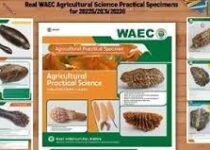
WAEC Agric Practical Specimen 2026/2027
WAEC Agric Practical Specimen 2026/2027 covers farm tools (cutlass, hoe, measuring tape, pegs), soil types (sand, clay, loam for capillary tests), biological samples (earthworms, pests like weevils/grasshoppers, fish, plants/roots), and organic materials (wood ash, compost, manure). Candidates identify and describe uses, maintenance, economic importance, and differences/relationships between these specimens, often involving practical identification and simple experiments like soil water retention or compost preparation.
This WAEC Agric Practical Specimen highlights key features, similarities, and likely practical questions to help you prepare confidently and perform well in the WAEC Agric practical examination.
Contents
- 1 WAEC Agric Practical Specimen 2026/2027
- 2 Specimen A: Ammonium Sulphate (Labelled)
- 3 Specimen B: Muriate of Potash (Labelled)
- 4 Specimen C: Cow Dung
- 5 Specimen D: Compost (Labelled)
- 6 Specimen E: Cutlass
- 7 Specimen F: Spade
- 8 Specimen G: Wheelbarrow
- 9 Specimen H: Yam Beetle
- 10 Specimen I: Cowpea Weevil
- 11 Specimen J: Centrosema pubescens
- 12 Specimen K: Spear Grass
- 13 Specimen L: Gizzard (Chicken)
- 14 Specimen M: Goat Skin (Fresh, with Hair Intact)
- 15 Specimen N: Horn
- 16 WAEC Agric Practical Specimen Previous
- 17 SPECIMEN A: Ranging Pole
- 18 SPECIMEN B: Arrow
- 19 SPECIMEN C: Measuring Tape
- 20 SPECIMEN D: Wooden Peg
- 21 SPECIMEN E: Dry Sand
- 22 SPECIMEN F: Dry Clay (Ground)
- 23 SPECIMEN G: Dry Loam (Ground)
- 24 SPECIMEN H: Maize Weevil
- 25 SPECIMEN I: Bean Beetle
- 26 SPECIMEN J: Grasshopper
- 27 SPECIMEN K: Cotton Stainer
- 28 SPECIMEN L: Tilapia (Whole and Fresh)
- 29 SPECIMEN M: Hay
- 30 SPECIMEN N: Fish Meal
- 31 Summary for Students
- 32 Instructions to Schools
- 33 Report Form
- 34 Recent Posts
WAEC Agric Practical Specimen 2026/2027
Below is the complete and well-organized list of specimens for the WAEC Agric 2025 practical exam, along with simple explanations and functions to aid easy understanding and revision.
Specimen A: Ammonium Sulphate (Labelled)
Explanation: A white, crystalline inorganic fertilizer rich in nitrogen.
Function: Promotes rapid vegetative growth in leafy crops such as spinach and lettuce.
Specimen B: Muriate of Potash (Labelled)
Explanation: A potassium-rich fertilizer, usually reddish or white granules.
Function: Enhances fruiting, root development, and overall crop quality (e.g., yam and maize).
Specimen C: Cow Dung
Explanation: Animal waste obtained from cows.
Function: Serves as organic manure to improve soil fertility and structure.
Specimen D: Compost (Labelled)
Explanation: Decomposed organic matter made from plant and animal waste.
Function: Supplies nutrients to the soil and supports sustainable farming practices.
Specimen E: Cutlass
Explanation: A farm tool with a flat, sharp metal blade.
Function: Used for bush clearing, weeding, and harvesting crops.
Specimen F: Spade
Explanation: A farm tool with a flat blade attached to a long handle.
Function: Used for digging, turning soil, and making ridges or beds.
Specimen G: Wheelbarrow
Explanation: A one-wheeled hand cart.
Function: Used to transport farm inputs, soil, manure, and harvested produce.
Specimen H: Yam Beetle
Explanation: An insect pest that attacks yam tubers in the soil.
Function: Helps students identify pests and understand control measures.
Specimen I: Cowpea Weevil
Explanation: A storage pest that bores holes into cowpea seeds.
Function: Demonstrates pest damage and storage problems in grains.
Specimen J: Centrosema pubescens
Explanation: A creeping pasture legume with purple flowers.
Function: Used for grazing and improves soil fertility through nitrogen fixation.
Specimen K: Spear Grass
Explanation: A perennial weed with tough stems and sharp leaves.
Function: Illustrates common weeds that compete with crops for nutrients.
Specimen L: Gizzard (Chicken)
Explanation: A muscular part of the chicken’s digestive system.
Function: Demonstrates the grinding function in poultry digestion.
Specimen M: Goat Skin (Fresh, with Hair Intact)
Explanation: Fresh skin of a goat with hair present.
Function: Shows animal by-products used in leather production.
Specimen N: Horn
Explanation: A hard, pointed structure found on animals like goats or cattle.
Function: Used to teach animal anatomy and the use of animal products in tools and ornaments.
WAEC Agric Practical Specimen Previous
SPECIMEN A: Ranging Pole
A ranging pole is a long, straight pole used in land surveying. It is usually painted in alternating red and white bands to make it visible from a distance. Farmers and surveyors use it to mark straight lines and measure distances when planning farms or fields.
Use: It helps in aligning and measuring land accurately.
SPECIMEN B: Arrow
An arrow is a small, pointed metal tool used in surveying. It is placed in the ground to mark specific points or directions during land measurement. It works with tools like the ranging pole and measuring tape.
Use: It is used for marking points or directions in surveying.
SPECIMEN C: Measuring Tape
A measuring tape is a flexible tool marked with measurements (meters or feet). It is used to measure distances accurately during surveying or fieldwork. Farmers use it to measure the length and width of fields or plots.
Use: It is essential for taking precise measurements in farming and surveying.
SPECIMEN D: Wooden Peg
A wooden peg is a small, pointed stake made of wood. It is used in surveying to mark boundaries or specific points on land. It is often used alongside arrows and ranging poles.
Use: It helps in marking boundaries or points during land preparation.
SPECIMEN E: Dry Sand
Dry sand is a soil type with large particles and low water retention. It feels gritty and drains water quickly. It is not very fertile because it lacks nutrients and organic matter.
Importance: It is unsuitable for most crops due to poor water and nutrient retention.
SPECIMEN F: Dry Clay (Ground)
Dry clay is a fine-textured soil with very small particles. It retains water well but drains poorly. When wet, it becomes sticky and hard to work with. It is rich in nutrients but difficult to till.
Importance: It is fertile but hard to cultivate due to its compact nature.
SPECIMEN G: Dry Loam (Ground)
Dry loam is a balanced soil made up of sand, silt, and clay. It has good drainage, good water retention, and adequate nutrients. It is easy to work with and supports plant growth.
Importance: It is ideal for growing crops due to its balanced properties.
SPECIMEN H: Maize Weevil
The maize weevil is a small beetle that attacks stored grains, especially maize. It bores into the grains, causing damage and reducing quality.
Effect: It destroys stored grains, leading to economic losses.
SPECIMEN I: Bean Beetle
The bean beetle is a pest of stored beans. It feeds on the beans, reducing their quality and making them unfit for consumption or sale.
Effect: It damages stored beans, affecting food security and income.
SPECIMEN J: Grasshopper
A grasshopper is a field pest that feeds on crops such as maize, rice, and vegetables. It eats leaves, stems, and grains.
Effect: It reduces crop yield by feeding on plants.
SPECIMEN K: Cotton Stainer
The cotton stainer is an insect pest of cotton. It feeds on cotton bolls, staining the fibres and reducing quality.
Effect: It lowers the quality and market value of cotton.
SPECIMEN L: Tilapia (Whole and Fresh)
Tilapia is a freshwater fish commonly reared in ponds or tanks. It grows fast and is a good source of protein.
Importance: It is important for food supply and income in fish farming.
SPECIMEN M: Hay
Hay is dried grass or legumes used as animal feed. It is rich in fibre and provides roughage for livestock such as cattle, goats, and sheep.
Importance: It is a key feed for livestock, especially during the dry season.
SPECIMEN N: Fish Meal
Fish meal is a protein-rich feed produced from processed fish. It is used in poultry and livestock feeding to support growth and egg production.
Importance: It is an important high-protein feed for animals and birds.
Summary for Students
- Specimens A–D: Tools used in surveying and land measurement.
- Specimens E–G: Soil types with different physical properties.
- Specimens H–K: Pests that affect crops and stored produce.
- Specimens L–N: Aquaculture and animal feed materials.
Instructions to Schools
- Great care should be taken to ensure that the information given does not reach candidates before the examination.
- Provision of Specimens:
- Schools are responsible for providing all specimens, materials, and equipment.
- Where specimens are insufficient, they should be shared among small groups of candidates.
- Each candidate should be provided with specimens A–D, properly labelled.
- Preparation of Soil Specimens (E, F, G):
- Obtain dry sand, dry clay (ground), and dry loam (ground).
- Use three capillary tubes labelled E, F, and G.
- Plug the lower ends with cotton wool and fill accordingly.
- Pack the soil by tapping, place the tubes in a half-filled water trough, and leave for 24 hours before the exam.
- Other Specimens:
- H: Maize weevil
- I: Bean beetle
- J: Grasshopper
- K: Cotton stainer
- L: Tilapia (whole and fresh)
- M: Hay
- N: Fish meal
Report Form
- Supply details of specimens and materials provided.
- Report any difficulties experienced by candidates.
- Record experimental observations.
- Enclose a completed report form in each envelope of scripts.
Recent Posts
- WAEC Textiles Syllabus 2026/2027 & Textbooks
- WAEC Efịk Syllabus 2026/2027 & Textbook
- WAEC Edo Syllabus 2026/2027 & Textbooks
- WAEC Ceramics Syllabus 2026/2027 & Textbooks
- WAEC Business Management Syllabus 2026/2027 & Textbooks
- WAEC Animal Husbandry Syllabus 2026/2027 & Textbooks
- WAEC Yoruba Syllabus 2026/2027 & Textbooks
- WAEC Book-Keeping Syllabus 2026/2027 & Textbooks
- WAEC Marketing Syllabus 2026/2027 & Textbooks
- WAEC Chemistry Syllabus 2026/2027 & Texbooks
- WAEC Arabic Syllabus 2026/2027 & Textbooks
- WAEC Syllabus For Economics 2026/2027 & Textbooks
- WAEC Literature-in-English Syllabus 2026/2027 & Textbooks
- WAEC Igbo Syllabus 2026/2027 & Textbooks
- WAEC Welding Syllabus 2026/2027 & Textbooks
- WAEC Mathematics Syllabus 2026/2027 & Textbooks
- WAEC Visual Art Syllabus 2026/2027 & Textbooks
- WAEC Islamic Religious Studies (IRS) Syllabus 2026/2027
- WAEC Government Syllabus 2026/2027 and Textbooks
- WAEC Arabic Syllabus 2026/2027 & Textbooks
- WAEC Music Syllabus 2026/2027 & Textbooks
- WAEC Food and Nutrition Syllabus 2026/2027 & Textbooks
- WAEC Data Processing Syllabus 2026/2027 & Textbooks
- WAEC Further Mathematics Syllabus 2026/2027 & Textbooks
- WAEC Financial Accounting Syllabus 2026/2027 & Textbooks
- WAEC Geography Syllabus 2026/2027 & Textbooks
- WAEC Mining Syllabus 2026/2027 & Textbooks
- WAEC Woodwork Syllabus 2026/2027 & Textbooks
- WAEC ICT (Core) Syllabus 2026/2027 & Textbooks
- WAEC Food and Nutrition Syllabus 2026/2027 & Textbooks
- WAEC Fisheries (Alternative B) Syllabus 2026/2027 & Textbooks
- WAEC Shorthand Syllabus 2026/2027 & Textbooks
- WAEC Refrigeration And Air-Conditioning Syllabus 2026/2027 & Textbooks
- WAEC Radio,Television and Electronics Works Syllabus 2026/2027 & Textbooks
- WAEC Office Practice Syllabus 2026/2027 & Textbooks
- WAEC Mining Syllabus 2026/2027 & Textbooks
- WAEC Typewriting Syllabus 2026/2027 & Textbooks
- WAEC Store Management Syllabus 2026/2027 & Textbooks
- WAEC Store Keeping Syllabus 2026/2027 & Textbooks

WAEC Physics Practical Specimen 2026/2027
WAEC Biology Practical Specimen 2026/2027
WAEC Practical Specimen for Animal Husbandry 2026/2027
About Author
