WAEC Practical Specimen 2026/2027 for All Subjects
WAEC Practical Specimen 2026/2027 for All Science Subjects includes items like watering cans, pliers (biology/agriculture), litmus paper, soil/cow dung, plant tubers (yam/cassava), and fruits (orange), plus typical titration apparatus (burette, pipette, reagents like NaOH, HCl, limewater for Chemistry) and biology tools (hand lens and scalpel).
WAEC Practical Specimen 2026/2027 for all subjects: – includes various subjects like biology, physics, chemistry, agricultural science, animal husbandry, fisheries, technical drawing, computer studies, visual art, data processing, and more for the 2026/2027 academic session. These specimens are important for students to practice and prepare for their exams.
Students preparing for the 2026 examinations need an up-to-date guide to all practical specimens, including subject breakdowns, safety tips, and exam requirements. Practical work is crucial because it tests laboratory skills, analytical ability, and proper handling of specimens, all of which affect final grades.
WAEC2026.blog positions itself as a trusted exam-prep platform in Nigeria, offering verified answers a day before exams, strong performance guarantees, and 24/7 support, helping students gain confidence and improve their chances of success in the WAEC 2026 examinations.
Contents
WAEC Practical Specimen 2026/2027
The WAEC Practical Specimen materials that you will find here will outline the range of subjects that include WAEC practical examinations, covering sciences, technical, vocational, and arts subjects. Schools use official specimens to assess students’ hands-on skills and understanding, making it essential for candidates to study them ahead of time.
WAEC practical specimens are designed to ensure uniform standards, fair assessment, and alignment with the official curriculum while helping students prepare effectively for their exams.
This article explains that students can access WAEC practical specimens for all subjects with practical exams through a simple list of. Each link allows instant download to a phone, enabling offline access at any time. Students can choose any subject from the available list and download the corresponding practical specimens immediately to aid their exam preparation.
- WAEC Practical Specimen for Biology 2026/2027
- WAEC Practical Specimen for Physics 2026/2027
- WAEC Practical Specimen for Chemistry 2026/2027
- WAEC Practical Specimen for Agricultural Science 2026/2027
- WAEC Practical Specimen for Animal Husbandry 2026/2027
- WAEC Practical Specimen for Fisheries 2026/2027
- WAEC Practical Specimen for Technical Drawing 2026/2027
- WAEC Practical Specimen for Computer Studies 2026/2027
- WAEC Practical Specimen for Visual Art 2026/2027
- WAEC Practical Specimen for Data Processing 2026/2027
To perform well in the WAEC 2026/2027 practical exams, students should carefully read all instructions, practice using the required equipment before the exam, observe experiments closely to understand what is happening, and ask teachers or classmates for clarification whenever they are unsure.
WAEC examinations are vital across West Africa, and Physics is especially important because of its practical components. The WAEC Physics practical exam tests students’ ability to conduct experiments, analyze results, and apply theory to real-life situations.
Practical specimens play a key role by giving students hands-on experience, reinforcing theoretical understanding, and forming a significant part of the overall Physics assessment, making familiarity with them essential for success in the 2026 exams.
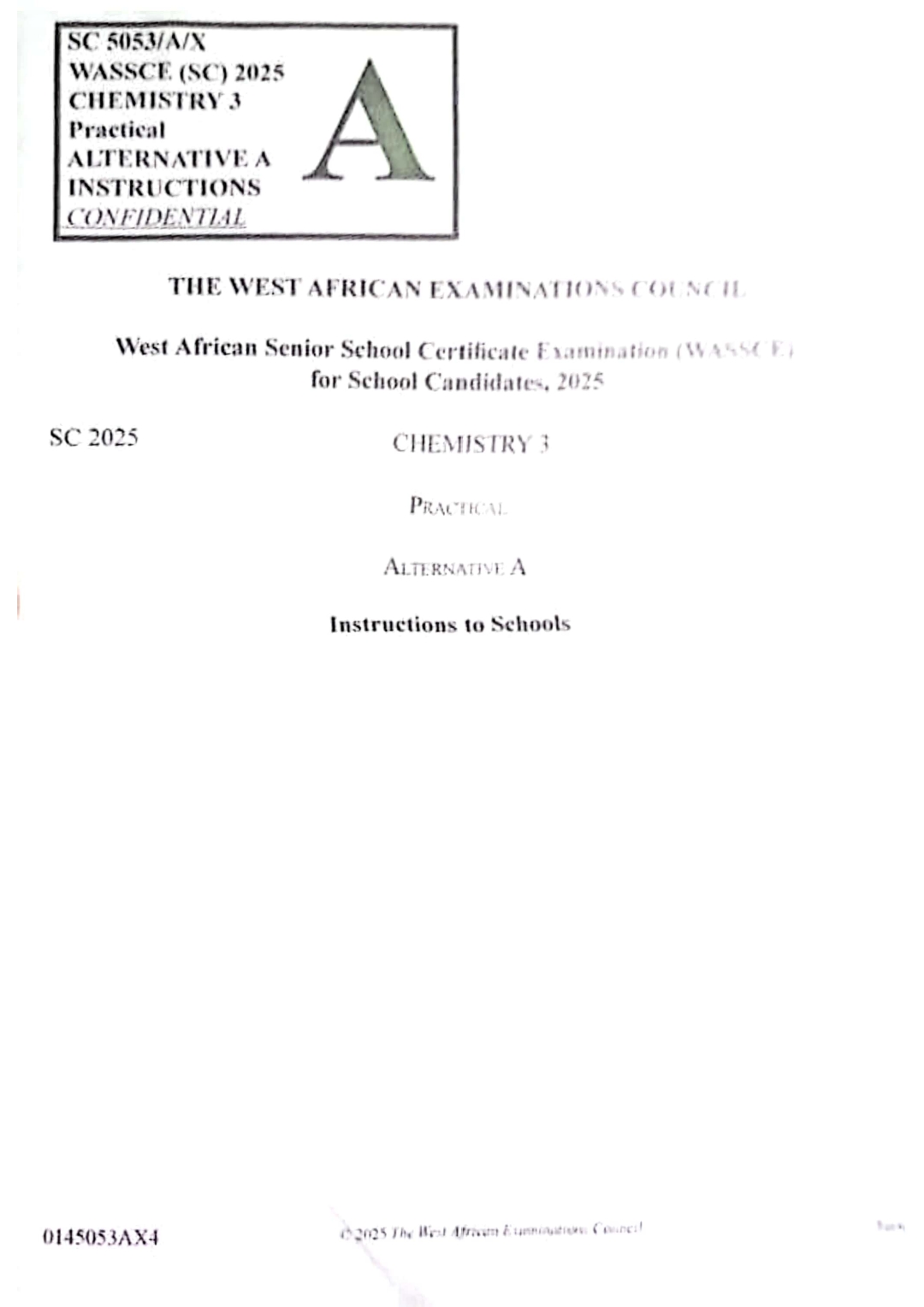
CHEMISTRY PRACTICAL SPECIMEN 2026
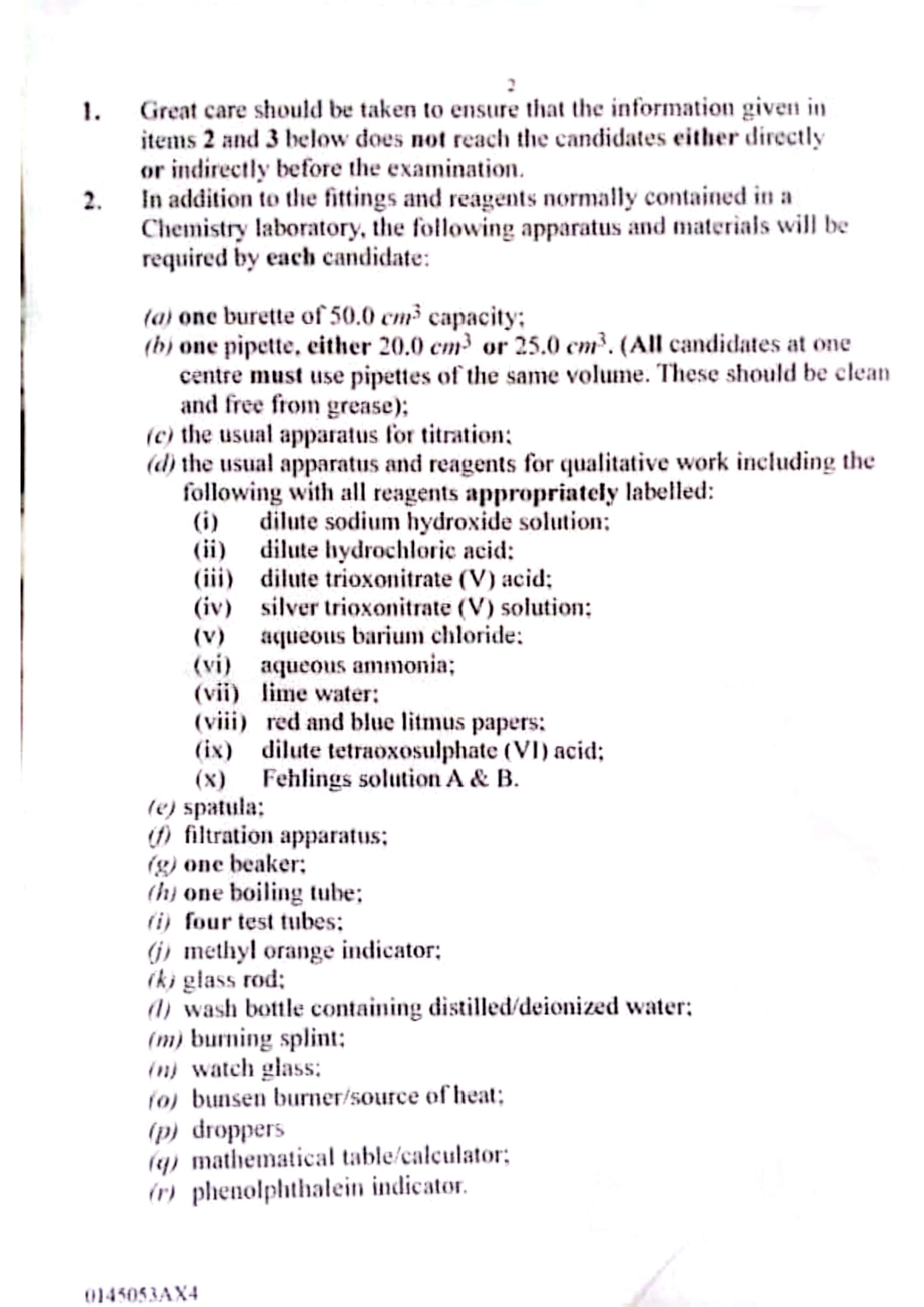
(1) Great care should be taken to ensure that the information given in items 2 and 3 below does not reach the candidates either directly or indirectly before the examination.
(2) In addition to the fittings and reagents normally contained in a Chemistry laboratory, the following apparatus and materials will be required by each candidate:
(a) one burette of 50.0 cm³ capacity;
(b) one pipette, either 20.0 cm³ or 25.0 cm³. (All candidates at one centre must use pipettes of the same volume. These should be clean and free from grease);
(c) the usual apparatus for titration;
(d) the usual apparatus and reagents for qualitative work including the following with all reagents appropriately labelled:
(i) dilute sodium hydroxide solution
(ii) dilute hydrochloric acid
(iii) dilute trioxonitrate (V) acid
(iv) silver trioxonitrate (V) solution
(v) aqueous barium chloride
(vi) aqueous ammonia
(vii) lime water
(viii) red and blue litmus papers
(ix) dilute tetraoxosulphate (VI) acid
(x) Fehlings solution A & B
(e) spatula
(f) filtration apparatus;
(g) one beaker:
(h) one boiling tube;
(i) four test tubes:
(j) methyl orange indicator;
(k) glass rod;
(l) wash bottle containing distilled/deionized water:
(m) burning splint:
(n) watch glass:
(o) bunsen burner/source of heat;
(p) droppers
(q) mathematical table/calculator;
(r) phenolphthalein indicator.
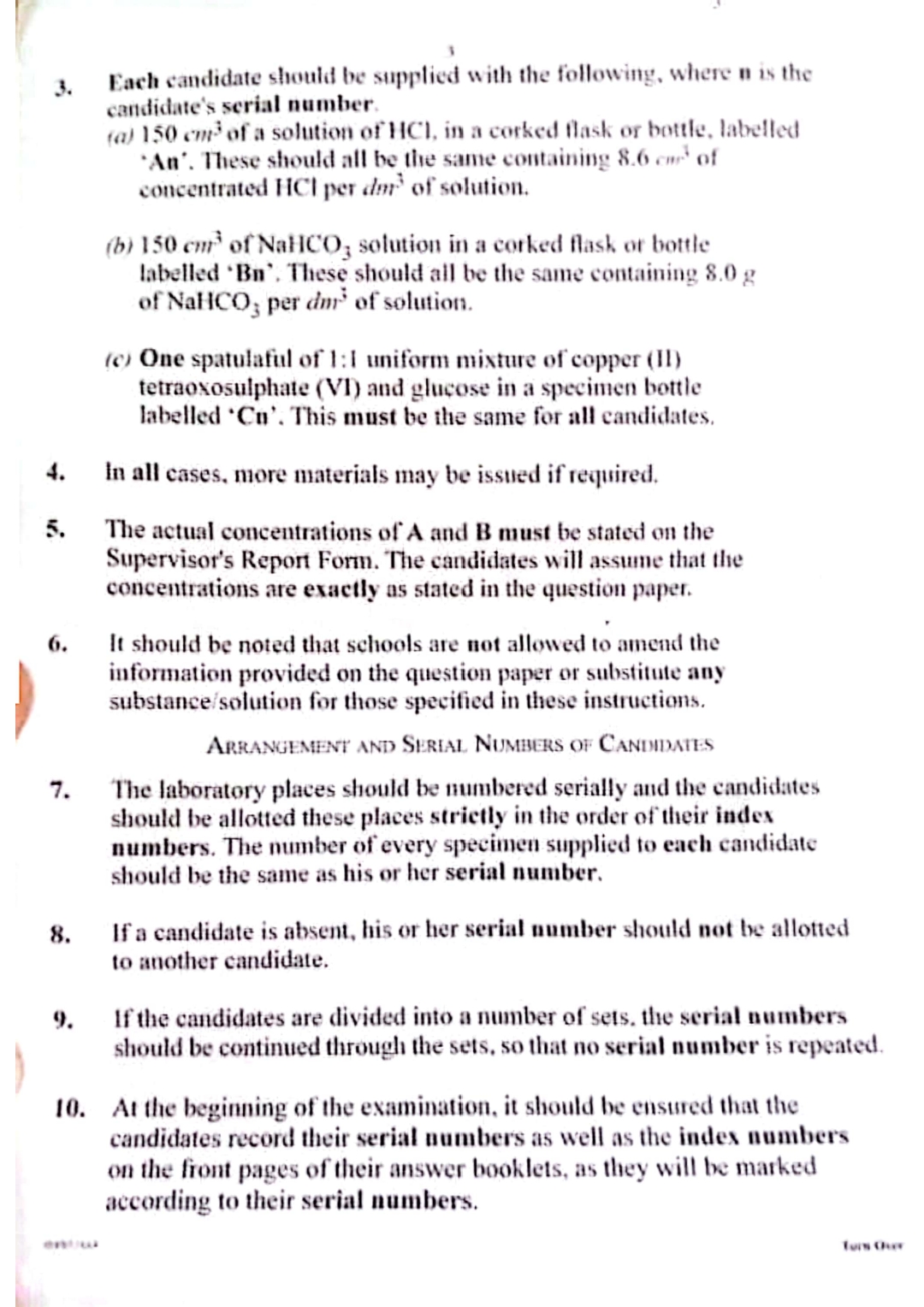
(3) Each candidate should be supplied with the following, where n is the candidate’s serial number.
(a) 150 cm³ of a solution of HCl, in a corked flask or bottle, labelled An’. These should all be the same containing 8.6 cm³ of concentrated HCI per dm³ of solution.
(b) 150 cm³ of NaHCO, solution in a corked flask or bottle labelled ’Bn’. These should all be the same containing 8.0 g of NaHCO3 per dm³ of solution.
(c) One spatulaful of 1:1 uniform mixture of copper (II) tetraoxosulphate (VI) and glucose in a specimen bottle labelled ’Cn’. This must be the same for all candidates
PHYSICS PRACTICAL SPECIMEN 2026/2027
Question 1:
(1) Three retort stands with clamps
(2) G-clamp
(3) A spiral spring
(4) Two 100 cm – rulers
(5) 100g mass labelled m
(6) Two pieces of thread with loops.
(7) Stop watch.
(8) An optical pin.
(9) Sellotape.
Question 2:
(1) Rectangular prism.
(2) A plane mirror.
(3) Four Optical pins.
(4) Thumb pins.
(5) Drawing board.
(6) Drawing paper.
Question 3:
(1) One potentiometer.
(2) Rheostat.
(3) Two cells (1.5V each).
(4) A voltmeter (0.2V).
(5) An ammeter (0.1A).
(6) A jockey.
(7) A key.
(8) One standard resistor labelled Rx (Rx = 1 ohm).
(9) Connecting wires.
BIOLOGY PRACTICAL SPECIMEN 2026/2027
Specimen A: Bean weevil
Specimen B: Bean seeds (with holes)
Specimen C: Waterleaf plant (whole)
Specimen D: Quill feather of a domestic fowl
Specimen E: Pineapple fruit (longitudinal section).
Specimen F: Orange fruit (transverse section)
Specimen G: Raw egg of a domestic fowl (freshly procured with shell intact)
Specimen H: Test tube containing 3 ml of water (placed on a test tube rack)
Specimen J: Longitudinal section of boiled egg (with shell)
AGRIC PRACTICAL SPECIMEN 2026
Specimen A: Ammonium sulphate (labelled)
Specimen B: Muriate of potash (labelled)
Specimen C: Cow dung
Specimen D: Compost (labelled)
Specimen E: Cutlass
Specimen F: Spade
Specimen G: Wheelbarrow
Specimen H: Yam beetle
Specimen I: Cowpea weevil
Specimen J: Centrosema pubescens
Specimen K: Spear grass
Specimen L: Gizzard (chicken)
Specimen M: Goat skin (fresh, with hairs intact)
Specimen N: Horn
ANIMAL HUSBANDRY PRACTICAL SPECIMEN 2026
SPECIMEN A: Wood shavings
SPECIMEN B: Beef
SPECIMEN C: Leather
SPECIMEN D: Crop with its content (Poultry)
SPECIMEN E: Fresh liver (From ruminant)
SPECIMEN F: Hoof
SPECIMEN G: Weighing scale
SPECIMEN H: Egg candler
SPECIMEN J: Thermometer
SPECIMEN K: Hypodermic syringe
SPECIMEN L: Cheese
SPECIMEN M: Milk (labelled)
SPECIMEN N: Horn
SPECIMEN P: Fresh Leucaena leucocephala
FISHERIES PRACTICAL SPECIMEN 2026
Specimen A: Thermometer
Specimen B: Aerator
Specimen C: Pelleted feed
Specimen D: Syphoning tube
Specimen E: Hand gloves
Specimen F: Knife
Specimen G: Common salt
Specimen H: Polyethene
Specimen J: Fish oil
Specimen K: Fish scale
Specimen L: Fish bone
Specimen M: Fish egg
Specimen N: Smoked sardinella
Specimen P: Salted dried fish
Specimen Q: Fermented catfish
More Loading…
Recent Posts
- WAEC Textiles Syllabus 2026/2027 & Textbooks
- WAEC Efịk Syllabus 2026/2027 & Textbook
- WAEC Edo Syllabus 2026/2027 & Textbooks
- WAEC Ceramics Syllabus 2026/2027 & Textbooks
- WAEC Business Management Syllabus 2026/2027 & Textbooks
- WAEC Animal Husbandry Syllabus 2026/2027 & Textbooks
- WAEC Yoruba Syllabus 2026/2027 & Textbooks
- WAEC Book-Keeping Syllabus 2026/2027 & Textbooks
- WAEC Marketing Syllabus 2026/2027 & Textbooks
- WAEC Chemistry Syllabus 2026/2027 & Texbooks
- WAEC Arabic Syllabus 2026/2027 & Textbooks
- WAEC Syllabus For Economics 2026/2027 & Textbooks
- WAEC Literature-in-English Syllabus 2026/2027 & Textbooks
- WAEC Igbo Syllabus 2026/2027 & Textbooks
- WAEC Welding Syllabus 2026/2027 & Textbooks
- WAEC Mathematics Syllabus 2026/2027 & Textbooks
- WAEC Visual Art Syllabus 2026/2027 & Textbooks
- WAEC Islamic Religious Studies (IRS) Syllabus 2026/2027
- WAEC Government Syllabus 2026/2027 and Textbooks
- WAEC Arabic Syllabus 2026/2027 & Textbooks
- WAEC Music Syllabus 2026/2027 & Textbooks
- WAEC Food and Nutrition Syllabus 2026/2027 & Textbooks
- WAEC Data Processing Syllabus 2026/2027 & Textbooks
- WAEC Further Mathematics Syllabus 2026/2027 & Textbooks
- WAEC Financial Accounting Syllabus 2026/2027 & Textbooks
- WAEC Geography Syllabus 2026/2027 & Textbooks
- WAEC Mining Syllabus 2026/2027 & Textbooks
- WAEC Woodwork Syllabus 2026/2027 & Textbooks
- WAEC ICT (Core) Syllabus 2026/2027 & Textbooks
- WAEC Food and Nutrition Syllabus 2026/2027 & Textbooks
- WAEC Fisheries (Alternative B) Syllabus 2026/2027 & Textbooks
- WAEC Shorthand Syllabus 2026/2027 & Textbooks
- WAEC Refrigeration And Air-Conditioning Syllabus 2026/2027 & Textbooks
- WAEC Radio,Television and Electronics Works Syllabus 2026/2027 & Textbooks
- WAEC Office Practice Syllabus 2026/2027 & Textbooks
- WAEC Mining Syllabus 2026/2027 & Textbooks
- WAEC Typewriting Syllabus 2026/2027 & Textbooks
- WAEC Store Management Syllabus 2026/2027 & Textbooks
- WAEC Store Keeping Syllabus 2026/2027 & Textbooks

How to Pass WAEC 2026/2027 in One Sitting

WAEC Igbo Syllabus 2026/2027 & Textbooks

Download WAEC Syllabus 2026/2027 For All Subjects – PDF
About Author
