Category: WAEC Questions 2026

  • WAEC CRS Answers 1st June 2026/2027

    WAEC CRS Answers 1st June 2026/2027

    WAEC CRS Answers 1st June 2026/2027: The WAEC Christian Religious Studies (CRS) exam is divided into Objective (Paper 1) and Essay (Paper 2) sections. Questions are drawn strictly from the approved syllabus, focusing on themes like the sovereignty of God, divine preservation, leadership, and the teachings of Jesus Christ and Paul.

    The examination consists of two papers. Paper 1 is an objective test containing 50 compulsory multiple-choice questions designed to assess candidates’ broad knowledge of the Bible and key Christian teachings, carrying a total of 50 marks. Paper 2 is an essay paper in which candidates are required to answer four questions selected from different sections, including the Old Testament, the Synoptic Gospels and Acts of the Apostles, and the Epistles.

    WAEC CRS Answers 1st June 2026/2027

    CRS ANSWER NUMBER 2 (a) Eli was a priest and judge in Israel. His two sons, Hophni and Phinehas, were wicked. They treated the Lord’s offering with contempt, taking meat by force and sleeping with women who served at the entrance of the tent of meeting. Eli heard about their evil deeds but only rebuked them weakly; he did not stop them or remove them from office. A man of God came to Eli and pronounced judgment: Eli’s household would be cut off; no old man would be in his family; both his sons would die on the same day; and the priesthood would pass to a faithful priest (Zadok). Later, in battle against the Philistines, Hophni and Phinehas were killed, and when Eli heard that the Ark of God was captured, he fell backwards off his seat, broke his neck, and died. (b)

    1. Set clear rules and enforce consequences consistently.
    1. Assign age-appropriate chores and hold children accountable.
    2. Model responsible behaviour themselves (lead by example).

    CRS ANSWER NUMBER 3 (a) King Saul was pursuing David to kill him. David had twice spared Saul’s life. The first time, in the cave at En Gedi, Saul came in to relieve himself, and David cut off a corner of Saul’s robe but did not harm him. Then David called out to Saul, showing the piece of cloth. Saul wept and admitted, “You are more righteous than I.” Later, David and Abishai found Saul asleep in his camp. Abishai wanted to kill Saul, but David took only his spear and water jug. From a distance, David called out, rebuking Abner for not protecting the king. Saul recognized David’s voice and said, “Is this your voice, my son David?” Saul then confessed, “I have sinned. Return, my son David, for I will no more do you harm, because my life was precious in your eyes this day.” David returned the spear, and they parted. (b)

    1. Respect for God’s anointed – David refused to harm Saul, even when provoked.

    CRS ANSWER NUMBER 4 (a) While repairing the temple, Hilkiah the high priest found the Book of the Law (likely Deuteronomy). He gave it to Shaphan the scribe, who read it to King Josiah. When Josiah heard the words of the Law, he tore his clothes in grief because he realized that Judah had not kept God’s commands and that great wrath was coming. He sent officials to inquire of the Lord. They went to Huldah the prophetess, who confirmed that disaster would come upon Judah for idolatry, but because Josiah’s heart was penitent and he had humbled himself, the disaster would not happen in his days. Josiah then gathered all the people and read the Book to them. He made a covenant to follow the Lord and keep His commandments. He proceeded to destroy all idols, altars, and high places throughout Judah and Israel. (b)

    1. Many people have lost knowledge of Scripture, just as the Book of the Law was lost.
    1. Idolatry exists in modern forms – money, fame, pleasure – replacing true worship.
    2. A remnant remains that responds with repentance and reform when they hear God’s word.

    Number 9

    (9a)
    Peter began with a general admonition to Christians to be subject, for the Lord’s sake, to every human institution, whether it is to the emperor as the supreme authority on earth, or to the government appointed by him to oversee the administration with delegated powers to punish offenders or reward those who do right, for this is the will of God, the ultimate power behind these earthly authorities. He said that by doing the right thing, they would put to shame the ignorance of foolish men. He admonished them to live as men free from the curse of the law and not to misuse their liberty as a pretext for evil. He said they should rather live as servants of God with the fear of God. They should honour all men, love the Christians brotherhood and honour the emperor.

    (9b)
    (i) He should have love for his nation and its legitimate institutions, both civil and religious.
    (ii) He should obey all laws and regulations set up for the smooth administration of the country.
    (iii) If the need arises, a good citizen should even fight to defend the territorial integrity of his nation if other options, including dialogue, fail.

    Recent Posts

  • WAEC Physics (Essay & OBJ) Answers 2026/2027

    WAEC Physics (Essay & OBJ) Answers 2026/2027

    WAEC Physics (Essay & OBJ) Answers 2026/2027: The 2026 WAEC May/June Physics (PHY) Essay (Theory) and Objectives (OBJ) Questions and Answers for School Candidates is here for free. The WAEC Physics exam assesses candidates through two main sections: Objective (OBJ) and Essay/Theory. To succeed, students must master core topics, mathematical formulas, and scientific concepts.

    WAEC Physics (Essay & OBJ) Answers 2026

    WAEC PHYSICS ANSWERS

    NUMBER ONE

    1a)
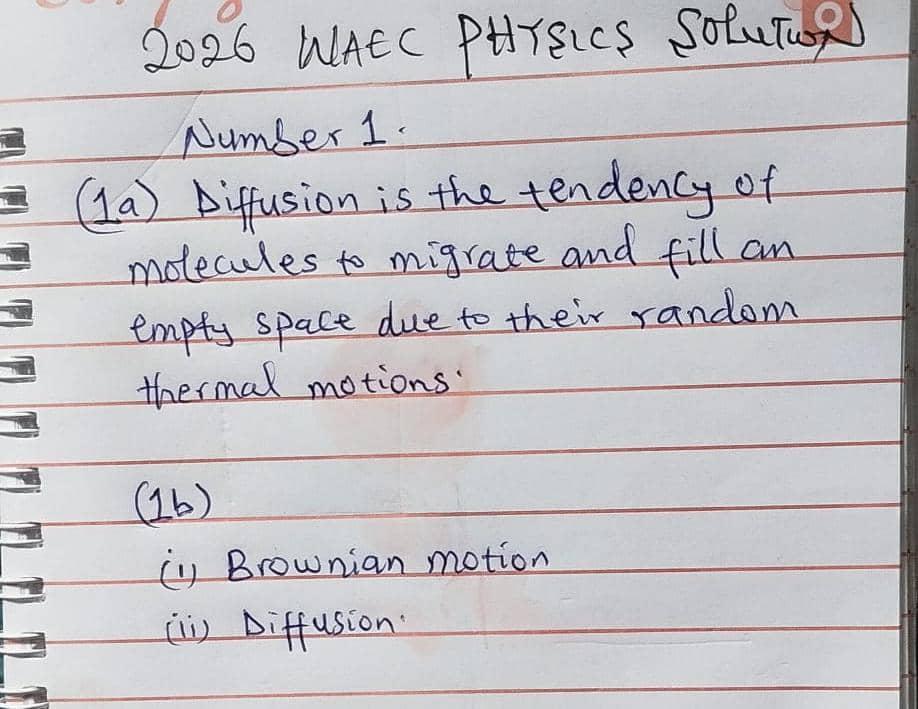
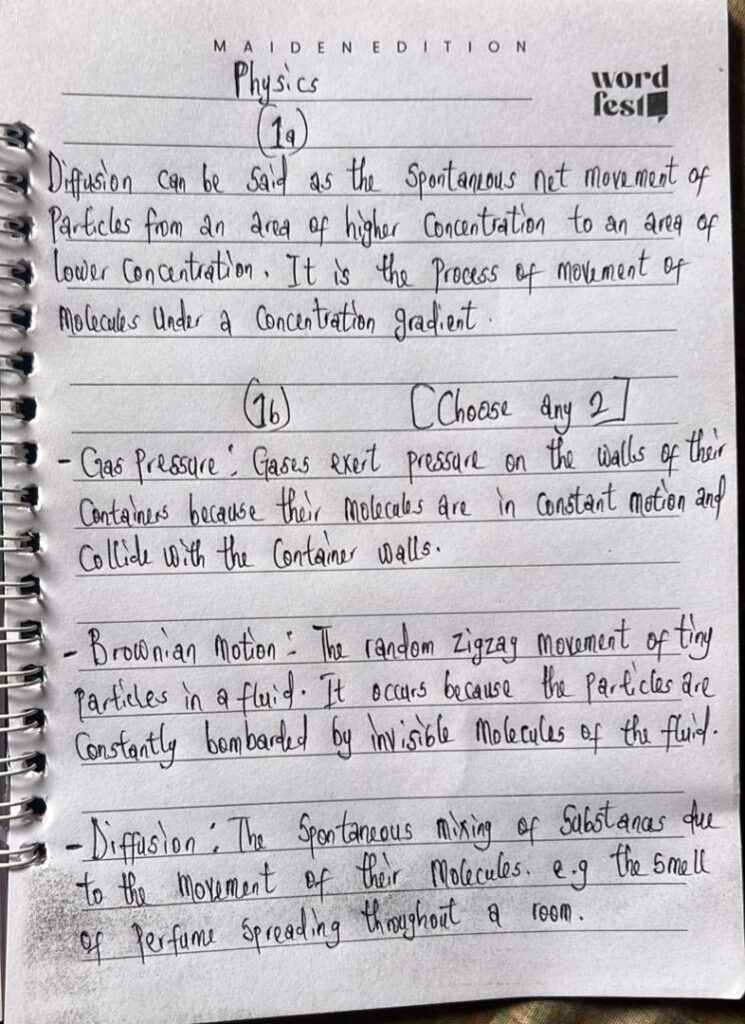
    Diffusion is the process by which particles of a substance move from a region of higher concentration to a region of lower concentration until they are evenly distributed, due to their constant random motion.

    1(b)
    PICK ANY TWO

    (I) Diffusion – e.g. the spreading of perfume smell in a room.

    (ii) Brownian motion – irregular zig-zag movement of tiny particles suspended in a fluid.

    (iii) Osmosis – movement of solvent molecules through a semi-permeable membrane.

    (iv) Expansion of gases when heated – showing that particles are in constant motion and move farther apart.
    ========•••===========

    NUMBER TWO

    (2a)

    (i) Majority carrier:

    Holes

    (ii) Minority carrier:

    Electrons

    (b)
    CHOOSE ONLY ONE

    (I) It requires no heater filament, so no heating is needed before operation.

    (ii) It consumes less power.

    (iii) It is smaller and more compact in size.

    (iv) It has a longer lifespan and is more reliable.
    ========•••===========

    Recent Posts

  • WAEC Islamic Religious Studies (Essay and Obj) Answers 2026/2027

    WAEC Islamic Religious Studies (Essay and Obj) Answers 2026/2027

    WAEC Islamic Religious Studies (Essay and Obj) Answers 2026/2027: The West African Examinations Council (WAEC) Islamic Religious Studies (IRS) examination consists of Objective, Essay, and Hadith sections based on the official WAEC syllabus. Questions are drawn from the Qur’an, Hadith, Fiqh (Islamic Jurisprudence), Tawhid (Belief), and Islamic history.

    WAEC Islamic Religious Studies (Essay and Obj) Answers 2026

    WAEC Christian Religious Studies OBJ Answers 2026

    01-10: DCCBACBDBD
    11-20: ABBBACCCCC
    21-30: ADBBBDCDDB
    31-40: ACBCBCBCBA
    41-50: ACCDCBBADB

    COMPLETED!!!

    WAEC Christian Religious Studies Essay Answers 2026

    Number 5

    (5a)
    John the Baptist was the forerunner of Jesus Christ. He preached in the wilderness of Judea, calling the people to repentance and preparing them for the coming of the Messiah. Many people went to him at the River Jordan to confess their sins and be baptized by him.

    One day, Jesus came from Galilee to the River Jordan to be baptized by John. When John saw Jesus, he recognized that Jesus was greater than him. John felt unworthy to baptize Him because he knew that Jesus was without sin. John tried to prevent Him and said that he himself needed to be baptized by Jesus, yet Jesus was coming to him for baptism.

    Jesus answered John and told him to allow it for the time being because it was proper for them to fulfill all righteousness. This means that Jesus wanted to obey God’s will fully and identify Himself with the people He came to save, even though He had no sin.

    After this, John agreed and baptized Jesus in the River Jordan. As Jesus came up from the water, the heavens were opened. The Spirit of God descended upon Him like a dove and rested on Him. This showed that God had anointed Jesus for His public ministry.

    Then a voice came from heaven saying, “This is my beloved Son, with whom I am well pleased.” This voice confirmed that Jesus was the Son of God and that God approved of Him. The event also revealed the presence of the Father, the Son, and the Holy Spirit.

    After His baptism, Jesus was fully prepared to begin His public ministry. The encounter between John the Baptist and Jesus at the River Jordan was important because it marked the beginning of Jesus’ work of preaching, healing, teaching, and saving mankind.

    (5b)
    (PICK ANY THREE)

    (i) It teaches Christians the importance of baptism as an act of obedience to God.

    (ii) It teaches humility, because Jesus humbled Himself to be baptized by John even though He was greater than John.

    (iii) It shows that Christians need the Holy Spirit to live a faithful and useful life.

    (iv) It teaches that God is pleased when His children obey His will.

    (v) It reveals Jesus as the beloved Son of God and strengthens Christian faith in Him.

    (vi) It teaches Christians to submit to God’s plan, even when they may not fully understand it.

    ========================

    Number 6

    (6a)
    The condemnation of Jesus to death began after He was arrested in the Garden of Gethsemane. Judas Iscariot, one of His disciples, had agreed with the chief priests to betray Him. He led a crowd with swords and clubs to where Jesus was praying with His disciples. Judas identified Jesus with a kiss, and Jesus was arrested.

    After His arrest, Jesus was taken to the house of the high priest. The chief priests, elders, and scribes were already gathered there. They were looking for false evidence against Jesus so that they could put Him to death. Many false witnesses came forward, but their testimonies did not agree.

    Later, some people accused Jesus of saying that He would destroy the temple and rebuild it in three days. Even this testimony was not enough to condemn Him. The high priest then asked Jesus directly whether He was the Christ, the Son of God. Jesus answered in a way that showed that He was truly the Son of God and that they would see the Son of Man seated at the right hand of power and coming with the clouds of heaven.

    When the high priest heard this, he tore his clothes and accused Jesus of blasphemy. He said they no longer needed witnesses because they had heard His words themselves. The council then judged that Jesus deserved death. After this, some of them spat on Him, covered His face, struck Him, and mocked Him.

    Early in the morning, the chief priests, elders, scribes, and the whole council held another meeting. They bound Jesus and took Him to Pontius Pilate, the Roman governor, because they did not have the power to carry out the death sentence by themselves.

    Before Pilate, they accused Jesus of misleading the people, claiming to be Christ a king, and forbidding people to pay taxes to Caesar. Pilate questioned Jesus and asked whether He was the king of the Jews. Jesus answered, “You have said so.” After examining Him, Pilate found no real fault in Him.

    When Pilate discovered that Jesus was from Galilee, he sent Him to Herod, who was also in Jerusalem at that time. Herod was happy to see Jesus because he had heard many things about Him and hoped to see Him perform a miracle. Herod questioned Him at length, but Jesus gave him no answer. The chief priests and scribes continued to accuse Him strongly. Herod and his soldiers mocked Jesus, dressed Him in a fine robe, and sent Him back to Pilate.

    Pilate gathered the chief priests, rulers, and the people and told them that neither he nor Herod had found Jesus guilty of any crime deserving death. He wanted to punish Jesus and release Him. However, the people shouted that Jesus should be crucified.

    During the feast, Pilate had the custom of releasing one prisoner to the people. He offered to release Jesus, but the crowd chose Barabbas instead. Barabbas was a criminal who had been imprisoned for rebellion and murder. The chief priests stirred up the crowd to ask for Barabbas and demand the crucifixion of Jesus.

    Pilate asked what evil Jesus had done, but the people shouted louder, “Crucify him.” Seeing that the crowd was becoming uncontrollable, Pilate gave in to their demand. He released Barabbas and handed Jesus over to be crucified.

    In this way, Jesus was condemned to death through betrayal, false accusations, jealousy of the Jewish leaders, pressure from the crowd, and the weakness of Pilate who failed to uphold justice.

    (6b)
    (PICK ANY THREE)

    (i) Upholding justice brings peace because people will feel protected and treated fairly.

    (ii) It reduces crime because offenders are punished and others are discouraged from doing evil.

    (iii) It promotes unity because citizens will trust the law and will not feel cheated or oppressed.

    (iv) It encourages development because people can work, invest, and live without fear.

    (v) It protects the rights and dignity of citizens, especially the weak and poor.

    (vi) It builds trust in government because people believe that leaders are fair and responsible.

    ========================

    Number 7

    (7a)
    The experience referred to in the statement happened in the early church after the death of Ananias and Sapphira. At that time, the believers were united and showed great love for one another. They shared what they had, and no one among them lacked basic needs. Some of the believers who owned lands or houses sold them and brought the money to the apostles so that it could be used to help the needy members of the church.

    One of the people who showed this spirit of generosity was Barnabas. He sold a field that belonged to him and brought the money to the apostles. His action was honest and sincere, and it encouraged others in the church.

    Ananias and his wife, Sapphira, also sold a piece of property. However, they agreed together to keep back part of the money for themselves while pretending that they had brought the full amount to the apostles. The problem was not that they kept part of the money, because the property belonged to them and they were free to decide what to do with it. Their sin was that they lied and tried to deceive the apostles and the Holy Spirit.

    Ananias came first and laid part of the money at the apostles’ feet as if it was the whole amount from the sale of the land. Peter, being guided by the Holy Spirit, knew what Ananias had done. He asked him why Satan had filled his heart to lie to the Holy Spirit and keep back part of the price of the land. Peter reminded him that while the land remained unsold, it was his own, and even after it was sold, the money was under his control. Peter then told him that he had not lied to men but to God.

    Immediately Ananias heard these words, he fell down and died. Great fear came upon all who heard what had happened. The young men in the church rose up, wrapped his body, carried him out, and buried him.

    About three hours later, Sapphira came in, not knowing what had happened to her husband. Peter asked her whether they sold the land for the amount that Ananias had brought. She also lied and said yes, that was the amount.

    Peter then asked her why she and her husband had agreed together to test the Spirit of the Lord. He told her that the feet of those who had buried her husband were at the door and that they would also carry her out. Immediately, Sapphira fell down at Peter’s feet and died. The young men came in, found her dead, carried her out, and buried her beside her husband.

    When the whole church and all who heard about these events saw the judgment that came upon Ananias and Sapphira, great fear came upon them. The incident showed that God hates hypocrisy, lies, deceit, and false appearance in His church.

    (7b)
    (PICK ANY THREE)

    (i) Christians should be honest and sincere in their dealings with God and people.

    (ii) The church should avoid hypocrisy and false display of righteousness.

    (iii) God sees secret sins, even when people try to hide them.

    (iv) Giving to God should be done willingly and not with deceit or pride.

    (v) Christians should not lie to the Holy Spirit or treat the things of God carelessly.

    (vi) The church should maintain discipline, holiness, and fear of God.

    ========================

    SECTION C

    Instruction: Answer at least one question from this section.

    Number 8

    (8a)
    James addressed the issue of partiality among Christians by warning them against showing favouritism in the assembly of God. He told them that believers in Jesus Christ, the Lord of glory, should not show partiality. This means that Christians should not treat people differently because of wealth, social position, fine clothes, tribe, education, or outward appearance.

    James gave an example of what could happen in a Christian gathering. He said that if a rich man wearing fine clothes and a gold ring came into the assembly, and a poor man wearing dirty or shabby clothes also came in, the members should not treat the rich man better than the poor man.

    He explained that if they gave special attention to the rich man and told him to sit in a good place, but told the poor man to stand aside or sit on the floor, they had become judges with evil thoughts. This kind of behaviour showed that they valued people based on outward appearance instead of seeing them as equal before God.

    James reminded the Christians that God had chosen many of the poor in the world to be rich in faith and heirs of the kingdom which He promised to those who love Him. Therefore, despising the poor was wrong because the poor were also important before God.

    He also pointed out that some of the rich people were the ones oppressing them, dragging them to court, and blaspheming the honourable name by which they were called. So it was wrong for Christians to honour the rich unfairly while dishonouring the poor.

    James then referred to the royal law in the scripture, which says, “You shall love your neighbour as yourself.” He taught that Christians do well when they obey this law. But if they show partiality, they commit sin and become guilty before the law.

    James further explained that whoever keeps the whole law but fails in one point is guilty of breaking the law. Therefore, Christians should not see partiality as a small matter. It is a sin before God because it goes against love, justice, and equality.

    He advised believers to speak and act as people who will be judged by the law of liberty. He also taught that judgment is without mercy to anyone who has shown no mercy, but mercy triumphs over judgment.

    In summary, James taught that Christians must treat both the rich and the poor with love, respect, and fairness. The assembly of God should not be a place where people are honoured because of money or outward appearance, but a place where all believers are accepted as children of God.

    (8b)
    (PICK ANY THREE)

    (i) Some Christians give more honour and attention to rich members than poor members in the church.

    (ii) Some churches give special seats and recognition to wealthy people while ordinary members are ignored.

    (iii) Some Christians judge people by their dressing, appearance, tribe, education, or social class.

    (iv) Some believers help only those who can benefit them, while neglecting the poor and needy.

    (v) Some church leaders treat influential members with more respect because of their money or position.

    (vi) Some Christians fail to show equal love and kindness to everyone as James recommended.

    ==========================

    Number 9

    (9a)
    Peter began with a general admonition to Christians to be subject, for the Lord’s sake, to every human institution, whether it is to the emperor as the supreme authority on earth, or to the government appointed by him to oversee the administration with delegated powers to punish offenders or reward those who do right, for this is the will of God, the ultimate power behind these earthly authorities. He said that by doing the right thing, they would put to shame the ignorance of foolish men. He admonished them to live as men free from the curse of the law and not to misuse their liberty as a pretext for evil. He said they should rather live as servants of God with the fear of God. They should honour all men, love the Christians brotherhood and honour the emperor.

    (9b)
    (i) He should have love for his nation and its legitimate institutions, both civil and religious.
    (ii) He should obey all laws and regulations set up for the smooth administration of the country.
    (iii) If the need arises, a good citizen should even fight to defend the territorial integrity of his nation if other options, including dialogue, fail.

    WAEC Islamic Studies Essay Answers 2026

    Number 1

    (1a)
    (i) Name of the devotion: Hajj (or ‘Umrah, though Hajj is the primary long-form pilgrimage).

    (1aii)
    Definition: Hajj is the annual Islamic pilgrimage to Makkah, Saudi Arabia, the holiest city for Muslims. It is a mandatory religious duty for Muslims that must be carried out at least once in their lifetime by all adult Muslims who are physically and financially capable of undertaking the journey.

    (1bi)
    First compulsory act: Ihram. This is the state of ritual purity which includes wearing specific white garments and making the formal intention (Niyyah) to perform the pilgrimage.

    (1bii)
    (i)Tawaf al-Qudum: Circling the Ka’bah seven times in a counter-clockwise direction.
    (ii)Sa’i: Walking/running seven times between the hills of Safa and Marwa.
    (iii)Wuquf at Arafat: Standing and praying at the plain of Arafat (the most essential pillar of Hajj).

    (1c)
    (i)Equality: The simple white garments of Ihram remove all distinctions of wealth, status, and nationality.
    (ii)Patience and Endurance: The physical demands of the rites build spiritual and physical discipline.
    (iii)Submission to Allah: Every ritual reflects the pilgrim’s total surrender to the will of God.
    (iv)Unity of the Ummah: It serves as a global gathering that strengthens the bond of brotherhood among Muslims worldwide.
    (v)Spiritual Rebirth: Successful completion is believed to cleanse a person of their past sins, providing a fresh start.

    ====================

    Number 2

    (2a)
    (i) Year of birth: 194 AH (810 CE).
    (ii) Place of birth: Bukhara (in modern-day Uzbekistan).
    (iii) Full name: Muḥammad ibn Ismā‘īl al-Bukhārī.
    (iv) Year of death: 256 AH (870 CE).
    (v) Title of his collection: Sahih al-Bukhari (originally Al-Jami’ al-Musnad al-Sahih al-Mukhtasar min Umur Rasul Allah wa Sunanihi wa Ayyamihi).
    (vi) One of his teachers: Imām Ahmad ibn Hanbal (others include Ishaq ibn Rahwayh and Ali ibn al-Madini).
    (vii) One of the places he visited to learn: He traveled extensively across the Islamic world, including Mecca, Medina, Egypt, Syria, and Baghdad.

    (2b)
    (i)Strict Continuity (Ittisal): He ensured an unbroken chain of narrators reaching back directly to the Prophet (S.A.W.).
    (ii)Narrator Integrity (‘Adalah): Every narrator in the chain had to be a person of exemplary character and piety.
    (iii)Accuracy and Memory (Dabt): Narrators were required to have a precise and proven memory to ensure the text remained unchanged.
    (iv)Proof of Meeting (Liqa’): Unlike some other scholars, Bukhari required proof that two successive narrators in a chain had actually met in person.
    (v)Lack of Flaws (‘Illah): The Hadith had to be free from any subtle hidden defects in the chain or the text.
    (vi)Spiritual Verification: It is recorded that he performed Ghusl and prayed two units of Istikhara prayer before adding any Hadith to his final collection.

    ====================

    Number 3

    (3a)
    (i)The Aws
    (ii)The Khazraj

    (3b)
    (i)Head of State: He exercised supreme political authority and unified the various factions under the Constitution of Madinah.
    (ii)Commander-in-Chief: He organized the defense of the city, planned military expeditions, and led the army.
    (iii)Diplomat: He sent and received envoys, negotiated treaties (such as the Treaty of Hudaybiyyah), and formed alliances with neighboring tribes.
    (iv)Chief Executive: He oversaw the implementation of laws, collected and distributed Zakat (charity), and managed the public treasury (Bayt al-Mal).
    (v)Legislator: He established a legal framework for the community, defining rights and responsibilities for both Muslims and non-Muslims.

    (3c)
    (i)Persecution in Makkah: The Quraysh intensified their physical and economic torture of Muslims, making life in Makkah unbearable and dangerous.
    (ii)The Divine Command: Muslims believe the Prophet (S.A.W.) received a specific command from Allah to migrate after years of patience.
    (iii)The Pledges of ‘Aqabah: Representatives from Yathrib (the Aws and Khazraj) pledged their loyalty and protection to the Prophet, providing a secure destination for the community.
    (iv)The Assassination Plot: The leaders of the Quraysh had conspired to kill the Prophet (S.A.W.) in his sleep, necessitating an immediate and secret departure to ensure his safety and the survival of the message.

    ====================

    Number 4

    (4a)
    Truthfulness: “And do not mix the truth with falsehood or conceal the truth while you know it.” This emphasizes that truthfulness is not just about speaking the truth, but also about integrity ensuring that truth remains pure and is never hidden to deceive others.

    (4b)
    (i)The Title of Al-Amin: Even before his Prophethood, he was known by the pagan Meccans as Al-Sadiq (The Truthful) and Al-Amin (The Trustworthy) due to his unwavering honesty.
    (ii)Trade and Commerce: As a merchant, he never cheated or hid defects in his goods, which led to the success of Lady Khadijah’s business and her eventual proposal.
    (iii)Fulfilling Covenants: He strictly adhered to the terms of treaties, such as the Treaty of Hudaybiyyah, even when the terms appeared disadvantageous to the Muslims.
    (iv)Conveying the Message: Despite intense persecution, he never altered the revelations of the Quran to please the Quraysh, maintaining absolute truth in his mission.

    (4c)
    (i)Loss of Trust: A society without truth suffers from a breakdown in social and business relationships, as no one can rely on the word of another.
    (ii)Spread of Corruption: When falsehood is normalized, injustice, bribery, and exploitation become prevalent, leading to the decay of moral values.
    (iii)Divine Displeasure: In Islamic theology, dishonesty is a characteristic of hypocrisy (Nifaq). It distances individuals from the mercy of Allah and leads to spiritual ruin.

    ====================

    Number 5

    (5a)
    Ayat al-Kursi (The Verse of the Throne).

    (5b)
    Allāhu lā ‘ilāha ‘illā Huwa al-Ḥayyu al-Qayyūm. Lā ta’khudhuhu sinatun wa lā nawm. Lahu mā fīs-samāwāti wa mā fīl-’arḍ. Man dhal-ladhī yashfa‘u ‘indahu ‘illā bi-idhnih? Ya‘lamu mā bayna aydīhim wa mā khalfahum, wa lā yuḥīṭūna bi-shay’im-min ‘ilmihī ‘illā bi-mā shā’. Wasi‘a kursiyyuhu s-samāwāti wal-’arḍ, wa lā ya’ūduhu ḥifẓuhumā, wa Huwa al-‘Aliyyu al-‘Aẓīm.”

    (5c)
    (i)Al-Hayy (The Ever-Living): He who possesses eternal life, neither beginning nor ending.
    (ii)Al-Qayyum (The Self-Sustaining): The One who remains and sustains all of creation without needing anything Himself.
    (iii)Al-Aliyy (The Most High): The One who is above all in rank, power, and status.
    (iv)Al-Azim (The Most Magnificent/Great): The One whose greatness is beyond human comprehension.

    (5d)
    (i)Absolute Oneness (Tawhid): It emphasizes that there is no deity worthy of worship except Allah.
    (ii)Total Sovereignty: Everything in the heavens and the earth belongs exclusively to Him.
    (iii)Divine Knowledge: Allah’s knowledge is all-encompassing, covering the past, present, and future, while humans only know what He permits.
    (iv)Effortless Guardianship: Allah maintains and protects the entire universe without ever becoming tired or weary.

    ====================

    Number 6

    (6a)
    The Hadith narrated by Abū Sa’īd al-Khudriyy is Hadith 34 in Imam an-Nawawī’s Forty Hadith.

    (6b)
    “Whoever amongst you sees an evil, let him change it with his hand; if he is not able, then with his tongue; and if he is not able, then with his heart and that is the weakest of faith.”

    (6c)
    (i)Obligation of Action: It is a religious duty for every Muslim to oppose injustice and wrongdoing according to their capacity.
    (ii)Levels of Authority: Changing evil “with the hand” generally refers to those in positions of authority (like parents or rulers), while “with the tongue” refers to speaking out or giving advice.
    (iii)The Power of Intention: Even if one is physically or socially unable to stop an evil, they must still hate it in their heart. This ensures the believer’s conscience remains pure.
    (iv)Degrees of Faith: The Prophet (S.A.W.) indicates that faith is not static; taking active steps to improve society is a sign of stronger faith compared to silent disapproval.
    (v)Wisdom and Gradation: The Hadith teaches a systematic approach to social reform, prioritizing direct action where possible but allowing for verbal and internal resistance to prevent greater harm.

    Recent Posts
  • WAEC Christian Religious Studies (Essay & Obj) Questions and Answers 2026/2027

    WAEC Christian Religious Studies (Essay & Obj) Questions and Answers 2026/2027

    WAEC Christian Religious Studies (Essay & Obj) Questions and Answers 2026/2027: The WAEC Christian Religious Studies (CRS) exam is divided into Objective (Paper 1) and Essay (Paper 2) sections. Questions are drawn strictly from the approved syllabus, focusing on themes like the sovereignty of God, divine preservation, leadership, and the teachings of Jesus Christ and Paul.

    • Paper 1 (Objective): 50 compulsory multiple-choice questions testing broad knowledge of the Bible and key teachings (usually 50 marks).
    • Paper 2 (Essay): Candidates are required to answer 4 essay questions out of a given set, drawn from three main sections:
      1. The Old Testament
      2. The Synoptic Gospels & Acts of the Apostles
      3. The Epistles.

    WAEC Christian Religious Studies (Essay & Obj) Questions and Answers 2026/2027

    CRS ANSWER NUMBER 2 (a) Eli was a priest and judge in Israel. His two sons, Hophni and Phinehas, were wicked. They treated the Lord’s offering with contempt, taking meat by force and sleeping with women who served at the entrance of the tent of meeting. Eli heard about their evil deeds but only rebuked them weakly; he did not stop them or remove them from office. A man of God came to Eli and pronounced judgment: Eli’s household would be cut off; no old man would be in his family; both his sons would die on the same day; and the priesthood would pass to a faithful priest (Zadok). Later, in battle against the Philistines, Hophni and Phinehas were killed, and when Eli heard that the Ark of God was captured, he fell backwards off his seat, broke his neck, and died. (b)

    1. Set clear rules and enforce consequences consistently.
    1. Assign age-appropriate chores and hold children accountable.
    2. Model responsible behaviour themselves (lead by example).

    CRS ANSWER NUMBER 3 (a) King Saul was pursuing David to kill him. David had twice spared Saul’s life. The first time, in the cave at En Gedi, Saul came in to relieve himself, and David cut off a corner of Saul’s robe but did not harm him. Then David called out to Saul, showing the piece of cloth. Saul wept and admitted, “You are more righteous than I.” Later, David and Abishai found Saul asleep in his camp. Abishai wanted to kill Saul, but David took only his spear and water jug. From a distance, David called out, rebuking Abner for not protecting the king. Saul recognized David’s voice and said, “Is this your voice, my son David?” Saul then confessed, “I have sinned. Return, my son David, for I will no more do you harm, because my life was precious in your eyes this day.” David returned the spear, and they parted. (b)

    1. Respect for God’s anointed – David refused to harm Saul, even when provoked.
    1. Forgiveness and restraint – David chose mercy over revenge.

    CRS ANSWER NUMBER 4 (a) While repairing the temple, Hilkiah the high priest found the Book of the Law (likely Deuteronomy). He gave it to Shaphan the scribe, who read it to King Josiah. When Josiah heard the words of the Law, he tore his clothes in grief because he realized that Judah had not kept God’s commands and that great wrath was coming. He sent officials to inquire of the Lord. They went to Huldah the prophetess, who confirmed that disaster would come upon Judah for idolatry, but because Josiah’s heart was penitent and he had humbled himself, the disaster would not happen in his days. Josiah then gathered all the people and read the Book to them. He made a covenant to follow the Lord and keep His commandments. He proceeded to destroy all idols, altars, and high places throughout Judah and Israel. (b)

    1. Many people have lost knowledge of Scripture, just as the Book of the Law was lost.
    1. Idolatry exists in modern forms – money, fame, pleasure – replacing true worship.
    2. A remnant remains that responds with repentance and reform when they hear God’s word.

    WAEC Christian Religious Studies Essay Answers 2026

    Number 1

    (1a)
    The Hebrews, who were the descendants of Jacob, came to Egypt during the time of Joseph. Joseph had become a powerful ruler in Egypt and helped the country survive a severe famine. Because of Joseph’s influence, his family was welcomed and settled in the fertile land of Goshen. Over time, the Hebrews multiplied greatly and became a large and prosperous people.

    After the death of Joseph and his generation, a new Pharaoh arose in Egypt who did not know Joseph or remember the good he had done for the nation. When Pharaoh noticed the rapid increase in the population of the Hebrews, he became afraid. He feared that they might become more numerous and powerful than the Egyptians. He also thought that if war should occur, the Hebrews might join Egypt’s enemies and fight against the nation.

    To prevent this, Pharaoh decided to oppress the Hebrews. He appointed taskmasters over them and subjected them to hard labour. The Hebrews were forced to build the store cities of Pithom and Rameses for Pharaoh. They worked under very harsh conditions, making bricks and carrying out other difficult construction tasks. Their lives became bitter because of the heavy burdens placed upon them. However, the more they were oppressed, the more they multiplied and spread throughout the land.

    Pharaoh’s fear increased when he realized that forced labour had failed to reduce their population. He therefore ordered the Hebrew midwives, Shiphrah and Puah, to kill every male Hebrew child at birth while allowing the female children to live. The midwives, however, feared God and refused to obey the king’s command. They preserved the lives of the Hebrew boys and explained to Pharaoh that the Hebrew women gave birth before they arrived.

    When this plan failed, Pharaoh issued a more severe decree. He commanded all the Egyptians to throw every newly born Hebrew boy into the River Nile while allowing the girls to live. This cruel order brought fear, sorrow, and suffering upon the Hebrew people. Parents lived in constant anxiety as they tried to protect their sons from being killed.

    It was during this period of slavery, oppression, and persecution that Moses was born. The Hebrews cried unto God because of their suffering, and God heard their prayers. He prepared Moses to become the leader who would eventually deliver the Israelites from bondage in Egypt.

    (1b)
    (PICK ANY THREE)
    (i) Obedience to the laws of the land.
    (ii) Respect for constituted authority.
    (iii) Promotion of justice and fairness.
    (iv) Tolerance of one another’s views and beliefs.
    (v) Peaceful settlement of disputes through dialogue.
    (vi) Respect for human rights and dignity.

    Number 9

    (9a)
    Peter began with a general admonition to Christians to be subject, for the Lord’s sake, to every human institution, whether it is to the emperor as the supreme authority on earth, or to the government appointed by him to oversee the administration with delegated powers to punish offenders or reward those who do right, for this is the will of God, the ultimate power behind these earthly authorities. He said that by doing the right thing, they would put to shame the ignorance of foolish men. He admonished them to live as men free from the curse of the law and not to misuse their liberty as a pretext for evil. He said they should rather live as servants of God with the fear of God. They should honour all men, love the Christians brotherhood and honour the emperor.

    (9b)
    (i) He should have love for his nation and its legitimate institutions, both civil and religious.
    (ii) He should obey all laws and regulations set up for the smooth administration of the country.
    (iii) If the need arises, a good citizen should even fight to defend the territorial integrity of his nation if other options, including dialogue, fail.

    Recent Posts
  • WAEC Visual Art 2 (Essay and Obj) Answers 2026/2027

    WAEC Visual Art 2 (Essay and Obj) Answers 2026/2027

    WAEC Visual Art 2 (Essay and Obj) Answers 2026/2027: The WAEC Visual Art 2 (Essay and Objective) exam requires a solid grasp of art history, design principles, and technical studio processes. To ace this paper, you need to manage your time efficiently and master key concepts across multiple sections.

    WAEC Visual Art 2 (Essay and Obj) Answers 2026/2027

    If you are looking for Solar Photovoltaic Installation questions and answers for 2026, this page will be updated with fresh exam-day updates as they become available. Some parts may appear earlier than others, so keep checking back and refresh this page regularly.

    This page covers the sections for Solar Photovoltaic Installation .The Essay and parts will be added in stages,as they become available.

    WAEC Solar Photovoltaic Installation Answers 2026

    1-10: Loading…
    11-20: Loading…
    21-30: Loading…
    31-40: Loading…
    41-50: Loading…
    51-60: Loading…
    Solving/Typing…

    WAEC Computer Hardware and GSM Repairs Answers 2026

    Number 1

    Answers Loading…

    ====================

    Number 2

    Answers Loading…

    ====================

    Number 3

    Answers Loading…

    ====================

    Number 4

    Answers Loading…

    ====================

    Number 5

    Answers Loading…
    Answers Loading…
    Please refresh this page every few minutes to see new updates.

    Recent Posts
  • WAEC Arabic (Essay and Obj) Questions & Answers 2026/2027

    WAEC Arabic (Essay and Obj) Questions & Answers 2026/2027

    WAEC Arabic (Essay and Obj) Questions & Answers 2026/2027: candidates are evaluated based on standard topics in Arabic grammar, composition, literature, and translation. WAEC provides official past papers to help candidates prepare.

    WAEC Arabic (Essay and Obj) Questions & Answers 2026

    If you are looking for Arabic questions and answers for 2026, this page will be updated with fresh exam-day updates as they become available. Some parts may appear earlier than others, so keep checking back and refresh this page regularly.

    This page covers the sections for Arabic.The Essay and parts will be added in stages,as they become available.

    WAEC Arabic Answers 2026

    1-10: Loading…
    11-20: Loading…
    21-30: Loading…
    31-40: Loading…
    41-50: Loading…
    51-60: Loading…
    Solving/Typing…

    WAEC Arabic Answers 2026

    Number 1

    Answers Loading…

    ====================

    Number 2

    Answers Loading…

    ====================

    Number 3

    Answers Loading…

    ====================

    Number 4

    Answers Loading…

    ====================

    Number 5

    Answers Loading…
    Answers Loading…
    Please refresh this page every few minutes to see new updates.
    Please refresh this page every few minutes to see new updates.

    Recent Posts
  • WAEC Visual Art 3A (Drawing) Answers 2026/2027

    WAEC Visual Art 3A (Drawing) Answers 2026/2027

    WAEC Visual Art 3A (Drawing) Answers 2026/2027 is a practical exam testing your observational and life drawing skills. Scoring high requires strict adherence to specific grading criteria, as examiners look for precise object representation, accurate perspective, spatial balance, and effective tone/shading.

    WAEC Visual Art 3A (Drawing) Answers 2026/2027

    If you are looking for Visual Art 3A (Drawing) questions and answers for 2026, this page will be updated with fresh exam-day updates as they become available. Some parts may appear earlier than others, so keep checking back and refresh this page regularly.

    This page covers the sections for Visual Art 3A (Drawing).The Essay and parts will be added in stages,as they become available.

    Visual Art 3A (Drawing) Answers 2026

    1-10: Loading…
    11-20: Loading…
    21-30: Loading…
    31-40: Loading…
    41-50: Loading…
    51-60: Loading…
    Solving/Typing…

    Visual Art 3A (Drawing) Answers 2026

    Number 1

    Answers Loading…

    ====================

    Number 2

    Answers Loading…

    ====================

    Number 3

    Answers Loading…

    ====================

    Number 4

    Answers Loading…

    ====================

    Number 5

    Answers Loading…
    Answers Loading…
    Please refresh this page every few minutes to see new updates.
    Please refresh this page every few minutes to see new updates.


    Recent Posts
  • WAEC Health Education (Essay & Obj) Questions and Answers 2026/2027

    WAEC Health Education (Essay & Obj) Questions and Answers 2026/2027

    WAEC Health Education (Essay & Obj) Questions and Answers 2026/2027: WAEC Health Education consists of an Objective (Paper 1) and an Essay (Paper 2) section. The syllabus rigorously tests human anatomy, personal and community health, environmental sanitation, communicable/non-communicable diseases, and first aid.

    WAEC Health Education (Essay & Obj) Questions and Answers 2026

    If you are looking for Health Education and answers for 2026, this page will be updated with fresh exam-day updates as they become available. Some parts may appear earlier than others, so keep checking back and refresh this page regularly.

    This page covers the sections for Health Education .The Essay and parts will be added in stages,as they become available.

    1-10: Loading…
    11-20: Loading…
    21-30: Loading…
    31-40: Loading…
    41-50: Loading…
    51-60: Loading…
    Solving/Typing…

    Health Education Answers 2026

    Number 1

    Answers Loading…

    ====================

    Number 2

    Answers Loading…

    ====================

    Number 3

    Answers Loading…

    ====================

    Number 4

    Answers Loading…

    ====================

    Number 5

    Answers Loading…
    Answers Loading…
    Please refresh this page every few minutes to see new updates.
    Please refresh this page every few minutes to see new updates.
    Please refresh this page every few minutes to see new updates.

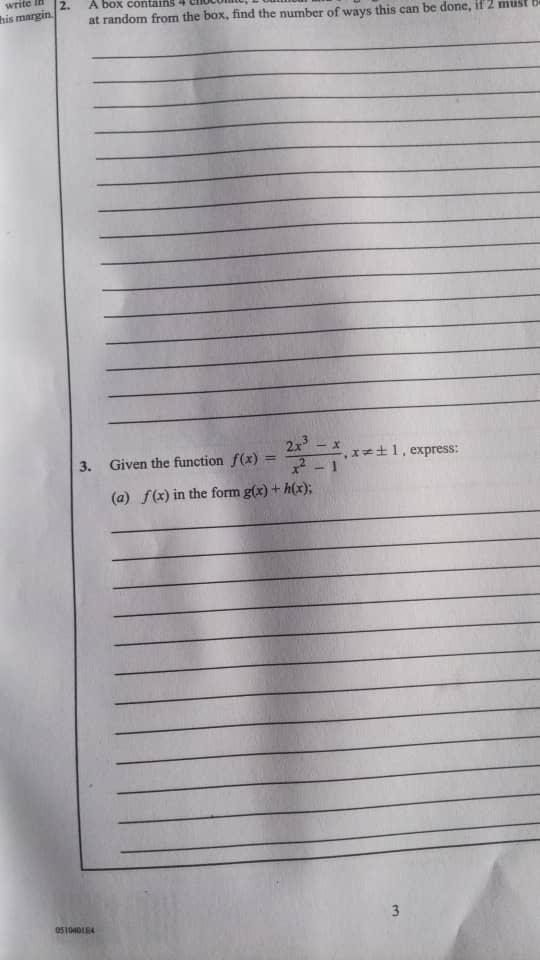
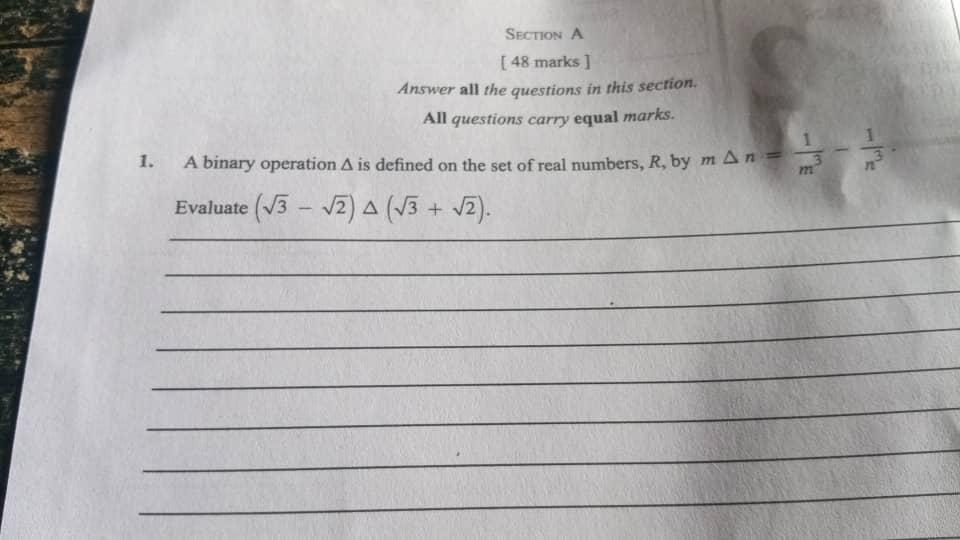
  • WAEC Futher Mathematics (Essay & Obj) Questions and Answers 2026/2027

    WAEC Futher Mathematics (Essay & Obj) Questions and Answers 2026/2027

    WAEC Futher Mathematics (Essay & Obj) Questions and Answers 2026/2027 :WAEC Further Mathematics exam (WASSCE) evaluates advanced mathematical concepts across two papers. Paper 1 is a 1.5-hour objective test with 40 questions, while Paper 2 is a 2.5-hour essay section. Both sections span Pure Mathematics, Statistics, Probability, Vectors, and Mechanics.

    WAEC Futher Mathematics (Essay and Obj) Questions and Answers 2026/2027

    FURTHER MATHS
    01-10: CABDCADACC
    11-20: ABCDDDBDDC
    21-30: DBCCBCDDCC
    31-40: AACABBDBAC

    COMPLETED

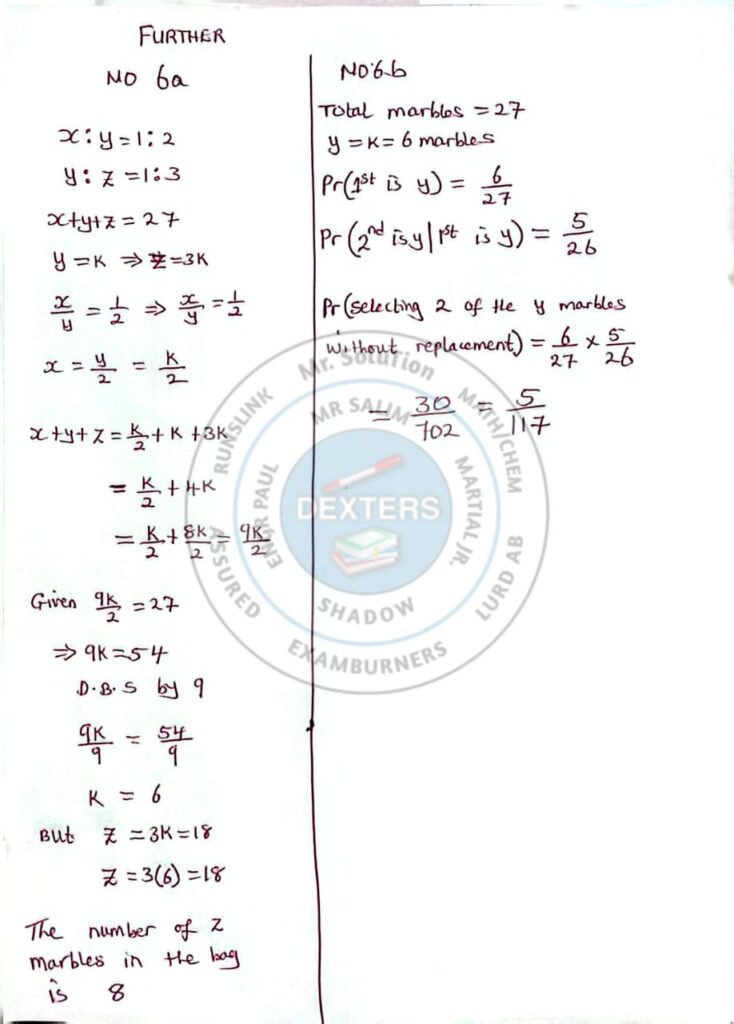
    (6a)
    From x:y = 1:2 and y:z = 1:3, combining gives x:y:z = 1:2:6
    Total parts = 1 + 2 + 6 = 9
    Number of z marbles = 6/9 × 27 = 18

    (6b) Number of y marbles = 2/9 × 27 = 6
    P(first y) = 6/27, P(second y) = 5/26
    P(both y) = 6/27 × 5/26 = 30/702 = 5/117

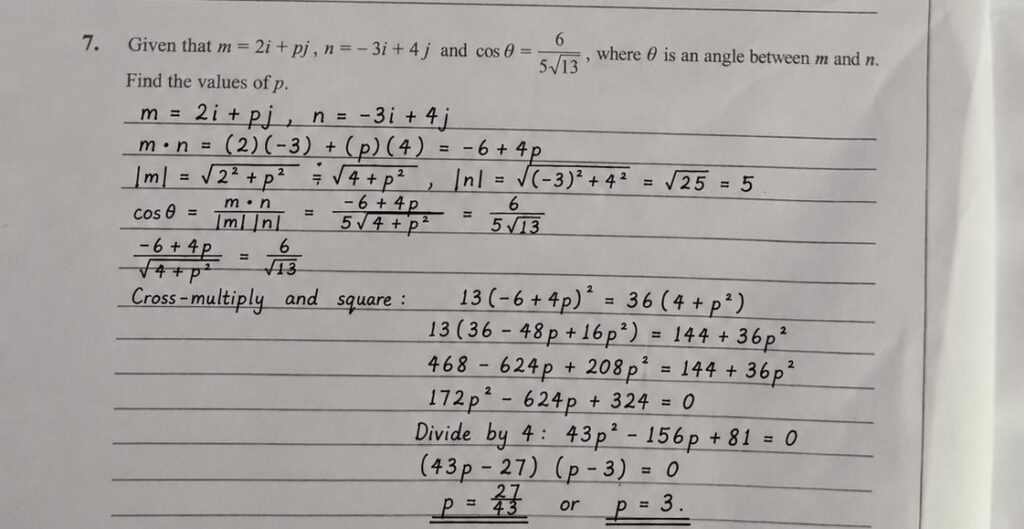
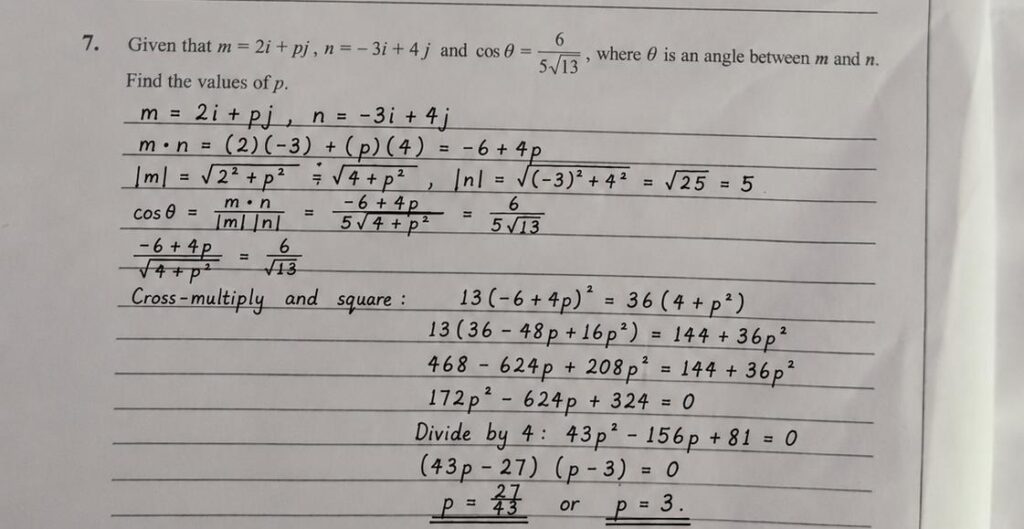
    (7)
    m·n = |m||n|cosθ
    m·n = (2)(−3) + (p)(4) = −6 + 4p
    |m| = √(4 + p²), |n| = √(9 + 16) = √13
    So: (−6 + 4p) / (√(4 + p²) · √13) = 6/(5√13)
    −6 + 4p = 6√(4 + p²)/5
    5(−6 + 4p) = 6√(4 + p²)
    (−30 + 20p)² = 36(4 + p²)
    900 − 1200p + 400p² = 144 + 36p²
    364p² − 1200p + 756 = 0
    91p² − 300p + 189 = 0
    p = (300 ± √(90000 − 68796))/182 = (300 ± √21204)/182 = (300 ± 145.6)/182
    p = 2.45 or p = 0.849

    (8)
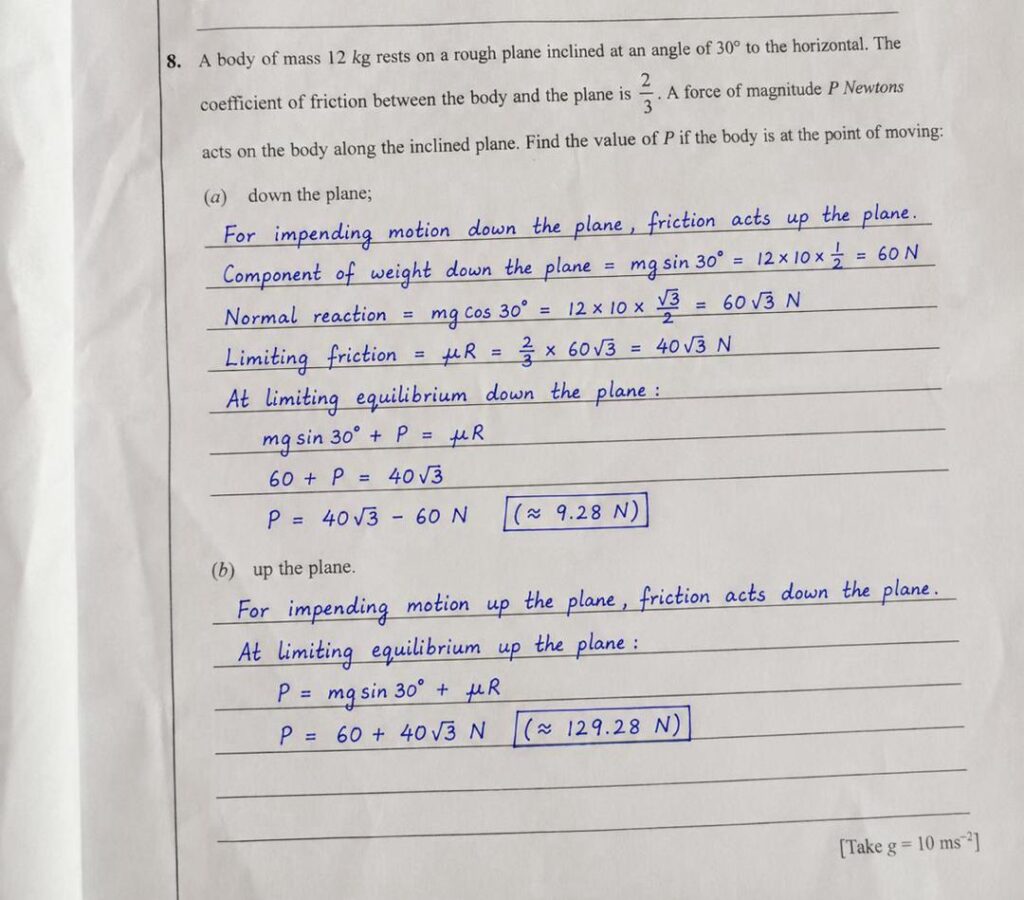
    Mass = 12 kg, θ = 30°, μ = 2/3, g = 10
    Normal reaction: N = 12g cos30° = 120 × (√3/2) = 60√3 N
    Friction force: F = μN = (2/3)(60√3) = 40√3 N
    Weight component along plane = 12 × 10 × sin30° = 60 N

    (a) Moving down the plane: P acts down, friction acts up
    At point of moving down: P + 60 = 40√3
    P = 40√3 − 60 = 69.28 − 60 = 9.28 N

    (b) Moving up the plane: P acts up, friction acts down
    P = 60 + 40√3 = 60 + 69.28 = 129.28 N

    (9)
    Total: 7 mid-fielders, 5 attackers, 8 referees. Committee of 6, each discipline represented.

    (a) Exactly 1 attacker, 1 mid-fielder → remaining 4 from referees:
    C(5,1) × C(7,1) × C(8,4) = 5 × 7 × 70 = 2450

    (b) Exactly 2 referees → remaining 4 split between attackers and mid-fielders (at least 1 each):
    C(8,2) × [C(5,1)×C(7,3) + C(5,2)×C(7,2) + C(5,3)×C(7,1)]
    = 28 × [5×35 + 10×21 + 10×7]
    = 28 × [175 + 210 + 70]
    = 28 × 455 = 12740

    (c) At least 2 attackers. Cases: 2, 3, 4, or 5 attackers (with at least 1 each from other groups):
    C(5,2)×C(7,1)×C(8,3) + C(5,2)×C(7,2)×C(8,2) + C(5,2)×C(7,3)×C(8,1) + C(5,3)×C(7,1)×C(8,2) + C(5,3)×C(7,2)×C(8,1) + C(5,4)×C(7,1)×C(8,1) + C(5,5)×C(7,1)×C(8,0)…
    = 10×7×56 + 10×21×28 + 10×35×8 + 10×7×28 + 10×21×8 + 5×7×8 + 1×7×1
    = 3920 + 5880 + 2800 + 1960 + 1680 + 280 + 7 = 16527

    (10b)
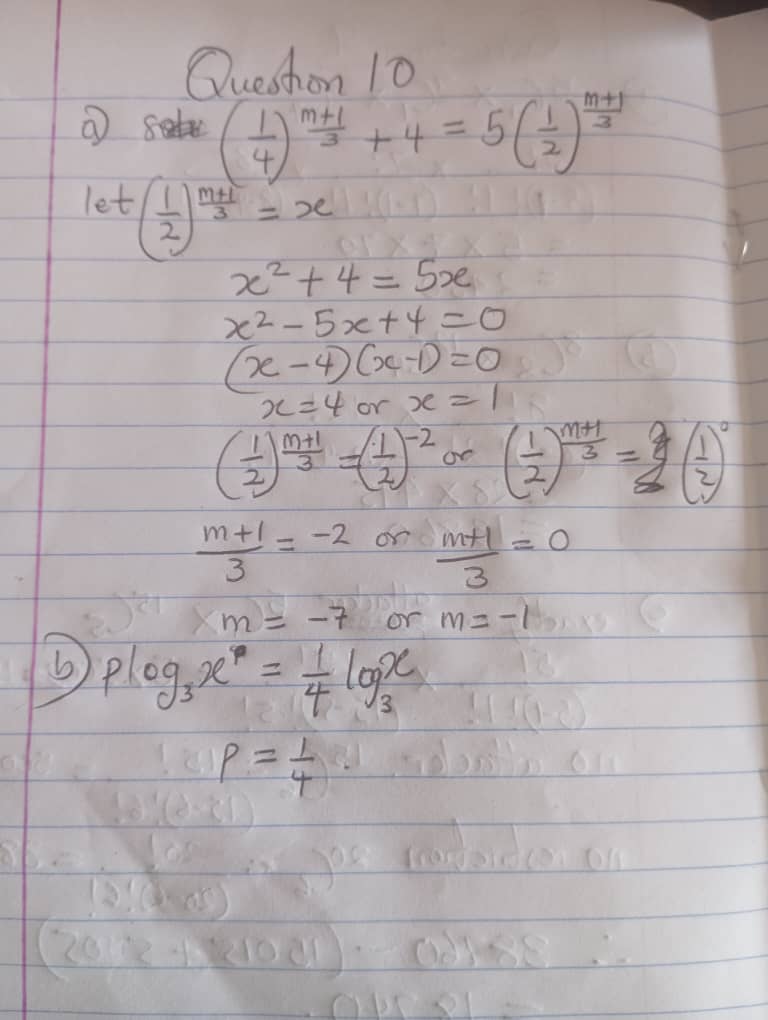
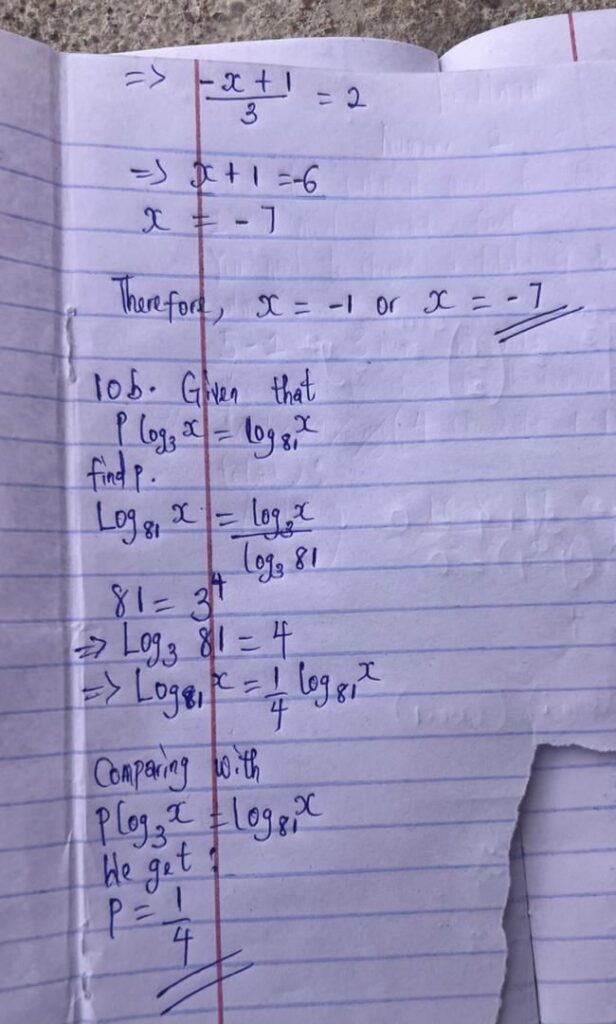
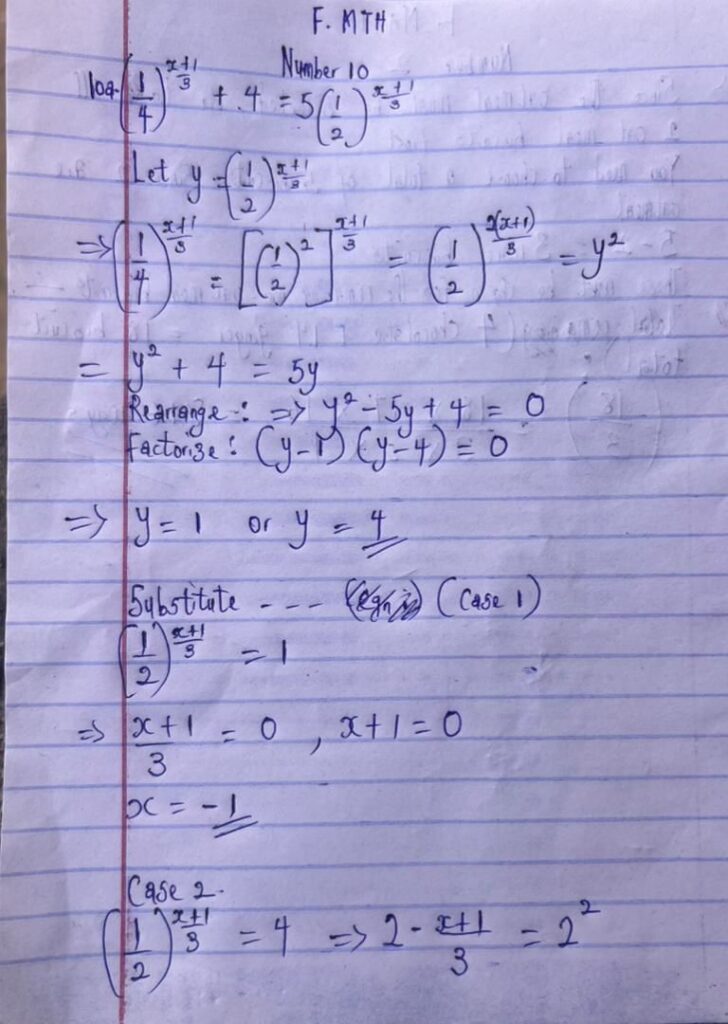
    p log₃x = log₈₁x
    log₈₁x = log₃x / log₃81 = log₃x / 4
    So p log₃x = (1/4) log₃x → p = 1/4

    Please refresh this page every few minutes to see new updates.
    Please refresh this page every few minutes to see new updates.
    Please refresh this page every few minutes to see new updates.
    Please refresh this page every few minutes to see new updates.