Category: WAEC Expo 2026

  • WAEC Technical Drawing (Obj & Essay) Questions and Answers 2026/2027

    WAEC Technical Drawing (Obj & Essay) Questions and Answers 2026/2027

    WAEC Technical Drawing (Obj & Essay) Questions and Answers 2026/2027: The WAEC Technical Drawing exam comprises three papers: Paper 1 (Objective), Paper 2 (Essay), and Paper 3 (Practical). To ace it, you need to master planar/solid geometry, freehand sketching, and either building or mechanical drawing. Questions and Answers 2026/2027.

    WAEC Technical Drawing Questions and Answers 2026

    TECHNICAL DRAWING
    01-10: AADCBBCBCD
    11-20: DCBDBBDDCB
    21-30: DCBDBCACAD
    31-40: CBDDDDBDBA

    MECHANICAL DRAWING
    31-40: CADDABABAD

    BUILDING DRAWING
    31-40: BDDABDBDAD

    COMPLETED

    Please refresh this page every few minutes to see new updates.
    Please refresh this page every few minutes to see new updates.
    Please refresh this page every few minutes to see new updates.
    Please refresh this page every few minutes to see new updates.

    Recent Posts

  • WAEC Digital Technologies Questions & Answers (Obj & theory) 2026/2027

    WAEC Digital Technologies Questions & Answers (Obj & theory) 2026/2027

    WAEC Digital Technologies Questions & Answers (Obj & theory) 2026/2027: WAEC Digital Technologies exams for 2026 focus on ICT fundamentals, data security, networking, and practical application software like word processing and spreadsheets. Main topics include AI, IoT, robotics, and ethical computing, with practical tests emphasizing formatting, formulas, and presentation design.

    WAEC Digital Technologies Questions & Answers 2026

    DIGITAL-TECHNOLOGY-OBJ
    01-10: CBABADCDBA
    11-20: CCDADABCDC
    21-30: ADDBBDABAA
    31-40: CBBBCBDDBA
    41-50: CCDBBACADC

    COMPLETED

    NUMBER 5 (5a) An integrated software package is a collection of related application programs bundled together as a single unit. These programs (such as a word processor, spreadsheet, and database) share a common user interface and allow for the easy transfer of data between them.

    (5b) (i)EXT (Extend Selection Mode): When this mode is active, you can use the arrow keys to extend the current selection of cells. Instead of moving the cursor to a new cell, the program “stretches” the highlighted area from the original cell to the new one. (ii)OVR (Overtype Mode): In this mode, any new character you type replaces (overwrites) the existing character at the cursor position. This is the opposite of the standard Insert mode, where new text is pushed in between existing characters.

    . (5c) (i)Insert Mode: The default mode where new text is inserted at the cursor, pushing existing text to the right. (ii)Overtype (or Overwrite) Mode: A mode where new text replaces the existing text character-by-character as you type.

    14:00

    Forwarded

    1(a) (i) Logic operation between A and B This is a NAND operation. (ii) Logic operation between C and D This is an OR operation. (iii) Logic equation for The outputs of the two gates are connected to an AND gate:

    1(b) The logic device used to invert the output is a NOT gate (Inverter).

    4(a) (i) Process box (ii) Input/Output box (iii) Decision box (iv) Flow lines/Arrows (v) Terminal (Start/End) box 4(b) (i) Used to represent a processing step e.g. “Calculate Total = Price × Quantity” (ii) Used to represent data input or output e.g. “Input Name” or “Print Result” (iii) Used to represent a decision/condition e.g. “Is mark >= 50? Yes or No” (iv) Used to show the direction of flow between steps (v) Used to mark the beginning or end of a program/flowchart

    (1a) (i) NAND operation (ii) OR operation (iii) Z = (A NAND B) AND (C OR D) Written as: Z = Ā·B̄ · (C + D) 1(b) A NOT gate (inverter) — drawn as a triangle with a small circle (bubble) at the output.

    2(d)
    (i) TCP/IP (Transmission Control Protocol/Internet Protocol)
    (ii) FTP (File Transfer Protocol)

    3(a) A register is a small, high-speed temporary storage location within the CPU that holds data, instructions, or addresses currently being processed.

    3(b)
    (i) Special purpose register — Program Counter (PC)
    (ii) General purpose register — Accumulator

    3(c)
    A special purpose register is designed to perform a specific function within the CPU (e.g. storing the address of the next instruction), whereas a general purpose register can be used to store any data or intermediate results during processing.

    3(d)
    (i)
    Register — Extremely fast and located inside the CPU
    Main Memory — Slower than registers and located outside the CPU

    (ii)
    Register — Very small storage capacity (holds only a few bits or bytes)
    Main Memory — Much larger storage capacity (holds gigabytes of data).

    1(c)

    • Row 1: A=1, B=0, C=1, D=1
      A·B = 0, Ā·B̄ = 1, C+D = 1, Z = 1
    • Row 2: A=1, B=1, C=1, D=0
      A·B = 1, Ā·B̄ = 0, C+D = 1, Z = 0
    • Row 3: A=1, B=0, C=0, D=1
      A·B = 0, Ā·B̄ = 1, C+D = 1, Z = 1
    • Row 4: A=1, B=1, C=0, D=0
      A·B = 1, Ā·B̄ = 0, C+D = 0, Z = 0
    • Row 5: A=1, B=0, C=1, D=1
      A·B = 0, Ā·B̄ = 1, C+D = 1, Z = 1

    2(a) The internet is a global network of interconnected computers and devices that communicate using standardised protocols to share information and resources worldwide.

    2(b)
    (i) Intranet is private and accessible only to members of a specific organisation — Extranet extends access to selected outside users such as partners or suppliers.
    (ii) Intranet is confined within one organisation — Extranet connects two or more organisations.

    2(c)
    (i) HTTP — HyperText Transfer Protocol
    (ii) IP — Internet Protocol
    (iii) LAN — Local Area Network
    (iv) TCP — Transmission Control Protocol

    NO 1

    Please refresh this page every few minutes to see new updates.
    Please refresh this page every few minutes to see new updates.
    Please refresh this page every few minutes to see new updates.
    Please refresh this page every few minutes to see new updates.
    Please refresh this page every few minutes to see new updates.
    Please refresh this page every few minutes to see new updates.

    Recent Posts

  • WAEC French Answers 2026/2027 (Oral)

    WAEC French Answers 2026/2027 (Oral)

    The WAEC French Answers 2026/2027 (Oral) examination will be held Monday, 27th April, 2026, alongside other subjects like Arabic 3 (Oral), Physical Education 3, Foods and Nutrition 3 (Practical), Home Management 3 (Practical), and Music 3B to Friday, 8th May, 2026. You as a candidate could study by reviewing the WAEC syllabus for core topics.

    Candidates are now preparing to perform well in the upcoming examination through the help of reliable resources; as such, we provide 2026 WAEC runs, 2026 WAEC expo, and 2026 WAEC midnight questions and answers.

    WAEC French Answers 2026/2027 (Oral)

    Number 1

    ====================

    Number 2

    ====================

    Number 3

    ====================

    Number 4

    ===================

    Please refresh this page every few minutes to see new updates.
    Please refresh this page every few minutes to see new updates.

    Recent Posts

  • WAEC Arabic (Oral) Answers 2026/2027

    WAEC Arabic (Oral) Answers 2026/2027

    WAEC Arabic (Oral) Answers 2026/2027: (Paper 3) focuses on communicative competence, requiring students to demonstrate proficiency in pronunciation, reading, and basic conversation. areas include listening comprehension, reading passages aloud with correct vocalization (tashkīl), answering direct questions (personal info, family, school), and identifying common vocabulary

    The West African Examination Council, WAEC, has set the WAEC Arabic (Oral) Questions and Answers paper for 27th April 2026. Candidates are now preparing to perform well in the upcoming examination through the help of reliable resources; as such, we provide 2026 WAEC runs, 2026 WAEC expo, and 2026 WAEC midnight questions and answers.

    WAEC Arabic (Oral) Answers 2026/2027

    Number 1

    Answers Loading…

    ====================

    Number 2

    Answers Loading…

    ====================

    Number 3

    Answers Loading…

    ====================

    Number 4

    Answers Loading…

    ====================

    Number 5

    Please refresh this page every few minutes to see new updates.

    Answers Loading…

    Please refresh this page every few minutes to see new updates.

    Recent Posts

  • WAEC Visual Art Practical Specimen 2026/2027

    WAEC Visual Art Practical Specimen 2026/2027

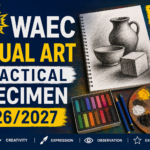
    WAEC Visual Art Practical Specimen 2026/2027: The 2026/2027 WAEC The visual art practical exam includes subjects like drawing (3A), creative design (3B), and creative painting (3C). Specimens typically focus on still life objects, natural forms, and materials for painting and graphic design. Specific items are released by WAEC for school supervisors a few weeks before the examination dates.

    Candidates should focus on practical drawing (3A)—still life, fruits, and natural objects; creative/graphic design (3B)—use of colored materials, lettering, and design tools; and painting/sculpture (3C)—using paints, brushes, clay, or carving tools. Knowledge of art history, especially indigenous techniques and materials, is also required.

     Practice regularly (observation drawing, shading, lettering, and color use), study the official WAEC syllabus, and prepare early since practicals often come first. Check updates on portals like WAEConline for accurate materials and guidelines.

    WAEC Visual Art Practical Specimen 2026/2027

    INSTRUCTION(S) TO SCHOOL

    For the successful conduct of the examination, the school must make available various items for candidates to choose from. Each candidate will select one set of items to draw during the exam.

    Object drawing options include a wheelbarrow, headpan, shovel, raised platform, and tablecloth.

    Nature drawing options include two coconuts, a pineapple, a bunch of plantains, a raised platform, and a tablecloth.

    Life Drawing features a teenage boy in traditional attire and a cap, along with a long stool. These items are to be provided for the candidates’ use during the examination.

    WAEC Visual Art syllabus 2026/2027

    TopicKey AreasImportant Points
    Rationale & Concept of Visual ArtsMeaning & ScopeVisual Arts = creative expression; includes drawing, painting, sculpture, design
    VocationsCareers in design, teaching, advertising, crafts
    National RolePromotes culture, tourism, economy
    Drawing Tools & MaterialsToolsPencils, brushes, paper, paints
    UsagePreparation, care, maintenance
    Drawing TypesStill life, figure drawing, communication drawing
    Design & CompositionPerspectiveTypes and application
    Design ProcessIdea development, product design
    ElementsLine, shape, colour, texture
    PrinciplesBalance, contrast, harmony
    Colour TheoryBasicsColour wheel (12-point), sources
    ConceptsTints, shades, harmony, psychology
    Cultural MeaningSymbolism (e.g., Ghanaian colour concepts)
    PrintmakingProcessesRelief, intaglio, lithography, screen printing
    UsesCommunication and design
    LetteringTypesBlock, Gothic (sans serif), Roman (serif)
    FeaturesStructure, function, and importance
    Prehistoric ArtPeriodsPaleolithic, Mesolithic, Neolithic
    FeaturesCave art, hunting purpose, tools/materials
    Ancient ArtEgyptian ArtFocus on eternity, strict style conventions
    InfluenceImpact on other cultures
    World ArtGreek ArtArchaic, Classical, Hellenistic contributions
    RenaissanceRebirth of art, major artists
    Oriental & OceanicBeliefs, styles, functions
    African ArtFeaturesFunctional, symbolic, religious influence
    TypesVisual, performing, verbal
    RelevanceCultural identity and development
    Art in National DevelopmentUsesTourism, education, politics
    Ghanaian ArtIndigenous (e.g., Adinkra) and contemporary forms
    Art Appreciation & Modern ArtAppreciationIdentification, analysis, interpretation
    CreativityProcess and traits
    MovementsCubism, Impressionism, Surrealism, Expressionism
    EntrepreneurshipBusiness SetupFunding, planning, management
    MarketingAdvertising, pricing
    RisksDirect and indirect
    ExhibitionPlanning and presentation
    Professional PracticeEthicsProfessional conduct
    Business ToolsBusiness plan, artist statement, brochure
    Museum & Gallery StudiesFunctionsPreservation, education, tourism
    StructureAdministration and operations
    ImportanceCultural and economic value

    Recent Posts